The F.I.S.T. method of bike fit for triathletes
April.06 by Dan Empfield
(www.slowtwitch.com)

Sport is full of "systems." One might ask if all these systems are necessary, since bike riders rode, swimmers swam, and runners ran (quite well, in fact), before any of today's systems. Why do tri bike owners need a bike fit system?

In point of fact, they don't. The worth of any of these systems is directly proportional to their abilities to transfer functionality that is already well-established in sport. A system for teaching a proper golf swing, or tennis serve, results in a student's ability to play tennis or golf in a way quite similar to those who are especially adept at these sports.

A proper road bike fit system is one that helps a rider adopt a road bike fit used by most of the better road bike riders. And a proper tri bike fit system will place triathletes in an optimized position for riding a bike outfitted with aero bars.

In the absence of such a system, we at Slowtwitch.com decided to develop one, and we call it Fit Institute Slowtwitch (F.I.S.T.). This system is the logical extension of the work done by the founders of Slowtwitch, who are also the founders of Quintana Roo, the first true tri geometry bike.

The end result of a FIST fit is a position easily recognizable. Any fan of baseball, tennis, basketball, bowling, or any sport grows to know what good technique looks like. Any triathlete who follows the sport knows what a good tri bike position looks like. You don't need to be a pro to know how a pro rides.

Follow the links below to our "all new" tri bike fit pages (new as of April, 2006).

FIST AXIOMS
FIST PROTOCOL
MEASURING CONVENTIONS
SEAT HEIGHT
COCKPIT LENGTH
HIP ANGLE
ARMREST DROP
TOOLS OF THE TRADE
YOUR BIKE'S "WAISTLINE"
TRANSLATING FIT SPECS TO BIKE SPECS

FIST AXIOMS

Noting we've written above is especially groundbreaking or controversial. Rest assured, there is plenty to follow to which certain folks will take exception. And because of this, it's only fair to lay out a few axioms upon which this system is based, so that readers understand the foundation atop which this bike fit system is built. It's only fair we produce these axioms here, because if you don't accept them as truisms you'll probably have a problem with the system built on these axioms. Here they are:

1. MOST PRO TRIATHLETES RIDE ALIKE. Pro triathletes started riding in positions exhibiting bike fit characteristics common one to another, and did so within two years of the introduction of aero bars (in 1987). Furthermore, most good pros ride the same way today as the best pros did in 1990. What do Mark Allen, Paula Newby-Fraser, Scott Tinley, Jürgen Zäck, Wolfgang Dittrich, and Pauli Kiuru all have in common? They were all stars 12 and 15 years ago, and they shared very similar tri bike fit characteristics. What do Normann Stadler, Torbjorn Sindballe, Faris Al Sultan, Peter Reid, Tim DeBoom, Heather Fuhr, Lori Bowden and Natascha Badmann all have in common? They are today's stars, and they not only share bike fit characteristics one to another, they are positioned in ways quite similar to those pros of an earlier generation. These similar characteristics are measurable, identifiable, and we'll identify and quantify them below.

2. FIT, TRIM AGE GROUP ATHLETES CAN EASILY ADOPT THE SAME POSITION AS THOSE RIDDEN BY PROS. What keeps you from the pro podium in the Hawaiian Ironman is not your inflexibility. It's not that you lack the "taint of steel," and that you can't take the pain of your peritoneum on the saddle nose the way Mark Allen could. What keeps you from the podium is that you cannot absorb 400 calories per hour during a race, like Mark Allen could. You heart doesn't have the stroke volume of Spencer Smith's heart. You can't burn the same amount of oxygen per kilogram of body weight per minute as can Peter Reid. In other words, you might not have a pro "motor," but you do have a pro "chassis," and there is no reason why you can't ride in a pro position. Most fit, trim golfers have the physical ability to swing the club like Tiger Woods, and tennis players can hit ground strokes like Venus Williams. Maybe not as hard, or as accurately, but if they don't exhibit the same basic technique it is not because they're physically disqualified from doing so. It's a myth to think triathletes can't ride their bikes in an appropriate fashion.

3. BODIES ARE SMART, AND CAN BE TRUSTED. Riding a bike in the aero position is an elemental exercise. There are few fine points of technique involved. A rider in his best position enjoys what one might call a "nexus of strength": optimized leverage combined with major thigh muscles firing in concert. By happy circumstance, the important elements of tri bike fit—those exhibited by most of the best pros throughout the past 15 years—are freely identified and selected by most of those given the opportunity to find their optimized position. In other words, your body will not betray you.

4. THE OPTIMIZED TRI POSITION REQUIRES MODERATE ATHLETICISM. While an optimized aero position is not difficult to achieve, it requires elements of athleticism in excess of that required for a road race position. While nearly everyone can ride a road race bike in a position not so different from those ridden by professional road racers a smaller percentage, perhaps half to two-thirds of those of those competing in triathlons, can adopt an optimized tri position. This might seem an axiom at cross-purposes with #2 above. Please note, though, the qualifiers, "fit" and "trim."

The axioms above allow us to build a bike fit system.

FIST PROTOCOL

There are two ways a bike fit can be executed. It can be imposed on the athlete by the fitter, or the fitter can artfully enable a process by which the rider self-selects his position. The FIST system endorses the latter methodology, for a pair of reasons.

First, there is utility in performing several trials, at different seat angles, optimizing one's position at east seat angle. An athlete might enjoy a trial at, say, 75° of seat angle, then again at 77°, at 79°, and at 81°. In this case it's important that the rider's body's levers and muscle groups fire at one's best efficiency: that "nexus of power" spoken of earlier. The important components of this nexus of power are detailed below, in the discussion of "seat height" and "hip angle." This, combined with an attention to comfort, result in what we term an "optimized" position.

Once these rider positions at various successively steeper seat angles have been optimized, the rider must choose a seat angle among them. It is common for a rider to indicate a preference to two adjacent seat angles, and this may require repositioning the rider in both of these "finalist" positions before the rider can clearly determine a preference (or, perhaps the rider will prefer a seat angle in between, say, 78° instead of the 77° and 79° angles.

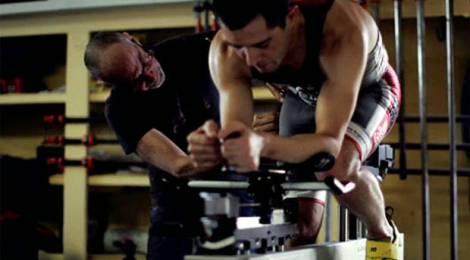
One can execute a FIST tri bike fit without the use of a position simulator, but the instant feedback such an apparatus offers makes this tool especially useful. My personal favorite, made by Ves Mandaric of a design he and I co-generated, is at right. A list of these (there are others I like), with an analysis of their pluses and minuses, will be discussed below.

There is a second reason why the self-selected fit is preferred. When a fitter invests this extra bit of time and executes the fit in this way, he equips his subject with the confidence that his instincts that can be trusted. Yes, there is a set of predetermined data upon which a good fitter will rely, to make sure that the subject is not leading himself awry (outlined in chapters below). Yet the experience a subject gleans from discovering, on his own, the same position ridden by the majority of triathlon's greatest athletes is invaluable.

MEASURING CONVENTIONS

All the above stated, at some point you actually must get 'round to measuring bikes, body angles, and the like. And, a FIST fit is not simply a process where a fitter helps an athlete find any old position that feels comfortable. Far from it. The end result of a properly executed bike fit is a position that conforms to a very narrow set of predetermined specs, measured both as angles formed by the body, and points on the bike.

DETERMNATION OF SEAT ANGLE: For quite a few years, the "Slowtwitch" way to measure a seat angle, for the purpose of bike fitting, was to measure the acute angle formed by two lines intersecting at the bike's bottom bracket. One line is horizontal, the other passes through the center of the bike's saddle. This year, we're changing. We're now measuring from the bottom bracket to the middle of saddle's rails. We're making this change because it's a measure more closely related to the bikes a subject is likely to buy in today's tri bike market. Since more and more bikes these days have "zero-offset" clamps that place the saddle directly in line with the centerline of the seat tube, we're measuring our seat angles that way. In so doing, when we say your saddle is positioned at, say 77 degrees of seat angle, this also descriptive of the seat angleof the bike a subject would ride, as long as the bike's seat clamp "grabs" the saddle in line with the seat tube and post.

This is, by the way, a point roughly 17cm behind the nose of the saddle, for most saddles. This is about 3cm rearward of the point midway through the saddle (in most cases). This means that, on average, a difference of about 2 to 3 degrees of seat angle exists between an angle measured through the center of the rails versus the centerline of the saddle. Therefore, what "we" previously called an 80 degrees seat angle we will now call a 78 degrees seat angle, or thereabouts.

ANATOMICAL MARKERS: When we measure angles of the body, we use markers that are easy to palpate. They aren't magic, or special. They're just the ones we use. Specifically, we use the knee -- dead center in the middle, on the lateral side -- as the apex of the knee angle (when we're identifying proper saddle height). We then measure to the greater trochanter (bony protrusion on the side of the hip), and to the maleolus (bony protrusion of the ankle).

When we measure the hip angle, the greater trochanter is the axis, and we measure to the clavicle and the bottom bracket to get our angle. The clavicle is easy to palpate when you're in the aero position. We could just as easily have chosen the acromion, the bony protrusion on the lateral side of the shoulder. But we didn't. Had we done so, we'd be looking for hip angles slightly more acute than those we expect to see measuring through the clavicle.

The point is, our anatomical markers are arbitrary. But the angular aspects created by knee, hip and shoulder are not. Bodies work within closely circumscribed ranges, one to another. "Every person is different," is a trite way to attempt escape from under a more impactful truism: "Bodies are a lot more alike than they are different." There are very precise postures and aspects the body will find itself in when its properly fitted to a tri bike, and that is elemental to the FIST system.

SEAT HEIGHT

There are plenty of ways to measure seat height, but my preference is to measure it while you're on the bike and in the pedaling mode. In choosing this method of proper saddle height identification, this is now the easiest parameter to "eyeball," and the hardest to measure. It's easy to eyeball because most people can correctly determine a saddle height that's too high or low just by watching a subject pedal his bike.

But it's hard to attach precision and objectivity using this method without paying particular attention to the angle of one's ankle at bottom-dead-center (BDC). You must pay a lot of attention to how the subject pedals: the aspect of his shoe at the bottom of the pedal stroke, the angle of his ankle, and the angle of his knee. It is common, for example, for a rider to have finished dropping through with his heel before BDC, and for his ankle to have risen in elevation right at BDC. Whatever it is he's doing during his pedal stroke must be reproduced by you (if you're playing the "fitter"), when he's stopped for his "snapshot" at BDC. It is during this snapshot that you measure his knee angle.

BDC is not at the absolute bottom of the pedal stroke (with the crank arm at 6 o'clock). It's with the crank at 5:25, or 5:27 (let us say) as is the case in the illustration.

You can also see from the photo that "knee over pedal spindle (KOPS) can be thrown out the window for this application (tri bike fit) because Swedish pro triathlete Jonas Colting (pictured) is riding a very steep position (80 degrees or thereabouts), and his knee is going to be well in front of the pedal spindle.

Frequently you'll read that knees should be flexed about 30 degrees (and this number is repeated by others without any real thought process invested in this measure). This is 30 degrees from what? Going through where? Where is this line through which one starts, before one flexes one's knee 30 degrees? You just about never (do a Google search on this) get to see a photo or any very good description of the methodology used to find this 30 degrees angle of which so many write.

Better to use the actual angle created by your actual leg, no? This is the obtuse angle created by the knee joint, and it's simply 180 degrees minus that 30 degrees (yes, 150 degrees).

But there's more to the story. First, there's one good reason we can measure obtuse angles -- because we have the tools to do so. For all our angles we'll use a specific goniometer (an angle finder with telescoping arms that allow us to measure angles made by long levers, like the goniometer shown in the photo adjacent).

In order to find the knee angle with precision, you've got to decide on precise points from which to measure. In my case, I've chosen the dead center of the knee, on the lateral side, as the apex of the angle.

The two arms of the angle pass through the greater trochanter and maleolus respectively. Each is a bony protrusion. The first is the outside of the hip, (but is not part of the hip joint proper; it is the bony head of the femur, and is just below the hip joint as you're standing up). The maleolus is the bony protrusion of the ankle, the "Kathy Bates" bone, if you saw the movie Misery.

I like 150 degrees of knee angle, but that's not the beginning and end of it. A proper range might be 145 to 153 degrees. Old time roadies-turned-triathletes tend toward the lower end of that range, that is, a slightly more flexed knee with a slightly lower seat height. Runners-turned-triathletes tend, in my experience, toward the higher end, on average.

I ride a very traditional road race seat angle, and a very steep, non-traditional tri bike angle. That might seem incongruous were not not for so many road racers now doing the same thing (CSC's stable of racers come to mind). I tend more toward the 145 degrees angle on my road bike, and more like 150 degrees on my tri bike. I don't know why, but I think this is typical. This accounts for about a 7mm or 8mm taller saddle height on my tri bike.

In actuality, though, my saddle is more like 1.5cm taller on my tri bike, though only half of that is due my knee angle difference. The other half is accounted for by difference in where I sit on the saddle. On my road bike I'm rearward, on my tri bike I'm nearer the nose, and if you simply measure the difference from the nose to the bottom bracket versus a point near the rear of the saddle to the bottom bracket, you'll see an extra 7mm or 8mm of seat height difference, depending on the tilt of your saddle.

Most people are right around 150 degrees when on their tri bikes in the aero position, but I don't much care what seat height a subject chooses between that 8 degrees range starting at 145 degrees of knee angle. Whatever he likes is okay with me. If it's slightly below 145 degrees I'll not be much concerned, as long as he rides with a cadence that makes sense, say, almost always above 85rpm. I'm not crazy about overly low seat heights combined with low cadences, as this appears to me a potential for some patellar tendon issues.

I'm more wary of saddle heights that are on the tall side, and as the knee angle gets to 153 degrees and even creeps above that I get more and more nervous. One thing subjects must understand: muscles tighten as they fatigue. Try to touch your toes 70 miles into a hard, hot, 90-mile bike ride (you're lucky if you can touch your ankles). This established, imagine what your muscles are going through with a saddle height on the too-tall side. This is when riders are more likely, in my experience, to be at risk of some soft tissue damage. Best to listen to your legs' "voices" deep into a long bike session.

COCKPIT LENGTH

This is the most urgent fit parameter among most of those who ride aero. A problem in cockpit distance (that is, in the length of the bike), is the problem that a rider will try to fix before fixing any other. If there is a problem, it is usually that bikes are too long; the top tube plus the stem equals a given length, and it is likely this length will be too long rather than too short.

Sometimes the rider will seek to "fix" this problem by adopting a steeper seat angle and, while I'm certainly not averse to steep seat angles, altering the seat angle as a means to fix an overlong bike is not a good tactic. But it is true that bike makers over the last decade have built their bikes making a pair of compatible mistakes. If you build your frame with an overlong top tube, and with an overshallow seat angle, you can fix both at the same time by moving the saddle forward. But I digress...

There is no caculable power advantage to having your aero bars somewhat closer or further from your saddle. But there are important issues. Chief among them is comfort, and this does translate to speed because an uncomfortable position is an unsustainable one. When you're uncomfortable you rise up out of the aero position and, at that moment, you'd be better off on a traditional road bike in a road position. The entire advantge of having an aero bike is lost when your elbows are not in the cups. This to say that in every way, on every course, in every maneuver, riding an aero bike is ONLY better than riding a road race bike when you're in the cups, so, seek to stay there.

Your aero bars should be placed such that your forearms represent a column perpendicular to the weight they're supporting. Therefore, there should be a 90° angle between your torso and your upper arm. However, we aren't measuring a straight line through the torso (the pink line adjacent), we're measuring from the greater trochanter (the angled green line), and that yields a smaller hip angle number.

Notice that when you match the horizontal pink line above with the vertical green line, this roughly represents the centerline of the torso and the centerline of the upper arm. In this photo, the angle achieved is less than 90 degrees, and is the personal choice of the athlete photographed, Swedish pro triathlete Jonas Colting. Is there a problem with this slightly overtight cockpit? Not while you're in the aero position.

But once you rise up and ride out of the saddle, the issue is knee clearance, and once you've smacked your kneecap on the back of the armrests, you come to appreciate the utility of a proper cockpit distance. That said, certain riders, Jonas included, spend very little time out of the saddle, and so this is of little import to them.

An angle more obtuse than 90 degrees can become an issue. Riding "stretched out" may be a sustainable position for a few, but it is not typical of comfort positioning. You're likely to be uncomfortable in the front of the deltoids, and in the middle of the trapezius, just below the neck. You don't need to be aboard a bike to demonstrate this to yourself. Stand up, bend over and simply mimic holding your arms in the aero position. See what shoulder angle you naturally adopt. Then move your elbows forward, more in front of you, and you'll experience the discomfort I'm describing above.

An overlong cockpit is also the cause of low back pain later in a ride, because you're now no longer supporting your entire torso weight skeletally. You've moved the column supporting it. The muscles now needed to aid in supporting this weight (now that your column is not under the weight) are the spinal erectors in your low back, hence low back pain resulting from a stem or top tube too long.

My target range for the shoulder angle is 80 to 85 degrees, measured from the greater trochanter to the clavicle (which protrudes nicely when you're in the aero position and yields an easy point to measure to). But the clavicle is not the apex of the angle. You must draw back along this line until you reach the midpoint of the shoulder, and a line following the centerline of the upper arm intersects with the vertical line just described. These two lines form the angle.

Cockpit distance is simply a matter of personal taste. Whatever the subject wants in a cockpit measure, the subject gets, and this is why my nomenclature states a "target" range, not an "acceptable" range. This range is what I expect to find, not what I mandate. Typically, there's not a lot of variance: 80 to 85 degrees is where the great bulk of athletes, regardless of ability, want to ride, assuming you give them the option.

HIP ANGLE

At this point in a fit there's just one major parameter left to consider, and that's how high or low the aero bars are relative to the saddle. This determines your hip angle.

As with every other element of the fit, under normal circumstances the most precise measuring instrument is the human body itself. A person knows when he's able to comfortably push greater power or not, and pitting heart rate and power against various hip angles certainly may work. But this method is cumbersome, often leads to bad conclusions, and ultimately not as accurate as simply placing trust in a person's own subjective notion of what's at once powerful and comfortable.

This being the case, I simply drop the front of the bike about a centimeter at a time, asking the subject if that's "better, worse or the same." Only if it's "worse" do I stop the exercise.

The position simulator I use for this allows me to lower the front of the bike while the subject is riding. This is helpful, because the instant feedback provided makes it easy for the subject to know when the front has been lowered to a point that's just too low.

When the subect cries "uncle," I then revert to a new method. I raise the bars 2cm, and ask the subject to select between two options, this one versus 1cm lower (the last place the subject considered acceptable). If the subject chooses the higher option, I go through the process yet again, raising the handlebar 2cm. It's usual for the subject to be much more equivocal with the bars "on the way up," versus "on the way down." It's easier to "feel" what's better versus worse.

Once the subject selects the desired aero bar elevation, he has by definition selected his desired hip angle. In almost all cases, there's a pretty narrow range he'll self-select, and that's a hip angle of 95° to 105°. You might think range of motion is an issue here. Almost never is this the case, because a nexus of power is reached before reaching the limit of one's range of motion. A hip angle of 100° is almost always achievable by just about everyone suited for tri bike riding.

Whether riding at 76, 78 or 80 degrees, it's typical to find a subject choosing the exact hip angle at each successive seat angle. It ought to become apparent, in this case, that a very specific and narrow range exists for the placement of this subject's aero bars, and in each case it's related to his hip angle. In other words, he doesn't have a specific amount of "armrest drop" in elevation relative to his saddle. It changes depending on his seat angle. The constant is his hip angle. That's what he'll seek to preserve as he's rotated around the bottom bracket as if around the face of a clock. He certainly may exhibit a preference for one specific place around this clock -- that is, he'll prefer one specific seat angle -- but his preference for armrest elevation is going to change based in the seat angle in which he's placed. The angle of his hip while in the aero position is the critical element.

To measure this hip angle, again we visit the greater trochanter, and this is our hip angle's fulcrum. We draw a line through to the clavicle, and another through the bottom bracket. I typically have the subject lower his drive side leg to bottom-dead- center (if I'm working on the drive side), but he can be wherever around the pedal stroke he wants, since you're measuring to the BB.

Now, it's certainly true that there are other places one could choose as measuring points. One could choose to measure down the femur (through the knee), instead of through the bottom bracket. In this case, of course, the placement of the foot at BDC is required. One could also choose to measure the acute hip angle, through the knee at top-dead-center. I have no problem with either of these methods. Of course, this would require a different set of ranges. Perhaps the acute angle of the hip, at TDC, ought to be 25 degrees, instead of "my" 100 degees at BDC. Any of that is fine, though the acceptable ranges will change.

In all these cases, the rider's armrest elevation relative to the saddle, at each given seat angle, is going to be the same. Simply put, other systems, with other reference points, can work fine with this proviso: Subjects will keep self-selecting hip angles that are within a narrow band. Any good system will honor this. Any system with ranges that do not comform to subjects' self-selected norms is, well, not good.

ARMREST DROP

When we speak of measuring the armrest drop, we're really talking about the hip angle. It's another way of looking at hip angle. That said, one thing is worth noting about this so-called hip angle: we never really do measure it per se. Even when we're measuring the angle described in the chapter above, we're really measuring across two joints -- the hip and the knee -- and even then we're measuring to the bottom bracket. Nothing in there describes the 'hip angle' as would be measured by, say, a physical therapist.

What we've been measuring is a proxy angle that is a precise and easy-to-measure approximator of one's hip angle. We are now going to measure the effect that hip angle has on one's bike. We're doing this as a sort of double-check, to see if we're on the right path. Hundreds of top athletes over the last decade and a half have had their saddle heights and armrest drops measured, and these coordinates tend to nicely fall inside a range. That range is expressed by the following quadratic equation:

C = .005D2 -.2D

In this equation, 'C' = armrest drop, and 'D' = saddle height. Remember, saddle height in this case is measured from the bottom bracket to the top of the saddle, midpoint between its fore and aft.

This formula is good at 77.5 degrees of seat angle, where seat angle is measured from the BB to the center of the saddle's rails.

Should the seat angle be steeper or shallower than 77 degrees, one adds or subtracts .0075 from the integer '2' for each degree distant from 77 degrees. One subtracts for angles steeper than 77 degrees, and one adds for shallower angles. So, let us say we're talking about a person riding at 79 degrees of seat angle. In this case, the integer '2' has subtracted from it .0075 twice, resulting in .185. So the formula at 79 degrees of seat angle would read as follows:

C = .005D2 -.185D

At 76 degrees of seat angle, the formula reads as follows:

C = .005D2 -.2075D

This does not give you your proper armrest drop. This formula simply provides you a glimpse into the sort of bike set ups that tend to be used by the better pros over the years. Not all pros have armrest drop numbers that fit this formula. But perhaps 75% of them will have an armrest drop that falls within +/- 1.5cm. The formula changes, then, to express this range:

C = .005D2 -.2D +/- 1.5

But how applicable is this formula to the typical age-grouper, assuming we're talking about one who is a candidate for an optimized tri position? Subtract about 1.5cm. This yields the following formula:

C = .005D2 -.2D - 1.5 +/- 1.5

How much weight should be given this formula? It would sit behind three other determiners of proper hip angle: what the subject determines is comfortable; what an experienced fitter observes as appearing appropriate; and the proxy hip angle measure discussed in the chapter above. If all these point in one direction, you've hit a triple. If the armrest drop of the subject also falls inside the 3cm range determined by the formula, touch them all, you've hit it out of the park.

Let's take a historic example. Scott Tinley, when he raced, used to ride a reasonably steep seat angle, in the neighborhood of 78 degrees. He had 81cm of saddle height. Here is how the formula would work for him:

C = .005(81)2 -.1925(81)
C = 32.8 - 15.6 = 17.2

The 3cm range expressed in the formula means Tinley's armrest drop should've been somewhere between 15.7cm and 18.7cm. In fact, it was right at 16cm. Were Scott Tinley an age-grouper, I would expect him to fall into that same range minus 1.5cm, so the range for an "age-group version" of Tinley might be 14.2 to 17.2. Were Scott to come back to racing now, I wouldn't be surprised to find his saddle height lower by a centimeter (I always though Scott's saddle bordered on the too-high) and I wouldn't be surprised to see his armrest drop at something more like 14cm or 14.5cm.

Remember, though, that this is not a determiner of proper armrest drop, it's simply an indicator of where athletes tend to historically fall.

A note on how to accurately measure this. I sit one end of a level on the high part of the saddle, near the nose, and angle the level over one of the armrests. I stand a metal metric ruler in the center of the armrest, and read its gradation as it intersects the underside of the level. Voila, armrest drop.

TOOLS OF THE TRADE

I do a lot of construction on the Slowtwitch Ranch (aka Xantusia), it's more or less my hobby. On any given day it's framing, masonry, laying tile, plastering, roofing, landscaping, electrical, plumbing, or finishing concrete. One thing is true of all these endeavors: the job is made a lot harder if you don't have the proper tools.

It's the same when I work on bikes. I'm sure it's the same with the stuff I'm pretty bad at, like working on cars, or electronics. Likewise, while it's not impossible to execute a proper tri bike fit without the best tools, but it's a bit harder, and it can take a lot more time.

Here is a list of the tools I use, and while others might find the need for tools not listed below, I can do everything I need with the tools I'll present below.

First and most important is the fit bike, or position simulator. There are perhaps eight of these in current manufacture that I know of, and you might lump them into two groups: those made to generate angular dimensions, and those that allow you to generate a set of X/Y measures. Two in that latter category are Serotta's Size Cycle, and the Kobila made by Ves Mandaric (also the maker of Yaqui bikes).

I own a pair of Kobilas (pics above, aside and below), and while they are on the pricey side they represent the apex of what I need as one who fits triathletes to their bikes. The Kobila does three things I like. First, it gives me a precise set of vertical and horizontal dimensions without having to apply a second external tool to the bike. In other words, after I've positioned the rider, I'll know how high, and how far in front, of the bottom bracket the aerobars lie, and the same X/Y relationship between the saddle nose and the BB.

Second, the saddle pitch or tilt remains the same throughout the range of fore/aft positioning. Third, I can lower the aero bars, and the saddle, while the athlete pedaling the bike.

While the Kobila is my favorite fit bike for tri bike use, I have another bike made by Waterford Cycles that is a great all-around bike (road race and tri), and it's a lot less money. It comes ready to mount a Computrainer as your load generator if that's what you'd prefer (I do), and it's quite rangy -- I can fit very short and very tall people on this bike.

I use a SmartTool as my digital angle finder. You can get these as stand-alone units or built into a level. I prefer the latter, specifically the 48" version. Yes, if I'm really interested in looking at everything on the basis of vertical and horizontal measures, the angular measures are not necessary.

Just the same, it's helpful to express someone's saddle position as an angle relative to the bottom bracket, because it makes it easier to tell which production bikes are made that conform most closely to the subject's optimized fit.

You hold the level so that its surface passes through the BB and the center of the saddle's rails and, voila, seat angle. A 48" Smarttool will cost between $120 and $160, depending on your luck and skill at shopping.

I discovered the Gollehon Goniometer online, and found it the easiest of all goniometers that I've used. The dial indicator is large and easy to read, and the telescoping arms make it easy to take the measure of hip and shoulder angles. Most other goniometers have arms that are not sufficiently long, so you have to visually extrapolate out to the knee, bottom bracket, shoulder. These cost around $60 at present.

There are two metal rules I use, one short and one long. My favorite short rule is only 15cm in length, and I use it to measure armrest drop. The longer one is a meter in length, and I use this to measure saddle height, cockpit length, and so forth. Yes, you can use tape measures instead, but the metal rule is just easier.

While I can use my Smarttool for measuring armrest drop, I favor a shorter carpenter's level for this, just because it's less cumbersome. You don't need a level more than 24" long for this exercise.

YOUR BIKE'S "WAISTLINE"

It's important to understand that how a bike fits is half the battle. How it handles is the other half. A lot of companies find themselves behind the eight ball on this second geometric theme. I've developed my own nomenclature in which I divvy up a bike frame's specs between fit-specific and handling-specific agendas. Most of the fit-specific specs occur at the level of the bike's top tube, and the handling-specific stuff happens around the bottom bracket -- hence above and below the waist.

How a bike frame fits is determined by where it's saddle is positioned relative to the bottom bracket, how long the bike's top tube, and how tall or short the head tube (normalized for bottom bracket drop, wheelsize, and whether the headset is integrated or not). That's it. Nothing else on the bike matters as regards fit.

But, there are certainly are other geometric parameters. There is steering geometry, for example. This is determined by a frame's head angle and fork offset. This has nothing to do with how the bike fits, but it certainly impacts a bike's handling.

Messing with the steering geometry impacts another important element of the bike's handing, its weight displacement. By shallowing the bike's head angle and adding fork offset, you can add front/center without much changing the bike's steering characteristics. Adding front/center (BB to front wheel axle) corrects a steep seat angle's weight displacement, and causes it to corner better. But that might come at a price, if you add so much front/center that the bike's wheelbase becomes unreasonably long. (The front/center issue on timed race bikes is discussed at some length here.)

Other issues that impact handling include chain stay length and bottom bracket drop. There are fairly narrow windows inside which a bike can be built that maximizes its handling and allows for a good fit. For example, a road bike in my size (I'm 6'2") might have a wheelbase of 100cm, maybe 102cm. A tri bike is going to have a longer front/center, hence a longer wheelbase, perhaps 105cm. Once the wheelbase is longer than that, the front and rear wheels start to work independently of each other, like surfing a longboard instead of a more nimble shortboard. Draw the wheelbase shorter than 105cm and you risk making a bike with too much weight over the front wheel.

TRANSLATING FIT SPECS TO BIKE SPECS

So let's say you have these coordinates "in space" that identify your optimized fit. What do you do now?

It depends what you want to achieve. If you have an existing bike, or you have a built bike sitting on a retailer's floor that you're intending to purchase:

1. Set the seat of this bike up so that the saddle is "so many" centimeters high, and its nose is "so many" centimeters in front or behind the bottom bracket (according to your "points in space" arrived at during your bike fit).

2. Make the needed changes in stem length and pitch to match the cockpit distance and armrest drop you got through your fit session -- take out or add a spacer or two, or whatever -- and, presto, you've made the bike fit you properly.

Okay, that's how you retrofit an existing bike. But there are other things you might like to do. For example, you might want the frame to be made custom to fit your "points in space" coordinates. Who should make this frame? Do you want a QR TiPhoon, or an Elite, or a Guru or Yaqui? Now that you've got your fit coordinates set, how do you let these companies know what your optimized bike geometry ought to be?

I ask this because if you give one of these companies stats like saddle height and set-back, armrest drop, cockpit length, they won't know what to do with them. Well, there's one who will, and that's the folks at QR. They can actually take FIST stats and "back into" geometry. But this method requires a bit of alchemy on their part and is designed for fitters of varying abilities. There's a more precise method out there for those fitters who have the right tools, which both QR and any other bike maker can use.

The problems with generating a proper bike fit for triathlon are these:

1. While most road bike fit systems tell you where you want to be positioned, FIST asks you where you want to be, and will stipulate to your decision as long as your requests fall inside a tight set of parameters. Because of this, a set of core and lever dimensional inputs cannot yield a geometry, because one input is lacking: do you want to ride fore or aft of the bottom bracket?

2. If there were no aero bars, life would be easy. But triathletes are all over the map on what stem pitch they prefer, and aero bar companies are all over that same map as to pad placement versus the pursuit bar. This adds logarithmically the variables to consider when settling on the proper bike geometry.

But there is a workaround to this.

Hearken back to the fit bike, or "position simulator" if you prefer. The trick is to reduce as many variables as you can that represent a multiplicity of spatial options. If a fitter places the aero bar his subject is going to eventually ride on the position simulator, he doesn't have to consider all the aero bar options out there and the spatial relationships each uniquely has between its armrest and the base bar upon which it sits.

Further, if he places the stem on the fit bike that conforms to that which a person ought to ride considering his stature, and he uses a stem pitch that he intends to use on the actual bike to be custom made, then he's removed this variable as well.

If this protocol is used, once the subject is positioned on the simulator, you've removed all guesswork above the frame's head tube. But still, how do you determine this frame's geometry?

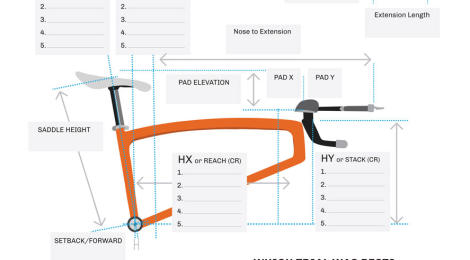
You'll remember Ves Mandaric's fit simulator and the gradations on its telescoping pistons and horizontal plates. The idea behind these is to give you a reference point to the bottom bracket. In the photo adjacent, you'll see "530" visible as the number just above the piston's stantion. This means the top of the plate on which the adjustable stem sits is 530mm above the plane of the bottom bracket (this is the frame's "stack"). You now have about the first of three necessary measures.

The horizontal plate's gradations will tell you how far in front of the bottom bracket the stem is. In the case of the photo adjacent, you'll note that the stem is sitting 5mm above the plane of the horizontal plate. You'd need to normalize this for the measure above the top of the head tube you intend your bike to have.

In other words, the intended custom bike is going to have an integrated headset or not, and if not, then you need to subtract a bit of head tube to make room for the external headset cups. If you want to have 15mm of spacers, you need to adjust for those. You then adjust your stack appropriately. In any case, the reading on this horizontal plate, right underneath your stem's connection to the virtual steer column, is the frame's "reach," and tells you how many millimeters the top of the head tube is in front of the BB. What we've done is reduced the frame's length and height to a set of X/Y coordinates, that is, vertical and horizontal coordinates.

Now you have two of the important fit-specific numbers needed to build the right custom bike. These terms "stack" and "reach" might be vaguely familiar to those who follow the tech articles on this site. I wrote an article three and a half years ago introducing these concepts. In this article, as well as the intro to geometry and 07 geometry articles mentioned above, you'll find that I keep making reference to the geometric specs that refer mostly to fit, versus those that affect handing. This should be easily apparent, because the bike's chain stay length has nothing to do with fit, does it? And what head angle you use also does not affect fit. But they both affect handling. Stack and reach are what you need to determine how a bike will fit.

You need a third parameter, however, and this is the bike's seat angle. A few years ago this was an almost unnecessary parameter to consider, because you could always figure out a way to get the saddle where you wanted it. But these days bikes tend to have seat posts you can't change out, they're part of the frameset. So, you do have to consider this. So, you run a SmartTool through the BB and the center of the seat post clamp and you've got the seat angle of the bike you'll be riding. Now the astute frame builder has all he needs -- in terms of fit specs -- to custom build your bike.

Keep on thing in mind. Depending on the custom bike maker, the seat post clamp may be set right on top of the seat tube and post, or a cm behind, or a cm in front. The actual seat angle of the bike itself may be a degree steeper or shallower than the virtual seat angle of the bike. Taking QR as an example, if you want a custom TiPhoon, and your perfect seat angle measures 79 degrees from the BB through the center of the seat clamp, your TiPhoon should probably be built with a 79.5 or 80 degree seat angle, because the TiPhoon's seat clamp is offset about 1cm behind the centerline of the seat tube.

But why don't you use an X/Y measuring system in the rear of the bike, since you're using it in the front? I can ask a frame builder what the "X/Y" is from the BB to the top of the head tube, and for every size bike he'll give me a specific answer. But if I ask him the X/Y from the BB to the seat post clamp, he can't tell me that, because it depends on the height of the saddle. So, in the rear I find it easiest to use an angular dimension.

But how will the frame builder know how tall to make the seat post? Easy. He already knows where the top of the head tube is, because you've precisely positioned this for him by giving him the stack and reach. He just needs to project back in a straight line (that's the bike's top tube), and there you have the seat tube terminus (since tri bikes always have shorter head tubes than road bikes, you won't need to worry about standover height, and can just bring the top tube back in a horizontal line).

How does this work in real life? Any frame builder with a parametric program for framebuilding (framebuilders all have these) can extrapolate a geometry out of stack, reach and seat angle. If you take my idea of the best production geometry as an example, in a size I would ride (historically the 58cm version of my idea of optimized production tri geometry), that geometry generates a stack of 560mm and a reach of 460mm. What is the top tube length generated by this stack and reach? It depends on what seat angle you use. Personally, I would use a steeper angle than the 78.5 degrees I recommend bike companies use in production, because I ride steeper than the average bear. My preference in a top tube is about 56cm as opposed to the 56.5cm production top tube length I recommend on that 58cm size. So, my own perfect custom geometry would call for an 80 degree seat angle, and my custom frame's reach would increase to about 47cm. I like that 145mm head tube length called for in my optimized production geometry, and the 7cm of bottom bracket drop, so I'll stick with the 56cm stack.

So my perfect custom bike would have a stack and reach of about 56cm and 47cm respectively. But so far we're talking about fit specs only. Now there's the handling-specific specs to consider, and this is where you either have to rely on the framebuilder's expertise in how tri bikes ought to handle, or you can use my article referenced above on the sorts of techniques used by production bike makers (as well as my own ideas of handling-specific bike specs). Accordingly, choose chainstay lengths, front/center and wheelbase specs, steering geometry, to suit.

You do not need Mandaric's fit bike to generate stack and reach. Serotta makes an X/Y tool that also does this. Making an X/Y tool would not be that hard, and somebody probably ought to make one for sale to those who have fit bikes that don't automatically give you X/Y dimensions.

What about production bikes that might work instead of getting a bike custom made? I anticipate, within a very few weeks, publishing another article with the stack and reach of every meaningful tri bike company, throughout their line and for each size. I already have some of these stats databased. Using my own 58cm size as an example, QR's new 2007 geometry says its 58cm Kilo and Tequilo have a stack and reach of 54.5cm and 45.5cm respectively. Alternatively, its 61cm size has specs of 57cm and 47cm. Since my own "perfect" specs would call for 56cm and 47cm respectively, it's apparent that QR's 61cm is actually very close to my perfect size -- the head tube is 1cm taller than perfect, and the top tube is perfect. That's certainly something easy to accommodate by moving a 1cm spacer out from underneath the stem.

Cervelo was the first company to start publishing stack and reach dimensions, fully 3 years in front of anybody else. Should one consider its geometry chart, one sees that the 61cm P3C Cervelo has a stack and reach of 56.4cm and 45.4cm. Again, this is very close to what I'd need. My stem on a Cervelo needs to be 1.5cm longer, and I'd need to take a 5mm spacer out from under the stem, and I'm there.

Then there's Felt's new geometries for '07. In my size, the seat angle is 78.5 degrees, so I can get my 80 or so degrees by moving the saddle forward on the rails. The stack and reach for its tri bikes in 60cm are 56cm and 46cm. My "perfect" spec, remember, is 56cm and 47cm. So, I add a cm to the stem I'd normally ride an on any '07 Felt I'm good to go.

Once all the stack and reach dimensions for all the popular tri bikes are posted here, it ought to be easy to see what bikes will work for you and which one's won't. Just keep in mind that you can't go to a FIST session, get your stack and reach numbers, find corresponding stack and reach specs of current production bikes, and jump on these bikes and ride off happy. Assuming your fit was executed with your own preference of aero bar and stem config, you'd need to take your Cervelo, Felt, QR, Giant, Litespeed, and stick your front end on that production bike in order for it to fit the same. And, of course, that bike's seat angle must be such to accommodate the angle you'll choose to ride.

What I hope to express here is that there is a path from "points in space" to finished bike geometry. But the path requires a fitter with state of the art tools, and a lot of expertise. When the article databasing the stack, reach and seat angles of each of our sport's production tri bikes is published, I'll also publish stack and reach of my optimized production tri geometry. I'm doing this for a variety of reasons, and one such reason is a sort of "buyer beware." If you're getting a custom bike built, I would recommend you look at how much its geometry differs from the production geometries of the bikes built close to your desired seat angle. If it differs a lot, then you might want to inquire why before you buy.