

Shoe Height and Ramp Angle
Written by: Dan Empfield
Date: Tue Mar 15 2011
Let's talk running technology for a moment. And, for just a moment, because, this is a big subject, with a lot of themes currently in play.
You might think natural or minimalist or barefoot running is a single theme, but I don't see it that way. Let's start with some simple definitions. What do you think "barefoot running" means?
Our running editor, Jeroen Van Geelen, explains "barefoot running" follows:
"You don’t make a heel strike while running. You don't land with extended knees, and legs ahead of your body. It means that you land with a bent knee more or less under your body, landing on the midfoot or forefoot."
This describes so-called barefoot running and I think it should become clear there's a presumption that you're going to run using this technique if you're to wear the footwear designed for this style of running.
To wit, the high-ramp-angle shoes ubiquitous for a generation (we'll get to what that means) appear to presuppose a heel-strike technique. If you continue to heel strike in certain shoes now built for midfoot-strike, it's like putting a tri bar on a road bike: Maybe it's the right technology for somebody, but not for you.
So, it's not enough to buy "barefoot" technology, you must run with proper technique. There is a plethora of techniques, models, schools, programs that champion one or more of the basic elements of good running technique. Jeroen Van Geelen notes, "There are many names in the market like "natural running", " Pose Running" "BK Method", "Chi Running" and so on."
I might add to that Curt Munson's site, to which I have in the past alluded, Good Form Running.
You might think natural or minimalist or barefoot running is a single theme, but I don't see it that way. Let's start with some simple definitions. What do you think "barefoot running" means?
Our running editor, Jeroen Van Geelen, explains "barefoot running" follows:
"You don’t make a heel strike while running. You don't land with extended knees, and legs ahead of your body. It means that you land with a bent knee more or less under your body, landing on the midfoot or forefoot."
This describes so-called barefoot running and I think it should become clear there's a presumption that you're going to run using this technique if you're to wear the footwear designed for this style of running.
To wit, the high-ramp-angle shoes ubiquitous for a generation (we'll get to what that means) appear to presuppose a heel-strike technique. If you continue to heel strike in certain shoes now built for midfoot-strike, it's like putting a tri bar on a road bike: Maybe it's the right technology for somebody, but not for you.
So, it's not enough to buy "barefoot" technology, you must run with proper technique. There is a plethora of techniques, models, schools, programs that champion one or more of the basic elements of good running technique. Jeroen Van Geelen notes, "There are many names in the market like "natural running", " Pose Running" "BK Method", "Chi Running" and so on."
I might add to that Curt Munson's site, to which I have in the past alluded, Good Form Running.
These are all "branded" packages describing good technique that any decent high school coach taught runners as far back as the 1960s and 70s and perhaps further back yet. Midfoot striking, eschewing overstriding, relatively high cadences, square shoulders with hands that do not cross the body's centerline, are running principles that have been around for generations, notwithstanding the existence of Emil Zatopek and other outliers you might identify.
So, let's demystify. You should endeavor to run with good technique. Now, assuming you'll do your best to incorporate this, are the steep ramp-angle shoes compatible with good technique?
Ramp Angles
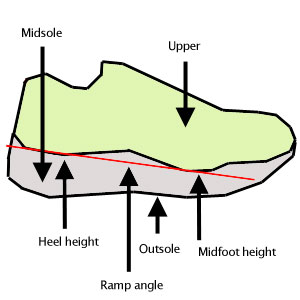
What we're talking about here is the distance your heel sits off the ground versus your forefoot, when you're standing in the shoe. In order to calculate an angle, you've got to solve a right triangle equation, specifically, in a size-9 shoe, the distance from the heel to the forefoot is a right triangle's long arm, the delta between heel and forefoot height is the short arm, connect these two arms via the hypotenuse, the slope of the hypotenuse is the ramp angle (or, just look at the image furthest above).
Who wants to calculate that? Not me.
So, let's just talk about heel height, forefoot height, and the delta between them. Typical of today's conventional running shoes is a 24mm heel and a 12mm forefoot. The delta between them is 12mm. This number is much easier to get one's arms around, so, from here on in I'm going to talk about Ramp Delta (a metric of my own invention—if you've got a better term, lay it on me, maybe I'll abandon mine and adopt yours).
So, let's demystify. You should endeavor to run with good technique. Now, assuming you'll do your best to incorporate this, are the steep ramp-angle shoes compatible with good technique?
Ramp Angles
What we're talking about here is the distance your heel sits off the ground versus your forefoot, when you're standing in the shoe. In order to calculate an angle, you've got to solve a right triangle equation, specifically, in a size-9 shoe, the distance from the heel to the forefoot is a right triangle's long arm, the delta between heel and forefoot height is the short arm, connect these two arms via the hypotenuse, the slope of the hypotenuse is the ramp angle (or, just look at the image furthest above).
Who wants to calculate that? Not me.
So, let's just talk about heel height, forefoot height, and the delta between them. Typical of today's conventional running shoes is a 24mm heel and a 12mm forefoot. The delta between them is 12mm. This number is much easier to get one's arms around, so, from here on in I'm going to talk about Ramp Delta (a metric of my own invention—if you've got a better term, lay it on me, maybe I'll abandon mine and adopt yours).
The complaint with a large ramp delta is this: If I'm a midfoot striker, can I midfoot strike without that propped-up heel getting in the way? Probably so if we're talking 10mm, maybe 12mm, but 15mm? (Which is not by any means unheard of.) That's questionable.
A bigger problem yet: Once I midfoot strike, the heel will touch down almost immediately—how much will the rear of the shoe compress? If it doesn't sufficiently compress, am I plantar flexing (pushing off) with an achilles tendon not sufficiently elongated?
Part of this depends on how firm the shoe is in the heel. If the midsole is less dense, the shoe may compress to a point where the shoe functions as if it had a smaller ramp delta.
Are traditional shoes made for heel strikers?
This is a contention I hear over and over again, with greater regularity. The running boom has spawned a lot of runners who didn't get the proper running technique memo (the narrative goes) and companies like Asics and Brooks have accommodated their overstriding, heel-striking, overpronating technique with shoes perfectly made for this inefficient method of running.
I buy this line of reasoning up to a point. I have some problems with this line of thinking and we'll get to these, but, here's an experience related to me by a shoe designer, Dave Jewell of Zoot, from a bit earlier in his career:
"We cut all the competition up with a band saw. We wanted to see what the midsole heights were. What we found was rather astounding. Yes their stated midsole heights were fairly correct but their overall height was rather outrageous. We found shoes that were stated as 25mm heel and 13mm forefoot. The total height was 34mm heel and 22mm forefoot. People were still buying them but it seemed to us like they were too tall."
A bigger problem yet: Once I midfoot strike, the heel will touch down almost immediately—how much will the rear of the shoe compress? If it doesn't sufficiently compress, am I plantar flexing (pushing off) with an achilles tendon not sufficiently elongated?
Part of this depends on how firm the shoe is in the heel. If the midsole is less dense, the shoe may compress to a point where the shoe functions as if it had a smaller ramp delta.
Are traditional shoes made for heel strikers?
This is a contention I hear over and over again, with greater regularity. The running boom has spawned a lot of runners who didn't get the proper running technique memo (the narrative goes) and companies like Asics and Brooks have accommodated their overstriding, heel-striking, overpronating technique with shoes perfectly made for this inefficient method of running.
I buy this line of reasoning up to a point. I have some problems with this line of thinking and we'll get to these, but, here's an experience related to me by a shoe designer, Dave Jewell of Zoot, from a bit earlier in his career:
"We cut all the competition up with a band saw. We wanted to see what the midsole heights were. What we found was rather astounding. Yes their stated midsole heights were fairly correct but their overall height was rather outrageous. We found shoes that were stated as 25mm heel and 13mm forefoot. The total height was 34mm heel and 22mm forefoot. People were still buying them but it seemed to us like they were too tall."
Dave does not rail against companies that make shoes with a taller heel, or a larger ramp delta. Rather, he offers this observation from the latest Hawaiian Ironman:
"The race up front is won by folks who can run in anything but choose the shoes with the smaller delta—say, 10mm or less. But those finishing the race from 3 hours behind to 10 hours behind tended to run in a shoe that has a 12mm delta. Are all of these people running in the wrong shoe? Clearly they are running in what’s most appropriate to their running style. Running shoe companies for years have offered different shoes with different deltas. In the past the shoes with the low delta were racing flats."
Does a low ramp delta require a low overall shoe height?
Some believe ardently that a firm connection between the foot and the ground is a must. Danny Abshire (founder and owner of Newton Shoes) believes this and offers the following rationale: There are thousands of nerve endings in the foot responsible for proprioception, and a loss of communication between the ground and these nerve endings interrupts the proper interaction between nerves and muscles. Adding distance between the foot and the ground interrupts this communication.
Newton's shoes are known for an exceptionally low ramp delta as well as generally low shoe heights. Still, Dave Jewell notes that, "Now there are shoes with a low delta and thicker overall midsoles that are getting some traction."
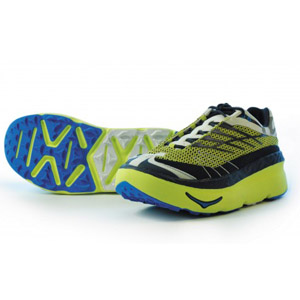
One of these is a shoe I've recently run about a hundred miles in, the Hoka One One Mafate (pictured above). As regards overall height, this is the anti-Newton. Still, this shoe shares in common with Newton a very low ramp delta. I have another Hoka One One on the way to me, the slimmer, lighter Bondi B, pictured below. (I have a sneaking suspicion this might be my triathlon racing flat. We'll see, and I'll report back.)
"The race up front is won by folks who can run in anything but choose the shoes with the smaller delta—say, 10mm or less. But those finishing the race from 3 hours behind to 10 hours behind tended to run in a shoe that has a 12mm delta. Are all of these people running in the wrong shoe? Clearly they are running in what’s most appropriate to their running style. Running shoe companies for years have offered different shoes with different deltas. In the past the shoes with the low delta were racing flats."
Does a low ramp delta require a low overall shoe height?
Some believe ardently that a firm connection between the foot and the ground is a must. Danny Abshire (founder and owner of Newton Shoes) believes this and offers the following rationale: There are thousands of nerve endings in the foot responsible for proprioception, and a loss of communication between the ground and these nerve endings interrupts the proper interaction between nerves and muscles. Adding distance between the foot and the ground interrupts this communication.
Newton's shoes are known for an exceptionally low ramp delta as well as generally low shoe heights. Still, Dave Jewell notes that, "Now there are shoes with a low delta and thicker overall midsoles that are getting some traction."
One of these is a shoe I've recently run about a hundred miles in, the Hoka One One Mafate (pictured above). As regards overall height, this is the anti-Newton. Still, this shoe shares in common with Newton a very low ramp delta. I have another Hoka One One on the way to me, the slimmer, lighter Bondi B, pictured below. (I have a sneaking suspicion this might be my triathlon racing flat. We'll see, and I'll report back.)
Hoka One One's designer/owner, Nicolas Mermoud has his own biomechanical rationale: Intramuscular capillaries shut down (says Mermoud) after sustaining a critical mass of pounding-related damage during an event. Therefore, a shoe with increased cushioning lessens the damage, which protects the muscles and lengthens the utility of a muscle during an event.
Is one narrative necessarily wrong? I don't know (they each sound good, don't they?!). I rather think Danny Abshire is right as far as it goes, but, Mermoud's shoe is the new darling of the ultra-runner, because, at a certain point, damage trumps proprioception. Which narrative is operative is probably dependent on runner speed, runner weight, technique, mileage base, and race distance.
Can a shoe with a low ramp delta work for a heel striker?
Yes, I think, depending on the shoe. These shoes with a low delta and thicker overall midsoles that Dave Jewell spoke of are cases in point. The Hoka One One, for example, features an exceedingly tall profile, yet it's got a small ramp delta. Heel strikers will find this shoe easy on the legs.
Still, any shoe with a small ramp delta may give a runner trouble if the transition from a large to a small delta is made immediately, with no transition, and on non-variable terrain. I suspect some of the early anecdotal problems with Newtons are due to an immediate transition from a tall-heeled shoe to this low-ramp delta shoe. My first run in a Hoka One One was 3 miles. Then, two runs in a Brooks Adrenaline. Then another 3-mile run in the Hokas. Then another Adrenaline run. You get the point.
Is one narrative necessarily wrong? I don't know (they each sound good, don't they?!). I rather think Danny Abshire is right as far as it goes, but, Mermoud's shoe is the new darling of the ultra-runner, because, at a certain point, damage trumps proprioception. Which narrative is operative is probably dependent on runner speed, runner weight, technique, mileage base, and race distance.
Can a shoe with a low ramp delta work for a heel striker?
Yes, I think, depending on the shoe. These shoes with a low delta and thicker overall midsoles that Dave Jewell spoke of are cases in point. The Hoka One One, for example, features an exceedingly tall profile, yet it's got a small ramp delta. Heel strikers will find this shoe easy on the legs.
Still, any shoe with a small ramp delta may give a runner trouble if the transition from a large to a small delta is made immediately, with no transition, and on non-variable terrain. I suspect some of the early anecdotal problems with Newtons are due to an immediate transition from a tall-heeled shoe to this low-ramp delta shoe. My first run in a Hoka One One was 3 miles. Then, two runs in a Brooks Adrenaline. Then another 3-mile run in the Hokas. Then another Adrenaline run. You get the point.
Does a low ramp delta necessarily mean a neutral shoe?
This is where the natural/barefoot/minimalist guys lose me. Yes, no doubt you'll overpronate less if you don't overstride. But in my experience, it's dangerous fiction to flatly state that an overpronator can, and should endeavor to, "teach" himself to run in a neutral shoe through engaging in exercises to strengthen his feet.
The Hoka One One Mafate is the first shoe I've run in that combines a tall overall height with tremendous (if unintended) support (enough to robustly support an orthotic), along with a small ramp delta. I'm certain this is a winning combo, and I'm equally certain companies in addition to Hoka One One can pull this off.
But we'll not veer into medial or lateral structure. That's a second, different axis, and we're sticking to a shoe's overall height, and its fore/aft delta, for now.
When I engage readers on the Slowtwitch Forum, this is far and away the sexiest axis going. This is the axis in play. What our readers want is a level shoe. It might be tall or it might not; it might have stability or guidance features, it might not. But it's got to have a low delta between heel and forefoot.
Just know that this works hand-in-hand with a proper running technique. If you run in a low ramp angle shoe, but you continue to overstride, you're liable to get more than your feelings hurt.
This is where the natural/barefoot/minimalist guys lose me. Yes, no doubt you'll overpronate less if you don't overstride. But in my experience, it's dangerous fiction to flatly state that an overpronator can, and should endeavor to, "teach" himself to run in a neutral shoe through engaging in exercises to strengthen his feet.
The Hoka One One Mafate is the first shoe I've run in that combines a tall overall height with tremendous (if unintended) support (enough to robustly support an orthotic), along with a small ramp delta. I'm certain this is a winning combo, and I'm equally certain companies in addition to Hoka One One can pull this off.
But we'll not veer into medial or lateral structure. That's a second, different axis, and we're sticking to a shoe's overall height, and its fore/aft delta, for now.
When I engage readers on the Slowtwitch Forum, this is far and away the sexiest axis going. This is the axis in play. What our readers want is a level shoe. It might be tall or it might not; it might have stability or guidance features, it might not. But it's got to have a low delta between heel and forefoot.
Just know that this works hand-in-hand with a proper running technique. If you run in a low ramp angle shoe, but you continue to overstride, you're liable to get more than your feelings hurt.
Articles related to this one
The Great Running Debate
What constitutes good running form? Does good form lend itself to natural, or barefoot, or minimalist, running technology? What are the hallmarks of that technology? 1.31.11
Tech footwear demystifier
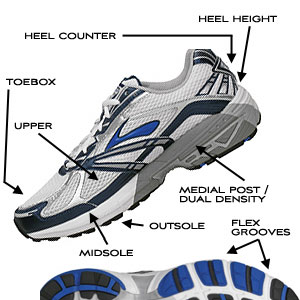
We write about running footwear here a lot. It seemed appropriate to tell you how to read and interpret these articles. What is a "pronator?" What is a "last?" What is an "outsole," and a "medial post?" 2.05.10
Comments
At last, the truth behind opinion
Reviewed by: James, Mar 19 2011 8:06AM
It is refreshing to see someone talking on a subject that displays their opinion using terms like 'I have a sneaking suspicion' as opposed to 'this is fact'. There seems to be a lot of alleged fact out there spouted by people on purchases, marketing, opinion and the desperate need to overcome problems or injuries. Phrases like 'they cured my achilles tendonitis' or 'they made me run faster' are simply unfounded. Those results may have been seen but possibly not attributed directly to the footwear. For example. I received a good discount on a bike the other day. I was wearing New Balance when i was offered the discount. Wearing New Balance does not mean I get a bike discount. "But it worked for me!" I could claim. The jump to new items is often persuaded by a need. Maybe injury. In this instance the new footwear could also be part of a string of events that includes focus on run form (even subliminally) or extra physio, or maybe you just end up trying something that suits you. We look for the magic cure and glue 'fact' to it because, quite frankly, we hope to hell we have found the holy grail.
Now I am not saying I agree or disagree with barefoot, minimal, forefoot, midfoot or whatever. In fact I have recently change my running style to try to become more efficient, but I just think that Dan has both summed up and left open the debate in a way that it should be. A logical collection of thoughts awaiting some form of scientific evidence to back it up.
Barefoot running/Shoe Height
Reviewed by: TriDork, Mar 17 2011 4:38PM
Finally shoes are being investigated and discussed. As with many discussions about technique and equipment, there are many points to ponder.
It seems to me that each of the variations on the theme come from each individuals opinion of the most important considerations to be addressed. An over-pronator for example is likely to think over pronation is the key thing to be addressed so makes motion control shoes. IMHO, many of the proponents of a particular style of running try to solve all the worlds problems with one solution.
I don't beleive there is one preferred technique that works for all. Necessarily, there are different ideal solutions for at least several groups of people (runner in this case)
Also, many people seem to think that perfect technique is displayed by the fastest runners. They use this as ammuntion to tell us we should all run that way.For many of us this may be beneficial but for many others it will not. I recall some years ago, I think it was Maurice Green. He ran with a very strange arm action. He also ran very fast. Some people thought to immitate this technique to run faster. When asked about his arm action, he responded that when he was about 11, he broke his arm. He kept running, but the weight of the cast force the strange arm action. When the cast was removed, he retained the arm action, not because it was faster, but because it was the way he'd learned to run. Running with that strange action, just because a fast runner ran like that was NOT the right conclusion to draw.
Many times, people get the cause/effect relationship backwards. Does forefoot running make you run faster, or when you run faster, does forefoot techinque just happen? When you pick up the pace, does midfoot striking naturally make the most sense. When tearing along is forefoot the natural result?
Before a preferred technique is chosen, these kind of questions need to be answered. Not just for the fast guys running fast, but for all different types of runners at a range of speeds. Just like off road shoes are differnt than road shoes and over pronators need different shoes that supinators, maybe different concepts work for different people under different conditions. One size does NOT fit all.
It seems to me that each of the variations on the theme come from each individuals opinion of the most important considerations to be addressed. An over-pronator for example is likely to think over pronation is the key thing to be addressed so makes motion control shoes. IMHO, many of the proponents of a particular style of running try to solve all the worlds problems with one solution.
I don't beleive there is one preferred technique that works for all. Necessarily, there are different ideal solutions for at least several groups of people (runner in this case)
Also, many people seem to think that perfect technique is displayed by the fastest runners. They use this as ammuntion to tell us we should all run that way.For many of us this may be beneficial but for many others it will not. I recall some years ago, I think it was Maurice Green. He ran with a very strange arm action. He also ran very fast. Some people thought to immitate this technique to run faster. When asked about his arm action, he responded that when he was about 11, he broke his arm. He kept running, but the weight of the cast force the strange arm action. When the cast was removed, he retained the arm action, not because it was faster, but because it was the way he'd learned to run. Running with that strange action, just because a fast runner ran like that was NOT the right conclusion to draw.
Many times, people get the cause/effect relationship backwards. Does forefoot running make you run faster, or when you run faster, does forefoot techinque just happen? When you pick up the pace, does midfoot striking naturally make the most sense. When tearing along is forefoot the natural result?
Before a preferred technique is chosen, these kind of questions need to be answered. Not just for the fast guys running fast, but for all different types of runners at a range of speeds. Just like off road shoes are differnt than road shoes and over pronators need different shoes that supinators, maybe different concepts work for different people under different conditions. One size does NOT fit all.
shoe height and ramp angle
Reviewed by: Dr. Allen, The Gait Guys, Mar 16 2011 2:45PM
yes, this was a really nice little article Dan. Thanks for putting together a nicely flavored article for the masses. This helps to support the NEwton, Altra and Vibram gang and the others that are frantically trying to play catch up to you guys. Dan, we attached the article on our blog www.thegaitguys.tumblr.com and paraphrased (let us know if that is not ok) and we gave full credits and kudos to you Dan. Keep up the great work on this site. Nice to rub shoulders with folks with similar strokes. SA
Altra Zero Drop Footwear
Reviewed by: Jeremy, Mar 16 2011 12:08PM
Great article! It is great to see that Zero Drop is coming into full play to eliminate that ramp angle. Just wish we (who coined the term "Zero Drop") were mentioned in the article.
Low delta
Reviewed by: David, Mar 16 2011 9:51AM
I really like this article as it has been a topic on my mind for quite some time now. I have used all varieties of shoes, from Newtons, to Zoots, to New Balance and more. I have been searching for that perfect shoe that gives me just enough cushion, but a low delta, and low weight. What are some suggestions?