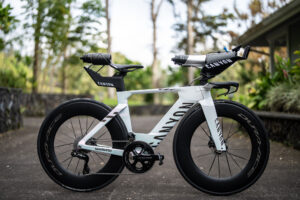
Armrest drop
Written by: Dan Empfield
Date: Thu Sep 13 2007
You'll want to follow the articles in succession, starting with Intro to the F.I.S.T. Method:
1. F.I.S.T. axioms
2. F.I.S.T. protocol
3. Measuring conventions
4. Seat height
5. Cockpit length
6. Hip angle
7. Armrest drop <-- You are here
8. Tools of the trade
9. Your bike's "waistline"
10. Translating fit specs to bike specs
You should've read our article on Hip angle prior to this. Our series begins here.
When we speak of measuring the armrest drop, we're really talking about the hip angle. It's another way of looking at hip angle. That said, one thing is worth noting about this so-called hip angle: we never really do measure it per se. Even when we're measuring the angle described in the chapter above, we're really measuring across two joints -- the hip and the knee -- and even then we're measuring to the bottom bracket. Nothing in there describes the 'hip angle' as would be measured by, say, a physical therapist.
1. F.I.S.T. axioms
2. F.I.S.T. protocol
3. Measuring conventions
4. Seat height
5. Cockpit length
6. Hip angle
7. Armrest drop <-- You are here
8. Tools of the trade
9. Your bike's "waistline"
10. Translating fit specs to bike specs
You should've read our article on Hip angle prior to this. Our series begins here.
When we speak of measuring the armrest drop, we're really talking about the hip angle. It's another way of looking at hip angle. That said, one thing is worth noting about this so-called hip angle: we never really do measure it per se. Even when we're measuring the angle described in the chapter above, we're really measuring across two joints -- the hip and the knee -- and even then we're measuring to the bottom bracket. Nothing in there describes the 'hip angle' as would be measured by, say, a physical therapist.
What we've been measuring is a proxy angle that is a precise and easy-to-measure approximator of one's hip angle. We are now going to measure the effect that hip angle has on one's bike. We're doing this as a sort of double-check, to see if we're on the right path. Hundreds of top athletes over the last decade and a half have had their saddle heights and armrest drops measured, and these coordinates tend to nicely fall inside a range. That range is expressed by the following quadratic equation:
C = .005D2 -.2D
In this equation, 'C' = armrest drop, and 'D' = saddle height. Remember, saddle height in this case is measured from the bottom bracket to the top of the saddle, midpoint between its fore and aft.
C = .005D2 -.2D
In this equation, 'C' = armrest drop, and 'D' = saddle height. Remember, saddle height in this case is measured from the bottom bracket to the top of the saddle, midpoint between its fore and aft.
This formula is good at 77.5 degrees of seat angle, where seat angle is measured from the BB to the center of the saddle's rails.
Should the seat angle be steeper or shallower than 77 degrees, one adds or subtracts .0075 from the integer '2' for each degree distant from 77 degrees. One subtracts for angles steeper than 77 degrees, and one adds for shallower angles. So, let us say we're talking about a person riding at 79 degrees of seat angle. In this case, the integer '2' has subtracted from it .0075 twice, resulting in .185. So the formula at 79 degrees of seat angle would read as follows:
C = .005D2 -.185D
At 76 degrees of seat angle, the formula reads as follows:
C = .005D2 -.2075D
This does not give you your proper armrest drop. This formula simply provides you a glimpse into the sort of bike set ups that tend to be used by the better pros over the years. Not all pros have armrest drop numbers that fit this formula. But perhaps 75% of them will have an armrest drop that falls within +/- 1.5cm. The formula changes, then, to express this range:
C = .005D2 -.2D +/- 1.5
But how applicable is this formula to the typical age-grouper, assuming we're talking about one who is a candidate for an optimized tri position? Subtract about 1.5cm. This yields the following formula:
C = .005D2 -.2D - 1.5 +/- 1.5
How much weight should be given this formula? It would sit behind three other determiners of proper hip angle: what the subject determines is comfortable; what an experienced fitter observes as appearing appropriate; and the proxy hip angle measure discussed in the chapter above. If all these point in one direction, you've hit a triple. If the armrest drop of the subject also falls inside the 3cm range determined by the formula, touch them all, you've hit it out of the park.
Let's take a historic example. Scott Tinley, when he raced, used to ride a reasonably steep seat angle, in the neighborhood of 78 degrees. He had 81cm of saddle height. Here is how the formula would work for him:
C = .005(81)2 -.1925(81)
C = 32.8 - 15.6 = 17.2
The 3cm range expressed in the formula means Tinley's armrest drop should've been somewhere between 15.7cm and 18.7cm. In fact, it was right at 16cm. Were Scott Tinley an age-grouper, I would expect him to fall into that same range minus 1.5cm, so the range for an "age-group version" of Tinley might be 14.2 to 17.2. Were Scott to come back to racing now, I wouldn't be surprised to find his saddle height lower by a centimeter (I always though Scott's saddle bordered on the too-high) and I wouldn't be surprised to see his armrest drop at something more like 14cm or 14.5cm.
Remember, though, that this is not a determiner of proper armrest drop, it's simply an indicator of where athletes tend to historically fall.
A note on how to accurately measure this. I sit one end of a level on the high part of the saddle, near the nose, and angle the level over one of the armrests. I stand a metal metric ruler in the center of the armrest, and read its gradation as it intersects the underside of the level. Voila, armrest drop.
For those who are mathematically anal and who want this "formula" expressed a single quadratic equation, here it is:
C = .005D2 + .0075(seat°)D - .7775D +/- 1.5
C = .005D2 -.185D
At 76 degrees of seat angle, the formula reads as follows:
C = .005D2 -.2075D
This does not give you your proper armrest drop. This formula simply provides you a glimpse into the sort of bike set ups that tend to be used by the better pros over the years. Not all pros have armrest drop numbers that fit this formula. But perhaps 75% of them will have an armrest drop that falls within +/- 1.5cm. The formula changes, then, to express this range:
C = .005D2 -.2D +/- 1.5
But how applicable is this formula to the typical age-grouper, assuming we're talking about one who is a candidate for an optimized tri position? Subtract about 1.5cm. This yields the following formula:
C = .005D2 -.2D - 1.5 +/- 1.5
How much weight should be given this formula? It would sit behind three other determiners of proper hip angle: what the subject determines is comfortable; what an experienced fitter observes as appearing appropriate; and the proxy hip angle measure discussed in the chapter above. If all these point in one direction, you've hit a triple. If the armrest drop of the subject also falls inside the 3cm range determined by the formula, touch them all, you've hit it out of the park.
Let's take a historic example. Scott Tinley, when he raced, used to ride a reasonably steep seat angle, in the neighborhood of 78 degrees. He had 81cm of saddle height. Here is how the formula would work for him:
C = .005(81)2 -.1925(81)
C = 32.8 - 15.6 = 17.2
The 3cm range expressed in the formula means Tinley's armrest drop should've been somewhere between 15.7cm and 18.7cm. In fact, it was right at 16cm. Were Scott Tinley an age-grouper, I would expect him to fall into that same range minus 1.5cm, so the range for an "age-group version" of Tinley might be 14.2 to 17.2. Were Scott to come back to racing now, I wouldn't be surprised to find his saddle height lower by a centimeter (I always though Scott's saddle bordered on the too-high) and I wouldn't be surprised to see his armrest drop at something more like 14cm or 14.5cm.
Remember, though, that this is not a determiner of proper armrest drop, it's simply an indicator of where athletes tend to historically fall.
A note on how to accurately measure this. I sit one end of a level on the high part of the saddle, near the nose, and angle the level over one of the armrests. I stand a metal metric ruler in the center of the armrest, and read its gradation as it intersects the underside of the level. Voila, armrest drop.
For those who are mathematically anal and who want this "formula" expressed a single quadratic equation, here it is:
C = .005D2 + .0075(seat°)D - .7775D +/- 1.5
Articles related to this one
Tour de Bike Fit
Read this first, if "tri bike fit" is new to you. It's a guide to the dozens of articles in the bike fit section. The articles are grouped, and we offer our advice about the order in which they should be read. 12.30.08
Bike geometry
I ride a 59cm bike or, if it's a road race bike (as opposed to a tri bike) I'll ride a 60cm bike. If it's a Litespeed tri bike, I'll ride 57cm, and so it goes. How are these bikes measured, and why do I ride different sizes depending on the manufacturer? 8.06.02
F.I.S.T. Axioms
This second in a series of articles describing our tri bike fit system lays out the axioms on which our F.I.S.T. system relies. 9.13.07
Comments
Measuring drop
Reviewed by: Jay Courant, Dec 10 2007 7:01PM
I used to measure drop the same way, now I just line up the leveled horizontal beam of a laser diode with the saddle top and stand a metal ruler on the elbow pad, the laser will mark the drop on the ruler and it is less unwieldy than measuring while making sure the level is just that.
fitting measurements
none
Reviewed by: jeff haase, Oct 24 2007 5:12PM
i always find it interesting that when people take measurements of many fast riders their assumption is they have a good fit. VO2 came make up for a lot of poor fits-that assumption of fast riders and good fits is not correct. when you have a formula with standard deviation you just have a bell curve shape which gives you and average. my question is what is your definition of a good fit and what biomechanical data do you have to support the claim.