Cockpit length
Written by: Dan Empfield
Date: Thu Sep 13 2007
If you're following these articles as a series, you would've read our article on Seat height prior to this. Our series begins here.
You'll want to follow the articles in succession, starting with Intro to the F.I.S.T. Method:
1. F.I.S.T. axioms
2. F.I.S.T. protocol
3. Measuring conventions
4. Seat height
5. Cockpit length <-- You are here
6. Hip angle
7. Armrest drop
8. Tools of the trade
9. Your bike's "waistline"
10. Translating fit specs to bike specs
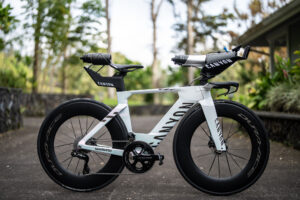
This is the most urgent fit parameter among most of those who ride aero. A problem in cockpit distance (that is, in the length of the bike), is the problem that a rider will try to fix before fixing any other. If there is a problem, it is usually that bikes are too long; the top tube plus the stem equals a given length, and it is likely this length will be too long rather than too short.
Sometimes the rider will seek to "fix" this problem by adopting a steeper seat angle and, while I'm certainly not averse to steep seat angles, altering the seat angle as a means to fix an overlong bike is not a good tactic. But it is true that bike makers over the last decade have built their bikes making a pair of compatible mistakes. If you build your frame with an overlong top tube, and with an overshallow seat angle, you can fix both at the same time by moving the saddle forward. But I digress...
There is no caculable power advantage to having your aero bars somewhat closer or further from your saddle. But there are important issues. Chief among them is comfort, and this does translate to speed because an uncomfortable position is an unsustainable one. When you're uncomfortable you rise up out of the aero position and, at that moment, you'd be better off on a traditional road bike in a road position. The entire advantge of having an aero bike is lost when your elbows are not in the cups. This to say that in every way, on every course, in every maneuver, riding an aero bike is ONLY better than riding a road race bike when you're in the cups, so, seek to stay there.
You'll want to follow the articles in succession, starting with Intro to the F.I.S.T. Method:
1. F.I.S.T. axioms
2. F.I.S.T. protocol
3. Measuring conventions
4. Seat height
5. Cockpit length <-- You are here
6. Hip angle
7. Armrest drop
8. Tools of the trade
9. Your bike's "waistline"
10. Translating fit specs to bike specs
This is the most urgent fit parameter among most of those who ride aero. A problem in cockpit distance (that is, in the length of the bike), is the problem that a rider will try to fix before fixing any other. If there is a problem, it is usually that bikes are too long; the top tube plus the stem equals a given length, and it is likely this length will be too long rather than too short.
Sometimes the rider will seek to "fix" this problem by adopting a steeper seat angle and, while I'm certainly not averse to steep seat angles, altering the seat angle as a means to fix an overlong bike is not a good tactic. But it is true that bike makers over the last decade have built their bikes making a pair of compatible mistakes. If you build your frame with an overlong top tube, and with an overshallow seat angle, you can fix both at the same time by moving the saddle forward. But I digress...
There is no caculable power advantage to having your aero bars somewhat closer or further from your saddle. But there are important issues. Chief among them is comfort, and this does translate to speed because an uncomfortable position is an unsustainable one. When you're uncomfortable you rise up out of the aero position and, at that moment, you'd be better off on a traditional road bike in a road position. The entire advantge of having an aero bike is lost when your elbows are not in the cups. This to say that in every way, on every course, in every maneuver, riding an aero bike is ONLY better than riding a road race bike when you're in the cups, so, seek to stay there.
Your aero bars should be placed such that your forearms represent a column perpendicular to the weight they're supporting. Therefore, there should be a 90° angle between your torso and your upper arm. However, we aren't measuring a straight line through the torso (the pink line adjacent), we're measuring from the greater trochanter (the angled green line), and that yields a smaller hip angle number.
Notice that when you match the horizontal pink line above with the vertical green line, this roughly represents the centerline of the torso and the centerline of the upper arm. In this photo, the angle achieved is less than 90 degrees, and is the personal choice of the athlete photographed, Swedish pro triathlete Jonas Colting. Is there a problem with this slightly overtight cockpit? Not while you're in the aero position.
But once you rise up and ride out of the saddle, the issue is knee clearance, and once you've smacked your kneecap on the back of the armrests, you come to appreciate the utility of a proper cockpit distance. That said, certain riders, Jonas included, spend very little time out of the saddle, and so this is of little import to them.
An angle more obtuse than 90 degrees can become an issue. Riding "stretched out" may be a sustainable position for a few, but it is not typical of comfort positioning. You're likely to be uncomfortable in the front of the deltoids, and in the middle of the trapezius, just below the neck. You don't need to be aboard a bike to demonstrate this to yourself. Stand up, bend over and simply mimic holding your arms in the aero position. See what shoulder angle you naturally adopt. Then move your elbows forward, more in front of you, and you'll experience the discomfort I'm describing above.
An overlong cockpit is also the cause of low back pain later in a ride, because you're now no longer supporting your entire torso weight skeletally. You've moved the column supporting it. The muscles now needed to aid in supporting this weight (now that your column is not under the weight) are the spinal erectors in your low back, hence low back pain resulting from a stem or top tube too long.
My target range for the shoulder angle is 80 to 85 degrees, measured from the greater trochanter to the clavicle (which protrudes nicely when you're in the aero position and yields an easy point to measure to). But the clavicle is not the apex of the angle. You must draw back along this line until you reach the midpoint of the shoulder, and a line following the centerline of the upper arm intersects with the vertical line just described. These two lines form the angle.
Cockpit distance is simply a matter of personal taste. Whatever the subject wants in a cockpit measure, the subject gets, and this is why my nomenclature states a "target" range, not an "acceptable" range. This range is what I expect to find, not what I mandate. Typically, there's not a lot of variance: 80 to 85 degrees is where the great bulk of athletes, regardless of ability, want to ride, assuming you give them the option.

But once you rise up and ride out of the saddle, the issue is knee clearance, and once you've smacked your kneecap on the back of the armrests, you come to appreciate the utility of a proper cockpit distance. That said, certain riders, Jonas included, spend very little time out of the saddle, and so this is of little import to them.
An angle more obtuse than 90 degrees can become an issue. Riding "stretched out" may be a sustainable position for a few, but it is not typical of comfort positioning. You're likely to be uncomfortable in the front of the deltoids, and in the middle of the trapezius, just below the neck. You don't need to be aboard a bike to demonstrate this to yourself. Stand up, bend over and simply mimic holding your arms in the aero position. See what shoulder angle you naturally adopt. Then move your elbows forward, more in front of you, and you'll experience the discomfort I'm describing above.
An overlong cockpit is also the cause of low back pain later in a ride, because you're now no longer supporting your entire torso weight skeletally. You've moved the column supporting it. The muscles now needed to aid in supporting this weight (now that your column is not under the weight) are the spinal erectors in your low back, hence low back pain resulting from a stem or top tube too long.
My target range for the shoulder angle is 80 to 85 degrees, measured from the greater trochanter to the clavicle (which protrudes nicely when you're in the aero position and yields an easy point to measure to). But the clavicle is not the apex of the angle. You must draw back along this line until you reach the midpoint of the shoulder, and a line following the centerline of the upper arm intersects with the vertical line just described. These two lines form the angle.
Cockpit distance is simply a matter of personal taste. Whatever the subject wants in a cockpit measure, the subject gets, and this is why my nomenclature states a "target" range, not an "acceptable" range. This range is what I expect to find, not what I mandate. Typically, there's not a lot of variance: 80 to 85 degrees is where the great bulk of athletes, regardless of ability, want to ride, assuming you give them the option.
Articles related to this one
Tour de Bike Fit
Read this first, if "tri bike fit" is new to you. It's a guide to the dozens of articles in the bike fit section. The articles are grouped, and we offer our advice about the order in which they should be read. 12.30.08
Bike geometry
I ride a 59cm bike or, if it's a road race bike (as opposed to a tri bike) I'll ride a 60cm bike. If it's a Litespeed tri bike, I'll ride 57cm, and so it goes. How are these bikes measured, and why do I ride different sizes depending on the manufacturer? 8.06.02
F.I.S.T. Axioms
This second in a series of articles describing our tri bike fit system lays out the axioms on which our F.I.S.T. system relies. 9.13.07
Comments
At once I'm confirmed!
Reviewed by: H.D., Aug 3 2009 7:04AM
I'm kind of laughing, but kind of crying. I have always noticed that when I do spin classes in the winter to keep from going nuts, that I have insane power on the spin machines with the set up that feels right after tweaking the spin bike at my gym(these are the nice ones that allow fore/aft saddle, bar heigh and saddle height). I took a plumb and ruler in to look at the set up and from the nose of the saddle to the distal front of the bar was only 55cm....talk about a short cockpit. I'm exactly 6' barefoot and ride a 56cm tt right now(roadie only)