
Tech footwear demystifier
[Editor's note: This is an amplification of an article written a year ago. It includes a "legend" interpreting a set of charts that append to every shoe review—2010 and hereafter—along with several other edits and additions.]
You might notice we've been writing a lot about running footwear over the past year. This, because we added a running footwear editorial team last year, and it pens expert and comprehensive commentary about these products. Our tech footwear editor is Jeroen van Geelen, a triathlete and the owner of Total Running, one of the more important running and triathlon retail establishments in The Netherlands.
Our big season for writing shoe reviews (and most product reviews in each category) is January to May. It seemed appropriate to tell you how to read and interpret these articles. What is a "pronator?" What is a "last?" What is an "outsole," and a "medial post," and a "stability" shoe? Let's get right to it.
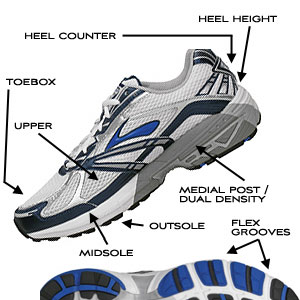
The parts of a shoe
The last
All shoes are built on a last. This is the heart of a shoe. It is a piece of plastic, metal, or wood, and its contour determines the shape and size of the shoe. The etymology of the word is "laest", the Old English word for footprint. There are three basic shapes: straight, semi-curved; and curved; but all three shapes vary from company to company as each company has its own lasts. Semi-curved is by far the most popular and most runners do well in a semi-curve-lasted shoe.
A straight-lasted shoe features a straight-shaped sole with little indentation at the arch. A straight last is appropriate for the overpronator with a flexible, flat arch. It helps to control inward rotation. Shoes with a straight last offer the most medial support, and "motion control" shoes tend to be built with a straighter last than stability shoes. A stability shoe is more likely to have a semi-curved last. Most racing shoes are built on a curved last.
The downsides of straight-lasted shoes is a lack of flexibility; they weight quite a bit; and they're less able to deliver a performance run. This isn't a speedwork shoe, or a tempo run shoe. Curved or semi-curve-lasted shoes are what you want for tempo runs, fartlek, speedwork. But, they break down quicker if you're an overpronator, and your orthotic, if you use one, will "help" break down the medial side of a curve-lasted shoe.
The term "last" can be confusing, because it can also refer to how the upper is attached to the midsole. You'll hear three terms used: slip-lasted; board-lasted; and combination-lasted. A slip-lasted shoe is made by sewing the upper into a shape that resembles a moccasin. This construct is then glued directly to the midsole without any board in between. These are flexible shoes with lots of cushioning and, on balance, little motion control.
Board lasted shoes have a sturdy insole fiberboard running the entire length of the foot bed. This type of construction provides the greatest stability. But shoes of this construction are rare nowadays because of weight, and lack of flexibility.
A combination-lasted shoe is stitched in the forefoot and glued in the rearfoot to that fiberboard. While slip-lasting is the most common construction, Asics is one brand that combination-lasts many of its shoes.
Some runners believe a combination-lasted shoe is the most stable and most supportive for orthotics, because the fiberboard mates nicely with the orthotic's heel. To determine which type of lasting the shoe has, remove the insole (also called the sock liner). If there's stitching in the rearfoot, it's slip-lasted. If you see that fiberboard on top of any of the stitching, it's combination-lasted.
Outsole
This is the outer sole of a shoe—the bottom of the shoe. It's the layer of the shoe that contacts the ground.
Carbon Rubber, a common outsole material, is rubber with a carbon additive to increase durability. It is denser and heavier than blown rubber, and often used in high impact areas.
Blown rubber, a common outsole material, is rubber mixed in some fashion with air. Blown rubber yields a relatively light, cushier outsole, but suffers in durability compared to carbon rubber. Blown rubber is a process most triathletes rely upon: it's what their wetsuits are made of (though wetsuit rubber is much lighter and softer than what is used in the outsoles of running shoes). It's not inconceivable that your wetsuit, your shoe's midsole and EVA outsole, your swim goggle's liner, and your cycling shoe winter booties, are all made of material from the same factory.
Many outsoles use a combination of blown rubber in the midfoot and forefoot—for a lighter shoe with a cushier ride—with carbon rubber in the rearfoot for added durability.
Midsole
This is the area of the shoe between the upper and outsole. It's primarily responsible for the shoe's cushioning. Most midsoles are made of foams: either EVA (ethylene vinyl acetate) or polyurethane. EVA is lighter and more flexible than polyurethane, but it also breaks down more quickly. Many midsoles also have additional cushioning elements such as air and gel.
Just as there are proprietary types of blown rubber used by different triathlon wetsuit manufacturers, there are proprietary types of EVA in the marketplace, such as Nike's Phylon and Brooks' Substance 257. Whether in wetsuits or in running shoes, some proprietary designations are more market- than substance-specific, and some really are substantive and provide specific efficacy. Adidas adiPRENE, Brooks HydroFlow, New Balance AbZORB, are additional examples of proprietary EVA.
Medial posting
"Medial" in this context refers to the inner side (the arch side) of a shoe. Lateral is the corresponding term referring to the outside edge of a shoe. Shoes rarely need much extraordinary support on their lateral sides, because most runners pronate, that is to say, their feet roll to the inside. Arch supports, and orthotics, are examples of products designed to buttress and support the foot on the medial side.
EVA is the most common midsole compound used in running shoes. This shock-absorbing foam is soft, light, and flexible. It can be made in variable densities: the more dense the EVA, the harder the ride, but the more supportive for over-pronators. For this reason, many footwear makers employ two densities of EVA, with the firmer density on the medial side of the midsole. This dual-density EVA combines a smooth, supportive ride with a barrier to compression on the shoe's medial side. This technique is called a medial post.
Other parts of the shoe
The "upper is the leather or mesh material that encloses the foot.
"Flex grooves" are midsole and outsole notches to allow the shoe to bend and flex properly with the natural motion of the foot improving forefoot flexibility at toe-off.
The "heel counter" is a device—often a piece of leather, or a plastic cup—forming the back of a shoe. Its job is to reinforce the heel and prevent excessive heel motion. The heel should fit snugly without being too tight. If it's too wide, the heel will slip in and out of the shoe and cause blisters. Women, in particular, often have narrower heels than men and require a narrow heel counter, common in some brands such as Saucony.
The "sock liner" is the removable insert added to cushion and protect your foot from the shoe's midsole. Orthotics, when used, replace sock liners.
The "toebox" is the area of the shoe that encases your toes.
Morphologies and styles of runners
Overpronation
Pronation is natural, and this rolling from the lateral to the medial side of the foot is one of the body's ways of absorbing shock. Overpronation refers to a foot that rolls excessively to the medial side. Footwear makers are keen to provide medial support for their overpronators. Medial posts, described above, are used to increase the firmness and support through the medial area of the shoe. That denser EVA in the medial side of the midsole—as in the dual density EVA in a shoe like the Brooks Adrenaline pictured—is an example of medial posting. There are also unique and proprietary methods used to create medial support, such as Mizuno's Wave, and you'll read about them in our footwear reviews.
Supination
This is the opposite of pronation. It's an outward rolling of the forefoot that naturally occurs during the stride cycle at toe-off. Supination—synonymous wtih underpronation—occurs when the foot remains on its outside edge after heel strike. A true supinating foot underpronates or does not pronate at all, so it doesn't absorb shock well. It is a rare condition occurring in a small fraction of the running population.
The shoes of supinators show outsole wear on the lateral side not just at the heel but all the way up to the forefoot (most runners will find their shoes wear on the lateral side at the heel, and the medial side in the forefoot). Typically, underpronators tend to break down the heel counters of their shoes on the lateral side. Supinators should consider running shoes from the "cushioning" and "neutral" categories.
Categories of shoes
With the above as a backdrop, let's use this knowledge to see if we can divine why some shoes are categorized as they are, and what these categories mean.
Motion Control
What do we know of "straight lasted" shoes? They offer support, robustness, durability. What sort of runner might need a shoe like this? Maybe a heavier runner, or an overpronator, or one who is both. A motion control shoe buttresses against overpronation. They are usually the most expensive, heaviest and protective shoes because they employ the most control and stability features. Their downside is weight, and lack of flexibility and suppleness.
Stability or Structured
Inside of this category are shoes preferred or required by the broadest swathe of runners. Stability shoes usually have a two-density midsole and a stable base of support to reduce overpronation. Inside of this category is the shoe featured in the image, the Brooks Adrenaline, the shoe I've most often worn for training over the past several years. If you marry a "motion control" shoe to a "neutral" shoe, and they mate and have babies, stability shoes are what will pop out.
Our chosen term, when we choose a category in which to place a shoe we review, is "structured." When we refer to structured trainers or racers this is our grab-bag for shoes that manufacturers themselves often call "stability" or "guidance."
Cushioned or Neutral or Lightweight Trainer
"Cushioned" is the traditional name for this category, but it is increasingly being replaced by "neutral," because a shoe can wander over into the stability category and still have reasonable cushion. Nevertheless, you're likely to get a softer ride here than in any shoe category, because these shoes are free of the need for any medial or rearfoot stability devices. Cushioned or neutral shoes are preferred by runners who have a good footfall. Here at Slowtwitch, we sometimes refer to them as "lightweight trainers," and we mean these shoes when we use the term "neutral."
Racing flats
These are the lightest, most flexible running shoes. Some racing shoes are half the weight of typical training shoes, but offer much reduced cushioning, protection and durability. Generally, only runners racing at 7-minute pace or faster; who are relatively light; and who have good footfalls (they don't overpronate!) should consider racing flats.
Natural-gait shoes
This is a new category that we don't utilize when we stick a shoe into one of our digital "shoeboxes." We put every shoe in one of these four categories:
– Motion Control
– Structured Trainers
– Neutral Trainers
– Racing
But since the publication of the book Born to Run by Christopher McDougall, and other books and portals popularizing "natural" or "barefoot" running, like barefootrunner, and products like Vibram Five Fingers, shoes have been popping up that incorporate some features that mimic or optimize "barefoot" or "natural" running. These shoes typically offer no "structure" (remember, this is a term of art around here, and structure means support on the medial side of the shoe); and they are typically level, or closer to level, in the elevation of the foot along the sagittal plane (toe to heel).
We typically, then, place these types of shoes as either Neutral Trainers, or perhaps in the Racing category if they're light enough to be considered racers.
Our Charts
You'll note charts at the bottom of all our shoe reviews, such charts debuting for the 2010 season. What do they mean?

Posting
Remember, a shoe is either Neutral, Structured, or is considered a Motion Control shoe based on how much "structure" it has. By "structure" we're talking about the ability of a shoe to keep the foot from flattening out or caving in to the inside (the medial side). "Posting" refers to features in the shoe that offer structure.
If you have a good "footfall" or "gait" you don't need this type of support, and you'll want a shoe that offers little or no posting. Also, if you believe that you'll be better off in a "natural" or "barefoot" shoe, posting is antithetical to this theory of running.
Expect a properly made Motion Control shoe to always score as Ample or Robust on our chart—indeed, if it doesn't, we probably don't consider it a very good motion control shoe, and not worth the extra weight. On the other end of the scale, a Racing shoe will almost never demonstrate much in the way of posting.
Weight
We will weigh a men's size-9 shoe, and it will fall into one of our five weight categories. They are as follows:
Feather: under 7 oz
Light: 7 to 9 oz
Average: 9.1 to 11 oz
Heavy: 11.1 to 13 oz
Robust: 13.1 oz and heavier



Start the discussion at forum.slowtwitch.com