


Hoke One One Bondi B
Written by: Dan Empfield
Date: Mon Mar 21 2011
My first run in Hoka One One Mafate's consisted of three very dubious miles. I was so wary of these shoes I was ready to pull them off and walk home barefoot, if need be. But the Mafate convinced me of its efficacy, over time, and it's since become my everyday trainer.
In contrast, the Bondi B was not scary to me at all. My first run in this shoe was a 5k road race. This particular footrace featured a first half that trends gently uphill, and a return that brings you back.
I liked these shoes a lot right from the gun. But it wasn't until about two miles into that race—on the descent—that I fell in love.
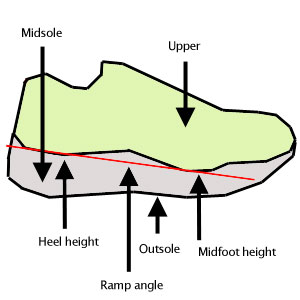
Hoka One One (look at our review of the Mafate for the etymology of the name) approaches footwear construction in much the same way as Newton. It believes in low ramp, or offset: 4mm in the case of Hoka, as opposed to 12mm in typical midweight running shoes. It believes in a pivot, or hinge, under the midfoot. Newton achieves this through the use of its ingenious lug system, Hoka and a few other shoes pursue its goal through a general shape scribed by the outsole.
In contrast, the Bondi B was not scary to me at all. My first run in this shoe was a 5k road race. This particular footrace featured a first half that trends gently uphill, and a return that brings you back.
I liked these shoes a lot right from the gun. But it wasn't until about two miles into that race—on the descent—that I fell in love.
Hoka One One (look at our review of the Mafate for the etymology of the name) approaches footwear construction in much the same way as Newton. It believes in low ramp, or offset: 4mm in the case of Hoka, as opposed to 12mm in typical midweight running shoes. It believes in a pivot, or hinge, under the midfoot. Newton achieves this through the use of its ingenious lug system, Hoka and a few other shoes pursue its goal through a general shape scribed by the outsole.
But there is one difference in the approach taken by each company. Newton believes that feedback between the road and the foot must be maintained, and that too much cushioning interrupts this earth-to-foot communication. Hoka designed its shoe strictly for ultra runners, so, its focus was less on this feedback, and more on the damage done to the legs over the course of a long race (especially if downhills feature in the race).
When I consider an event such as an Ironman, there are two undeniably truths with which footwear makers must contend. First, the typical triathlete—even the typical elite male long distance triathlete—is not 125 pounds, rather is 155 to 165 pounds (this I know from years of fitting them all into their wetsuits). The second truism is this: You don't run a marathon at the end of an Ironman; you run the last 26 miles of a 40- or 50-mile run during an Ironman.
Accordingly, for a long distance triathlete, a shoe designed for an ultrarunner is probably not a bad idea.
When I see Ironman athletes running their marathons in racing flats, I think they may be penny wise and pound foolish. I used to watch Dave Scott win his Ironman races wearing midweight—more than 10oz—shoes like Asics Gel Lite Trainers. I think Dave is still the all-time master of understanding and calibrating his own body's reaction to the Ironman distance, and he seemed to understand the toll pounding takes on his legs during an event of that distance. How much more of a toll would it take on those running 3:45, or 4:45, instead of 2:45?
When I consider an event such as an Ironman, there are two undeniably truths with which footwear makers must contend. First, the typical triathlete—even the typical elite male long distance triathlete—is not 125 pounds, rather is 155 to 165 pounds (this I know from years of fitting them all into their wetsuits). The second truism is this: You don't run a marathon at the end of an Ironman; you run the last 26 miles of a 40- or 50-mile run during an Ironman.
Accordingly, for a long distance triathlete, a shoe designed for an ultrarunner is probably not a bad idea.
When I see Ironman athletes running their marathons in racing flats, I think they may be penny wise and pound foolish. I used to watch Dave Scott win his Ironman races wearing midweight—more than 10oz—shoes like Asics Gel Lite Trainers. I think Dave is still the all-time master of understanding and calibrating his own body's reaction to the Ironman distance, and he seemed to understand the toll pounding takes on his legs during an event of that distance. How much more of a toll would it take on those running 3:45, or 4:45, instead of 2:45?
Enter the Bondi B, the first and only shoe I've yet to run in that combines relatively light weight with great cushioning, an orthotic-ready platform, and a low ramp delta. This is Hoka One One's road racing flat—just understand that Hoka One One considers a "race" an event that lasts several hours.
That established, it's probably going to be my racing flat from 5k and up, whether at the end of a triathlon or in a straight-up footrace. This, because I'm 54 years old, 165 pounds, and suffer from intermittent Mad Calf Disease. Running in anything lighter or denser is, for me, high-risk, low-reward.
The Bondi B (yes, "Bondi" is named after Bondi Beach, so the correct pronunciation is bond-eye) appears a neural shoe in its construction. There is no high-density foam on the insole's medial side, no post, no plate, no wave. But, like its heavier sister shoe the Mafate, it's straight-lasted, with ample support for an orthotic (which would sit squarely on a board-lasted platform), or you can leave the sock liner in and run in it as its designers intended.
The upper is made of softer, more compliant material than the trail-designed Mafate, but, understand this is not a triathlon shoe per se. There are no ingenious lace-locking mechanisms such as those in shoes made by Zoot. If you want a quick transition into this shoe, you must resort to an aftermarket solution.
I haven't yet found the Bondi B's terminal mileage before breakdown. I have about 100 miles in a set of Mafates, and these shoes—while a tad pricy—seem to have a lot of life in them. The medial side of the Mafate (I'm an over-pronator) is rock solid, and shows no signs of breaking down. The Bondi B, however, does not appear to be as medially robust, and I'm just going to guess 100 miles in these babies is going to take its toll (again, this assumes you're an over-pronator like me; if you're gifted with a neutral footfall the shoe is going to have a much longer life).
That established, it's probably going to be my racing flat from 5k and up, whether at the end of a triathlon or in a straight-up footrace. This, because I'm 54 years old, 165 pounds, and suffer from intermittent Mad Calf Disease. Running in anything lighter or denser is, for me, high-risk, low-reward.
The Bondi B (yes, "Bondi" is named after Bondi Beach, so the correct pronunciation is bond-eye) appears a neural shoe in its construction. There is no high-density foam on the insole's medial side, no post, no plate, no wave. But, like its heavier sister shoe the Mafate, it's straight-lasted, with ample support for an orthotic (which would sit squarely on a board-lasted platform), or you can leave the sock liner in and run in it as its designers intended.
The upper is made of softer, more compliant material than the trail-designed Mafate, but, understand this is not a triathlon shoe per se. There are no ingenious lace-locking mechanisms such as those in shoes made by Zoot. If you want a quick transition into this shoe, you must resort to an aftermarket solution.
I haven't yet found the Bondi B's terminal mileage before breakdown. I have about 100 miles in a set of Mafates, and these shoes—while a tad pricy—seem to have a lot of life in them. The medial side of the Mafate (I'm an over-pronator) is rock solid, and shows no signs of breaking down. The Bondi B, however, does not appear to be as medially robust, and I'm just going to guess 100 miles in these babies is going to take its toll (again, this assumes you're an over-pronator like me; if you're gifted with a neutral footfall the shoe is going to have a much longer life).
But this is not a big concern to me, for this reason. The Bondi B is my racing flat, and will be used for my higher-speed training sessions. The faster I run in these shoes, the less stress I'll place on their medial sides. And, because I'll run in these shoes less frequently, these shoes will afford me about the same chronological runway as a set of Mafates in which I'll train regularly.
Obviously, these Hoka One One models have made a favorable impression on me. But I'm less enamored with them than I am with idea behind them. These shoes combine features that shoe makers used for a generation, but have not appeared together in the same shoe. Low ramp deltas have been around from time immemorial. But, not in a cushioned, relatively straight-lasted shoe in which over-pronators can successfully run. This is the sort of shoe many triathletes need, yet, because it hasn't been offered, it's a solution few triathletes are asking for.
(Shoe manufacturers have danced around the idea of shoes like this in generations past. Nike was on the right track with its Air Mariah, but this she came and went decades ago.)
I have identified four retail store that ordered early and deep on Hoka One One shoes: Playmakers (Okemos, MI), Wasatch Running Center, Salt Lake Running Company, Boulder Running Company, and Super Runners Shop (NYC). Then there is the web store at Hoka One One.
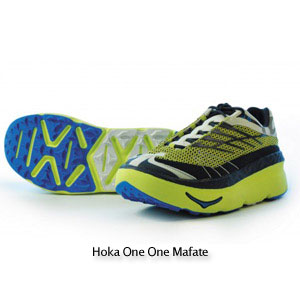
Obviously, these Hoka One One models have made a favorable impression on me. But I'm less enamored with them than I am with idea behind them. These shoes combine features that shoe makers used for a generation, but have not appeared together in the same shoe. Low ramp deltas have been around from time immemorial. But, not in a cushioned, relatively straight-lasted shoe in which over-pronators can successfully run. This is the sort of shoe many triathletes need, yet, because it hasn't been offered, it's a solution few triathletes are asking for.
(Shoe manufacturers have danced around the idea of shoes like this in generations past. Nike was on the right track with its Air Mariah, but this she came and went decades ago.)
I have identified four retail store that ordered early and deep on Hoka One One shoes: Playmakers (Okemos, MI), Wasatch Running Center, Salt Lake Running Company, Boulder Running Company, and Super Runners Shop (NYC). Then there is the web store at Hoka One One.
Articles related to this one
Hoka One One Mafate
If you want your legs to feel as fresh at 8, or 15, or 22 miles into your run as they feel during the first few miles, you need your shoe to reduce the accumulated damage done. This is that shoe. 3.21.11
Shoe Height and Ramp Angle
Let's break "barefoot" running down into its constituent parts. Is it a techology or a technique? Or both? Today, we're looking at the question of shoe height. 3.15.11
Comments
Toe Box
Reviewed by: Jay, May 29 2011 11:43AM
I've been told the toe box is a bit smaller on the Bondie B. That huge toe box on the Mafate is my only complaint (toes rub a lot with so much room).
I ran 26 trail miles in Mafates yesterday and was able to run an 8 mile M pace run today. I really believe the value is in the recovery time saved due to diminished abuse of the legs.
They work....
Reviewed by: Lee, May 23 2011 4:10PM
I'm 6'5" and I supinate. I'm 210lbs and i run infrequently due to fear of overuse injuries as I've had in the past. These are great shoes. I've had them for about two months and I've improved my 10km times by 12% as I can now train hard without fear. Got get them, I can't see how you will be disappointed.
Think they would work for Clydesdales?
Reviewed by: Greg North, May 3 2011 10:48AM
Do you think they'd work for bigger triathletes? I'm 6'4 230, and it seems like sneakers weren't designed for me. Plus I have a high arch and I supinate.
Hoka Bondi B
Reviewed by: Jim, Apr 27 2011 3:12PM
I couldn't agree more with the review. I have a couple 5k runs in them now and my knees are very happy I got these shoes. Unusual feeling to get used to, but so far so good, and am happy I made the purchase. Looking forward to getting some more miles in these shoes to see how my knees do in them.
Bondi B
My immpressions
Reviewed by: Dan Kennison, Mar 31 2011 6:02PM
I ran in the shoes some this week. 5K, 10K, 10K, 10K. They are nice, I think the sizing is a bit on the small size. My knees feel really good. My knees had been getting stressed a bit from the increased volume but are much better after changing to these shoes. Not sure why but my small toe in the left shoe seemed to get a bit numb at about 4 miles. I'm going to see if I can find something in the shoe sock. ????


