
IRONMAN Puts Draft Zones to the Test With Race Ranger and Aero Expert Marc Graveline
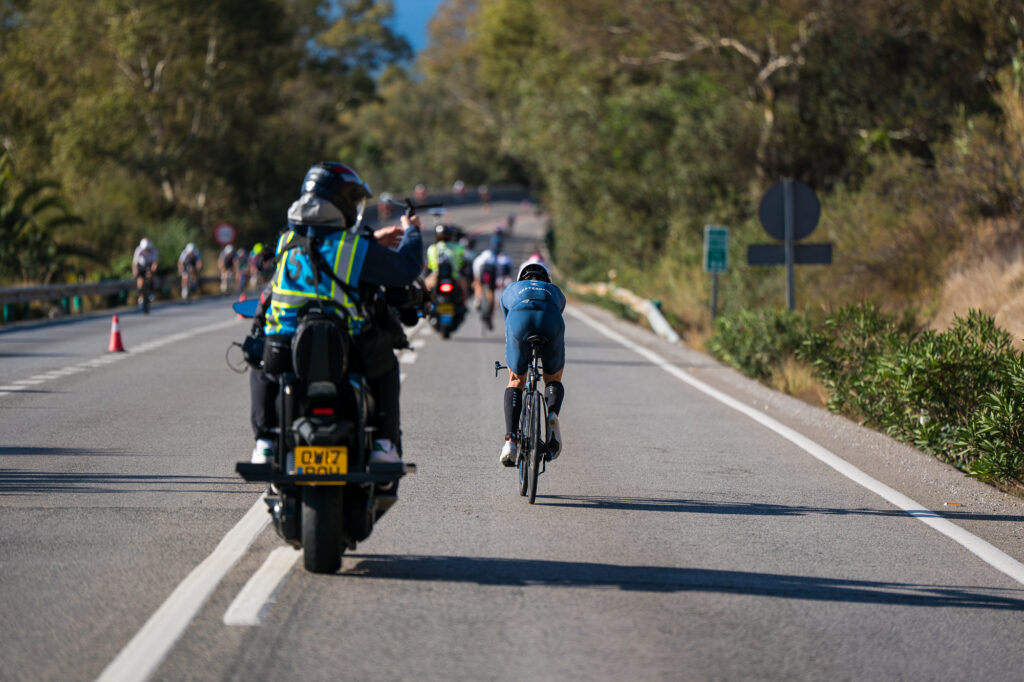
Athletes on the course at the IRONMAN 70.3 World Championship Marbella. Photo: Kevin Mackinnon
This week IRONMAN is doing a series of tests in Tucson, Arizona with a number of pro athletes “to test theories and simulations using real world conditions … with an end results that demonstrates to what degree there is meaningful impact between different draft zone distances and how they affect the race dynamics, including course density within IRONMAN and IRONMAN 70.3 events,” according to a release sent out earlier today.
IRONMAN has brought in aerodynamic expert Marc Graveline to help with the process. We wrote about Graveline and his innovative “Gizmo” aerodynamic testing sensor earlier this year.
Graveline doesn’t just work with triathletes and gravel riders – he also works with various World Tour cycling teams.
“I am excited to work with IRONMAN in collaboration with RaceRanger and professional athletes to apply technology that can accurately measure and understand the impact of draft zone distances,” Graveline said. “This data will be fed into sophisticated models that incorporate historical riding data and key factors such as pass times and slotting in, enabling a deeper understanding of how drafting impacts athlete performance.”
According to the release, the testing in Tucson this week includes six pro athletes and is being done “at IRONMAN 70.3 race pace speeds and wattage.” The various test runs include 12-, 16- and 20-meter distances. The bikes will be set up with the RaceRanger sensors in order to monitor the specific draft-zone distances.
“During the various testing runs, rider positions will be exchanged to examine how the size difference of riders may affect power data,” IRONMAN’s release stated. “Data computed from the baseline CdA will be compared to the data from the group test and can determine power savings at the various positions and distances. The data will then be used to approximate power differences at other race speeds as well. Once the data is produced, a team will review and determine other potential testing necessary.”
Further testing will be done in 2026, and data will be analyzed to come up with “the optimal draft zone distance that can be applied consistently across all events that host professional and age-group athletes.”
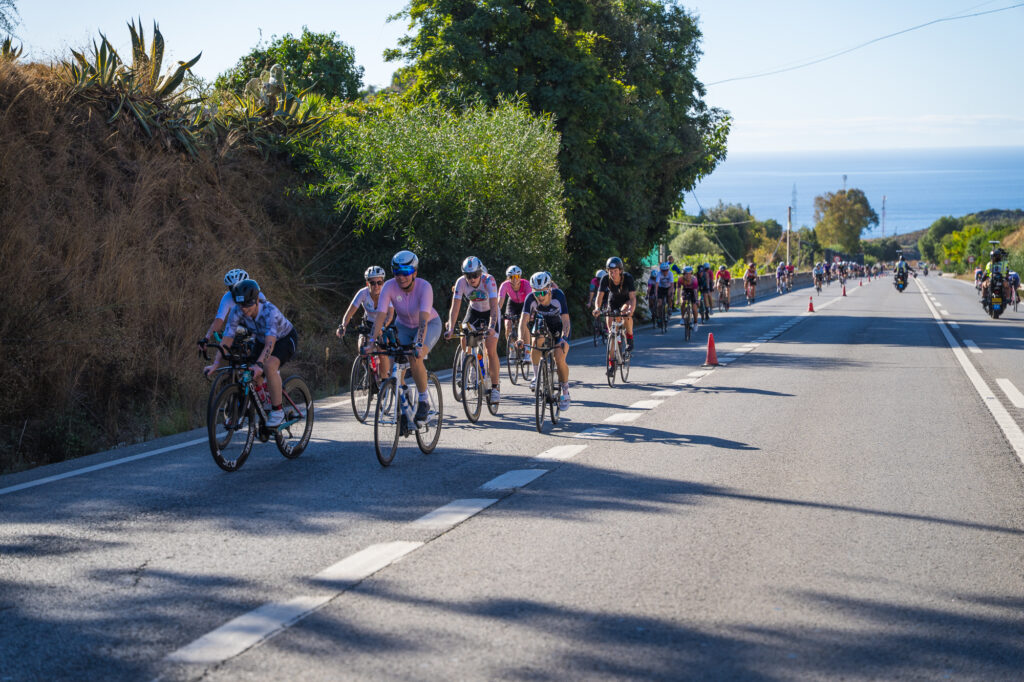
Age-group athletes compete at the IRONMAN 70.3 World Championship in Marbella, Spain in November, 2025. Photo: Kevin Mackinnon
Of course one of the key factors in any decision for IRONMAN races will be the number of athletes out on the course. As the photo above demonstrates, a large, competitive field (the 70.3 world champs, for example) racing on a narrow course can see some bunching at various times. According to IRONMAN:
Other key operational factors, such as course density, professional and age group start protocols, and race-course logistics, will also be considered as part of the decision in determining the optimal draft zone for our athletes. Any changes will be shared and could include both changes to the distance and time allowed to pass.
Since 2015 professional athletes at IRONMAN events have utilized a 12-meter draft zone, and that same zone has also become the standard for age group athletes. (See the 2025 IRONMAN Competition Rules.)
This isn’t the first time IRONMAN has done testing around draft zones. Former CEO Ben Fertic enlisted then sponsor Ford to help do some testing in the company’s wind tunnels between 2005 and 2008. There’s long been a push from pro athletes for a larger draft zone, which is why the Professional Triathletes Organisation has utilized a 20-m draft zone at its professional events, with age-group competitors using a 12-m zone. Challenge-Family events also utilize a 20-m draft zone for the pros, and also use the same zone at some age-group races as well. Today’s announcement no-doubt comes, in part, because of the pressure on IRONMAN to follow suit with a larger professional draft-zone at its races.
“The conversation related to the impact of different draft zone distances has been a topic for many years, and today it is a topic that many athletes care deeply about,” said Scott DeRue, CEO for the IRONMAN Group. “By bringing in outside expertise to do scientific testing, we are not only listening to the interests of our athletes, but also putting in the work and resources to test different models and simulations with real world conditions to understand the full impact of race dynamics for our professional and age-group athletes.”
IRONMAN events typically have much larger fields than T100 or Challenge-Family races (Challenge Roth being one of the exceptions, of course), which would make a 20-m draft zone for the entire field seemingly a challenge, especially on looped courses.
Tags:
draft-detectiondraftingIRONMANIRONMAN 70.3Marc GravelineRace RangerRelated Articles:


Continue the discussion at forum.slowtwitch.com
211 more replies




I’m glad that they’re testing it but the one thing that I hope comes out of this is that we don’t all automatically rush to the conclude that the optimal race distance should be where there is minimal draft benefit.
Just because there’s draft benefit at a certain distance, doesn’t mean we need to automatically eliminate that benefit. What we’re actually looking for is the optimal race dynamic, which is a separate point from whether or not there’s benefit.
I know that the sport was founded on the assumption that 12m means that there is no benefit, but we all know this to be false, but that doesn’t mean that the race dynamic is broken. I mean, can anyone tell me the last world champs that was a boring race? It would seem to me that the desired race dynamic is already happening. We’re getting engaging, interesting races at the highest level - so what’s broken exactly?
The other point I’ll note is that this may also mean that men and women get different draft zones, or at the least, the rules need to be written to include women as well. We can’t just say that MPros get x% draft benefit, and we desire y% benefit, therefore we’ll set the distance to the MPro standard.
I agree with what you wrote other than the different distance for men v women. While that makes sense, it’s too complicated and messy. And will just lead at some point to “why can’t we have that too” and accusations of sexism etc that are just a distraction to deal with. Inflexible consistency in the rules might not always be ideal, but in this case it would be preferrable in my view.
Now, where I worry about this draft zone test thing is how it encourages such strong populism on the issue in a sense, and I fear Ironman will get rushed and pushed into making a decision that as you point out will make their races a little more boring, with no clear cut justification as to why. The bike leg of a 70.3 or an Ironman just is not broken.
Give out some penalties a little more frequently, deal with the grief that comes your way when you get it wrong, but that’s officiating.
The other area I worry about is the temptation to extrapolate results that we cherry pick. “For this slice of time, we observed this benefit” DOES NOT EQUAL “therefore an athlete saves X amount of time or watts across the entire race”.
All that it means is simply, that occasionally, an athlete can receive up to that benefit. Sometimes it will be less. And sometimes, they will let the race slip away from them (Kat Matthews nearly did) as they play the wrong hand.
There are all kinds of changes in terrain, weather/air, who is in the group, equipment, what’s around you, passes being made, body position, etc. that are going to influence things with this number they supposedly spit out. The reason why I get a little annoyed at PTN constantly beating this hobby horse is because they assume away all of that nuance and just focus on what they care about with no tradeoffs.
It’s literally the tactic of a straight up rabble rousing populist.
Agreed, which is why im glad they are saying they are going to look into the data in 2026. That right away pushed back on any people that are going to demand an immediate change. I still hope once they do come up with their conclusions they test them in non pro-series races supported by RR. They don’t have a lot to lose there since they arent broadcasting those so we it won’t impact spectating.
How does sitting in a time trial test change your position vs knowing you have to run for your life once you get off the bike?
Like, I find it fascinating, that this test is going to do anything, when we have results like this from actual scientists with truckloads of money behind them:
This doesn’t mean we can’t trust any data, but it does indicate why testing things is so hard.
Sorry, I don’t understand your point.
I wasn’t specifically responding to a question you raised, but the idea of this test in general being relevant in a way that can extrapolate to all other races is really a stretch. I don’t think you can do a proper trial test to say, “this is what is happening in all races” best case they can say, “this is what happened in this circumstance”. But these guys aren’t doing this test in Tucson where they will be running for dough. They know they are part of the test. Are they hitting aid stations and so on.
There’s a reason why so many trials fail after the “evidence” is rolled out into widescale implementation when everyone know what is being trialed.
Ahhh got it and agreed. Trials and test should on inform real world application on a test basis. Which is why I strongly hope they use it in non-Series RR races to test real world application of their findings. Then if their findings hold true test it in a few Pro-series races in a slow ramp to any final implementation. They gain nothing from rushing to make a change without being really sure it works well.
Glad they are doing testing and glad @marcag is getting paid, but pretty sure he could tell them the results without having to do any of the testing.
What I’m missing here are the words ‘drafting penalties’ and ‘enforcement mechanisms’. It is a bit ridiculous that the penalty for yo-yoing into the draft zone and forming outright pelotons is nominally the same. A 3 minute penalty may be an appropriate punishment for pros who are racing with RaceRanger, but is probably not a sufficient deterrent against instances of shameless drafting among age groupers, especially since the likelihood of getting a penalty for it is pretty low in the first place. Roving technical officials on motorcycles also don’t seem like the most efficient way to enforce anti-drafting rules among thousands of competitors on the bike course at the same time.
Of course, Ironman probably has a financial incentive to not clamp down too harsh on drafting violations among age groupers…
I don’t think we need to give men and women a different draft zone, but that we need to account for differences when determining rules. Maybe it’s just that they split the difference?
But really, if they determine that the ideal zone is 15m, I’d still be in favor of keeping it 12m if for no other reason than, “tradition!” of how it’s been done so long on the island.
My thought being that let’s say they determine that 15m is a decent trade off, my response is you’re talking about a marginal change on a marginal issue being more important than maintaining a historical precedent and better race dynamics.
I think the concept of the road reflectors in Kona is a fun piece of history. A baseball bat can be created any size and we can argue over the length but it’s been standardized for 100 years.
Yes rules can change, and many do. Maybe you can argue this is one of them. But ultimately it’s misplaced in the perceived “fairness” as discussed elsewhere and the impact is not guaranteed to be better. Indeed, nothing in the T100 races have shown us it’s better. I assume at 12m the men and women’s final would have been more interesting!
He was just jealous of @rrheisler’s tests on hookless.
They’re sticking with 12 then. No way they’ll apply 20 m to age group fields.
What is the source of this info? Podcasters keep harping on about Challenge allegedly separating pros by 20 m, but it only applies to the Championship AFAIK.
Edit: not only. Checked a couple of race guides. Challenge Peguera-Mallorca has 20 m for the pros. Challenge St. Poelten has 20 m for everyone.
It will be interesting to see who will be less akward to deal with ironman or slowtwitch ( which he left as the establishment wore him down )