
Are We In the “Find Out” Phase of Super Shoes?
If the past month of running performances across IRONMAN events and World Marathon Majors has proven anything, it is that there is no denying the performance benefit of carbon-plated running shoes. At IRONMAN Texas, we saw Kristian Blummenfelt nearly break the 2:30 barrier in the marathon, with four other men joining him under the 2:35 mark. John Korir obliterated the course record at the Boston Marathon, running 2:01:52; the other podium finishers (Felix Simbu and Benson Kipruto) also would have broken the prior course record of 2:03:02.
And then, of course, there was this past weekend in London, where Sabastian Sawe and Yomif Kejelcha smashed through the two hour window for the marathon. Sawe set the new world record, running an astonishing 1:59:30; Kejelcha followed a mere eleven seconds later. They did it wearing the $500 Adidas Adizero Adios Pro Evo 3 – the latest and greatest version of the three-stripe brand’s super shoe.
It has been an arms race with shoes for the past decade. Nearly every brand has some staple racing shoe that follows along the formula that Nike innovated with the Vaporfly: light but rebounding foam; carbon-plate; upper that holds you to it as best as it can. And by every brand, I quite literally mean it; new brands are sometimes starting with their racing shoe and then moving to the everyday footwear. I’m in the process of testing a couple of pairs from Mount to Coast, where innovation started in their racing platforms before moving to their training shoes.
But is that innovation coming at a price? According to a lawsuit filed by two-time world champion and four-time NCAA champion Abby Steiner, the answer is yes — that price can be catastrophic injury.
Steiner, who won gold at the 2022 World Athletics Championships as part of the 4 x 100 and 4 x 400 relay teams, filed suit against Puma and its subsidiaries on Friday, April 24th, in Massachusetts Superior Court. The suit alleges that Steiner was “seriously injured by products designed, engineered, tested, developed, manufactured, advertised, marketed, promoted, imported, sold and distributed” by Puma. Specifically, the suit calls out “running shoes that had carbon fiber plate…and/or NITROFOAM…technology.” The suit gives examples as the Deviate Nitro Elite 2 and 3, the evoSpeed Tokyo Nitro, and the evoSpeed Tokyo Nitro 400M.
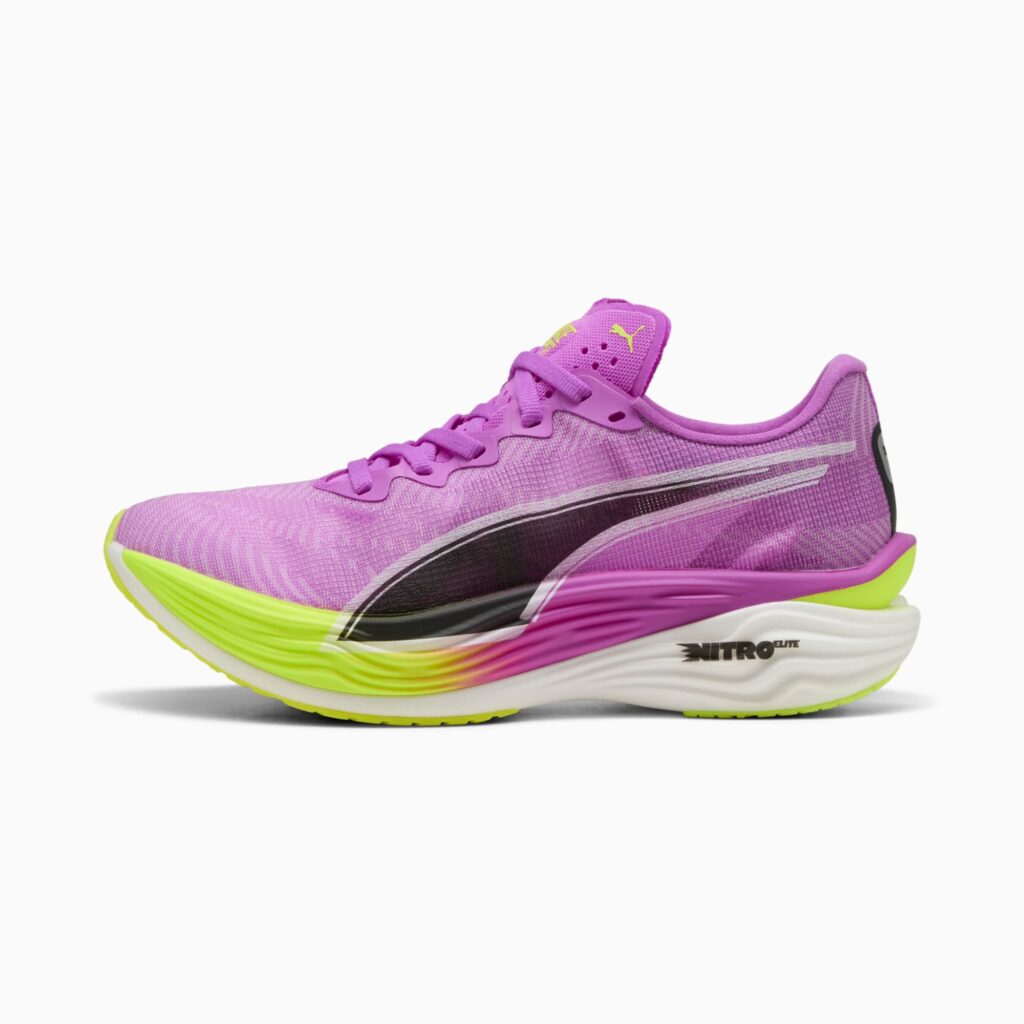
The suit alleges that Puma was “aware that the…shoes had defects that made them unsafe, unreasonably dangerous, defective and capable of causing injury and harm to consumers during ordinary, anticipated and foreseeable uses” and that they were under obligation to report these defects to the U.S. Consumer Products Safety Commission.
Steiner signed with Puma following her breakout 2022 campaign, where she earned the double gold in relays at the world championships. She’d also taken two golds at the NCAA Championships that year, and added another win in the 200 meters at the USA Outdoor Track and Field Championships. The deal was reported to be valued at the time in the vicinity of $2 million.
Shortly thereafter the signing with Puma, Steiner suffered her first foot injury and surgery. She attempted a return for the 2024 Olympic Trials, where she would finish sixth. Shortly thereafter, though, she would undergo additional surgeries for bone a torn Achilles, a Haglund’s deformity, and other injuries. The suit alleges that “her use of the Puma Shoes for training and in competition” resulted in “severe and permanent injuries resulting in multiple surgeries, rehabilitations, and recovery.”
The suit cites eleven different factors that make Puma’s shoes defective. They are:
- “They alter the biomechanics of runners predisposing them to risk, injury and harm;
- They alter the manner in which the stresses of running impacts the human body;
- They cause bone stress injuries;
- They increase the risk of suffering injury, harm and damage;
- They cause extreme, abnormal and irregular stresses and strain on the body and feet of runners;
- They change a person’s foot and ankle mechanics resulting in an increased risk of injury, harm and damage;
- They cause extreme strain and stresses on the feet, bones and connective tissue in the feet;
- They cause fractures, stress fractures, inflammation, the development of bone spurs, Haglund’s and other injuries;
- Any alleged benefits of their design are outweighed by the risks and dangers associated with the design;
- Safer alternative designs existed that do not present the same risks associated with the Puma shoes; and
- The likelihood that runners were aware of the risks associated with the…design is low given they were designed, developed, marketed, promoted, advertised and sold to be appropriate for running and had no warning or indication these risks existed…”
Steiner is the largest name to have sued a shoe company over their carbon-plated footwear. Former Division I athlete Heather Cerney sued Nike in November, alleging injury over her use of that brand’s AlphaFly shoe. That case was referred to private alternative dispute resolution in February of this year, with a trial date set for May 10th, 2027 if a resolution is not otherwise reached.
Tags:
PumaRun ShoesRelated Articles:


Continue the discussion at forum.slowtwitch.com
10 more replies



Anyone know the result of the other college runner who did similar? I believe it was vs Nike
Give me about 30 more mins and it should be on the front page.
So its the shoes. And the soft fat tires and exposed brakes on the bikes. And the faster skis although they had to replace high fluoro. Oh come on … nobody is that naive.
Man, considering all my Injuries over the years I should sue too, I’d be a millionaire. Both athletes had injury issues prior to the shoe they are suing…
IIRC, Steiner tore an ACL when she was younger, then had a good 2021, outstanding 2022, signs with Puma and the shit starts hitting the fan.
This all said – I think it’s probably reasonable that carbon plated shoes change load on the body compared to running in non carbon plated shoes. The question is whether that change is extreme enough to warrant some type of waiver / risk assumption before purchasing and use.
Sugarman has a major track record in MA on these cases. Puma will probably move it to federal court if they can. But Steiner’s got the “right” lawyers for this type of thing.
I guess this is a case of , only in the USA … it’s a bit like I did not know hot water could burn me …( if you are over the age of 6 )
I don’t know, EU product liability laws can be pretty stringent. The issue there tends to be limits on damages for plaintiffs.
Aside – because you allude to it – in that whole infamous case, McDonald’s was serving its coffee at over 190 degrees; they’d been warned not to serve it at that temperature; it’s reasonably foreseeable that somebody will spill that temperature of coffee on themselves; the lady in question in the lawsuit suffered third degree burns; she’d originally asked to settle for the cost of her medical care; the jury award for punitive damages was later overturned, but she still received compensatory damages.
IMHO – with regard to the run shoe debate, I wonder whether there’s going to be assumed risk read into the activity (much akin to, say, skiing), which will make it far harder to create the causal connection between the shoe and the injury.
Can she really prove it was these specific shoes (vs another specific pair of shoes), and not just “runners get injured all the time?”
the only thing I will say is that any change of running shoes has never changed the amount of injuries.
the biggest factor of running injuries is training load and nutrition. and in fairness we had a pretty good idea what carbon shoes do by 2022.
That’ll be the jobs of her attorneys – and, as I think I mentioned, she’s got one of the strongest product liability plaintiff side firms representing her. If anybody can tie it together, it’s them.
Though in order to prove that super shoes cause injuries, they’re going to need data - not just her - that proves that these shoes are somehow more injury prone than traditional shoes. Ideally, you’d want 1000’s of runners tracking their shoes and their injury rates, but I suspect the bar here will be lower
The disconnect here though is that the almost universal anecdote of supershoes is that they allow you to run more kms in training - which would seem to suggest that the injury rate is lower (at least per km).
Today’s reminder that not a lawyer, just a guy who went to law school and probably should’ve taken the bar exam but didn’t –
Disclaimer out of the way, no, I don’t think they’re going to need to prove that they are generally more injury-prone than other shoes. I think they’re just going to need to show that the load stresses are different and can lead to more specific types of injury at a different rate than that of “normal” shoes. See also: the Vibram Five Fingers and other minimalism shoe lawsuits.
Meh, I’d say the majority of the buyers are scalpers who are putting them up on StockX.
I agree with you @timbasile , own several different pairs of super shoes and noticed this article in Triathlon Wire this morning…
I think my approach to using and racing in super shoes was pretty conservative, although, I’ve noticed a couple niggles here and there (achilleas and calf) that I didn’t have before putting some miles on super shoes. As long as I stay consistent with a little mobility/strength/flexibility routine focused on the calf/ankle/foot area(s) I seem to be fine.
Sorry if this article belongs on a different thread.