
SRAM Force AXS: All You Really Need in a Triathlon Groupset
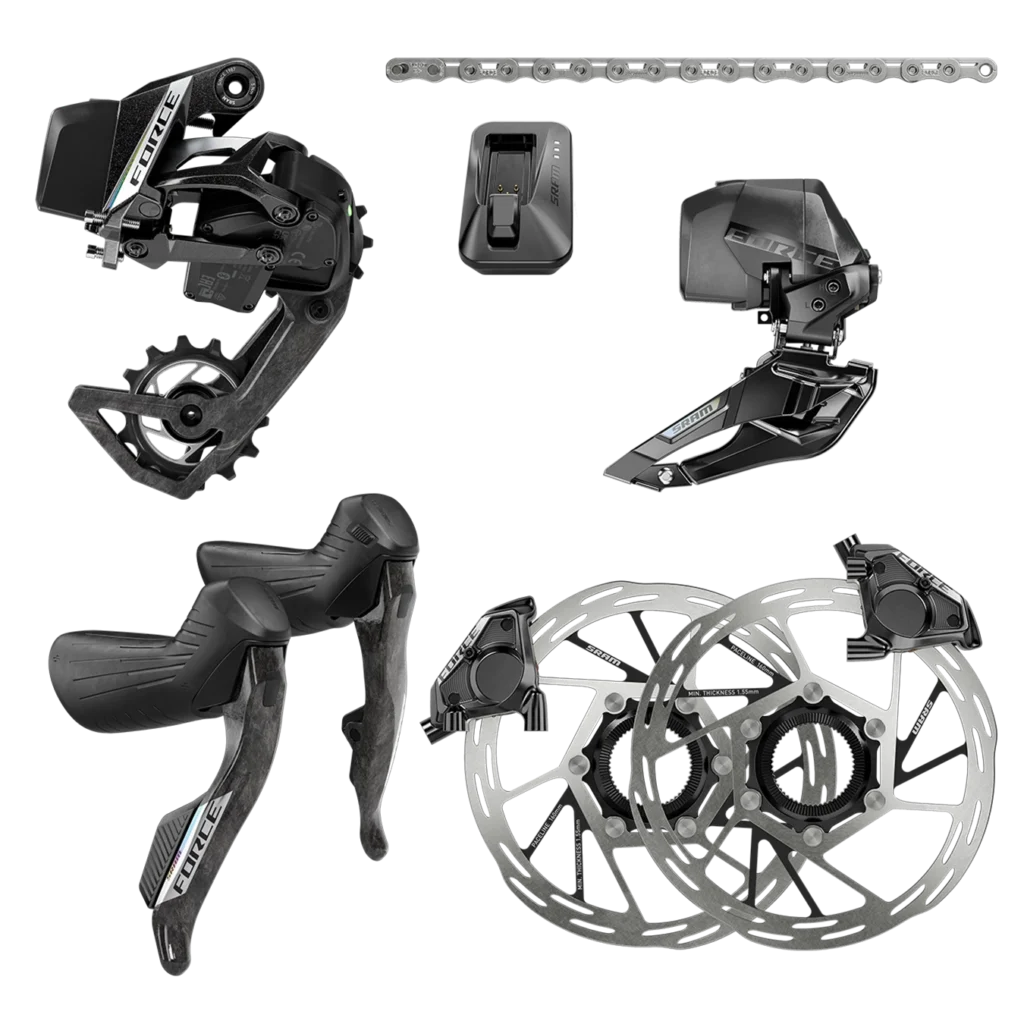
Earlier this year I posted my review of the Ceepo Katana, which I’d had decked out with SRAM’s latest edition of its Force Groupset. SRAM launched the new gruppo halfway through the year, just a few months after it had released the revamped version of its flagship Red components. While Force is a step down from the lighter and brighter-finished Red groupset, it is really hard to imagine why most triathletes need to fork out roughly an extra grand for those benefits. Yes, if you’re at the top of your game and can see how 300 g of weight-savings will help your performance, Red is what you need. Ditto if you’re one of those people who absolutely needs to have the top of the line gear. But I’m guessing that most of us can come up with some cool things to do with that extra money.
As a proviso here, I reviewed the triathlon set up of the Force components, so rather than using the newly designed brake/ shifters that many reviewers raved about, my system came with a couple of sets of blips – more on that later. One of the really cool additions to the new Force shifters are the “bonus” buttons on the inside of the hood that allow for thumb-actuated shifting or controlling ANT+ bike computers.
SRAM Red vs Force — Triathlon 1X Setup
●SRAM Red: — ~$3,500–$4,500
●SRAM Force — ~$2,000–$2,800
(I’ve left some of the XPLR gravel-oriented stats in this chart for those who might be interested in that comparison as well.)
| Spec | ● SRAM Red | ● SRAM Force |
|---|---|---|
| Weight | ||
| Full group | ~1,810 g ★ lighter | ~2,120 g |
| Crankset (175mm) | ~590 g ★ lighter | ~680 g |
| Derailleurs (combined) | ~278 g ★ lighter | ~340 g |
| Materials & Construction | ||
| Crankarms | Carbon fibre ★ premium | Aluminium / carbon blend |
| Derailleur body | Carbon / titanium hardware ★ premium | Aluminium / steel hardware |
| Brake calipers | Carbon-bodied ★ premium | Aluminium-bodied |
| 1X Drivetrain Compatibility | ||
| Rear derailleur | Red AXS XPLR or road 1X | Force AXS XPLR or road 1X |
| Cassette range | 10–44T (XPLR), 10–36T (road) same range | 10–44T (XPLR), 10–36T (road) |
| Chainring options: 2x | 33–54T, various BCD | 33–50T, various BCD |
| Chainring options: 1x | 44-68T | 44-50T |
| Crankarm lengths: | 160, 165, 167.5, 170, 172.5, 175mm | 160, 165, 170, 172.5, 175mm |
| Chain | Red Flattop 12sp ★ premium coating | Force Flattop 12sp |
| Shifting Performance | ||
| Shift mechanism | AXS wireless same platform | AXS wireless |
| Shift speed | Marginally faster actuation ★ slight edge | Virtually identical feel |
| Firmware / app | SRAM AXS app same app | SRAM AXS app |
| Battery life | 20-60 hrs per charge same | 20-60 hrs per charge |
| Braking (Hydraulic Disc) | ||
| Lever feel | More refined blade action ★ slight edge | Excellent, very close |
| Modulation | Improved pad/piston spec ★ slight edge | Very capable, race-worthy |
| Triathlon-Specific Notes | ||
| TT/tri bar compatibility | Blip buttons (AXS) same | Blip buttons (AXS) |
| Aero levers | Compatible with aero extensions same | Compatible with aero extensions |
| Value | ||
| Performance per $ | Diminishing returns above Force | Best performance-to-price |
| Upgrade path | Top of the line — nowhere to go | Can mix Red components selectively |
So, to wrap up the statistical differences, in addition to the lighter weight, Red offers some performance gains on the chainring front, especially when it comes to big front chainrings. Red also offers a 167.5 crank length that’s not available in the Force group set.
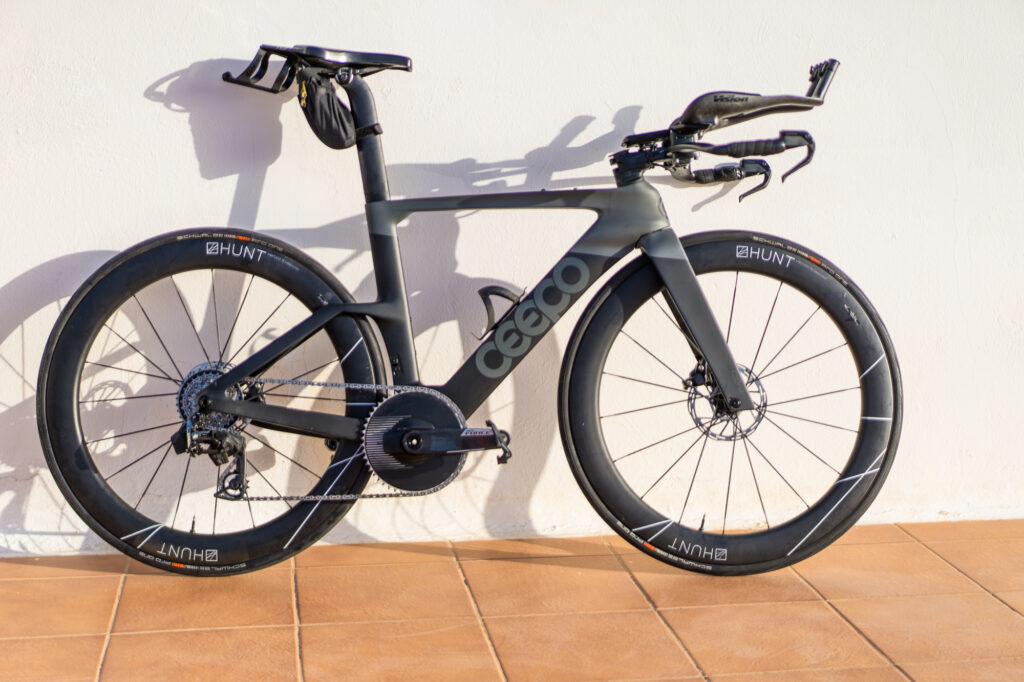
AXS and 1x
For those unfamiliar with SRAM’s electonic shifting, here’s a short primer.
SRAM AXS is the American brand’s fully wireless electronic group set platform that covers road, gravel and MTB set ups. It is available at all three levels of SRAM components – Rival, Force and Red. There are no cables – each component — derailleurs, brake levers, satellite shifters — communicates via a proprietary 2.4GHz protocol, with independent batteries that are interchangeable across the entire ecosystem. Shifting is triggered by pressing both brake levers (or, in my case, blips) simultaneously to change chainrings, or individual levers to move through the cassette. The system is customizable through the SRAM AXS smartphone app, which allows riders to remap buttons, monitor battery levels and adjust shifting behaviour.
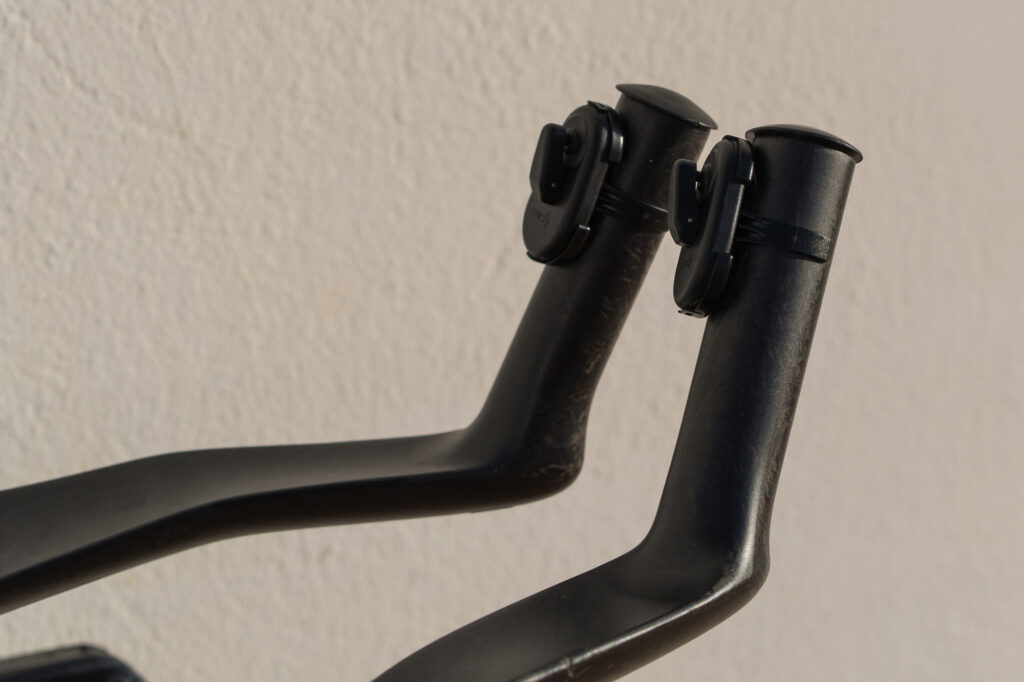
As mentioned, I reviewed the triathlon 1x set up, so there was no front derailleur to worry about and rather than using the shift levers to switch gears, I had a couple of sets of “blips” – one on the inside of my handlebars near the brake levers, and another set at the end of my aero bar extensions.
If you are wary of running just one front chainring, I think, for the most part, you’ll be pleasantly surprised at just how much you can do without that extra ring up front. I’ve long been a fan of the 1x system and had a 54-tooth chainring on my old triathlon bike that I coupled with a 10-33 cassette for any big climbing expeditions, and a 10-28 for my rides here at home that don’t feature any super-long or super-steep climbs. This latest set up, with a 50-tooth front and a 10-36 cassette, was more than enough for even the windiest and toughest days I faced during a training camp in Lanzarote. SRAM has done a masterful job with the cassette set up, so there are five one-tooth jumps in the sweet spot of the gear ratio, so you’ll find you have all the options you’ll want for the majority of your riding, with the option to go super easy or very hard when the terrain dictates.
My set up came with two pairs of blips, so I had access to shifting both while sitting up with my hands near my brakes, and also down in the aero position. The blips don’t require a blip box like the older AXS system – you pair the blips with the rear derailleur and off you go. Set up was very easy through the SRAM AXS app, allowing me to customize which blip controller did what, and it took me no time to get myself sorted and out on the road.
The crank included as part of the Force 1 AXS Power Meter included 165 mm crank arms (shorter is better these days – when I raced I rode 180 mm cranks and the shortest I’d been on prior to this was 172.5) was also really easy to set up with the Karoo head unit I was using, offering all the data I could want and need, including right and left leg power balance.
On the Road
Before I describe getting out on the road during a winter training camp in Lanzarote, I did want to mention that one of the big advantages I’ve always enjoyed about SRAM’s AXS technology is its ease when it comes to traveling. Yes, you still have brake cables to deal with when you take your bars off, but the wireless shifting means those are the only cable you need to worry about. (I would suggest that you pop the blips out of the brackets for the trip – on the way over to Lanzarote one of them popped out and it took a bit to find in the bottom of my bike case.)
OK, so on to the big question – what is it like to ride the Force components.
As per the title of this article, there’s not really anything but great things to say about riding with Force. Every thing just works, and works extremely well. Braking is smooth and efficient. Shifts are crisp and quick. You feel like all the power you put into the cranks helps move you forward. To be honest, the best thing I can say about the system is that you quickly forget about it and take for granted that everything you ask of your bike is just going to happen. I haven’t ridden the new Red gruppo, but I will say that this group set performs so much better than my roughly 10-year-old Red components that I had been riding.
SRAM fans will love the new Force gruppo and appreciate all the performance built into it. For those who haven’t used SRAM components before, it is definitely worth a look. If you come across the bike you like and it’s armed with Force, there’s absolutely no reason not to jump at it.
SRAM’s Force group set was met with rave reviews by just about everyone who got hold of it last year, and I can’t really find anything to dispute their takes. The only downside, for me, is that I am just not any sort of a fitness level that could in any way justify having the flagship Red components on my bike. I guess that could also be an upside – it gives me something to work towards this summer.






Dumb question: how does “Pure performance with no compromise. Force AXS builds on the design of previous generations, taking our fully wireless technology and adding refined ergonomics, effortless braking and further AXS integration” not contradict “brake cables?”
Brake hoses are not “wires”. Hose-less or cable-less brake systems do not exist.
Brake by wire seems to exist for cars already. The primary brake piston being actuated by an electric motor.
I would’t dare to state that it is not possible in the future for bicycles. But you’ll need more power and more stored energy than for derailleurs.
All I hear from my friends with SRAM are issues with charging, battery contact points and updates.
In 7 years of Shimano Di2 on multiple bikes I’ve never thought about it other than charging (every 6-12 months on 11 speed and 1-2 months on 12 speed).
I have multiple of both bikes and this is completely accurate. When it works, its great; and it certainly makes travel super easy. But I’ve had numerous charging/contact issues with multiple bikes and batteries, and I now carry a spare battery whenever I’m on my gravel bike to avoid getting stranded; this was never a concern with Di2.
That said, it looks like Shimano is going the “full wireless” route for the new groupsets, which I think is a mistake. A lot of people like the big battery that is completely hidden and needs charged every ~6 months. It’ll be a shame if they mimic Sram in that aspect.
I have two bikes with SRAM AXS components. Been using the AXS groupset for most of this decade. I purchased a spare battery before I installed the parts, knowing it was prudent to have a charged spare in case. I don’t see a charging problem. Charging any device is an inconvenience. Always will be. I upgraded my phone last year to one with a longer lasting battery, but I knew my previous phone had a relatively short charge capacity because it was a folding model. People should be aware of the hardware requirements and limitations well before making a large investment.
When I purchased my Andean several years ago, it came equipped with a Dura-Ace R9170 groupset. After I took the bike out for the first couple of rides, I knew I had to rip this group out and replace it with AXS. I did not like all the wires and the big internal battery, which was hard to access in the deep storage area above the BB. Aside from the crank, the DA parts have been in my spare parts bin since. Even if the battery only required one charge every decade, would that have changed my mind? Never. Charging to me is like muscle memory; it’s something that’s reflexively done without much thinking.
Updates are mostly a non-issue unless you absolutely need a new feature. You’re not forced to do them. It never changed my experience one way or another. I’m long overdue for an update. Haven’t updated since last summer, and it hasn’t affected anything that I noticed. We all have our preferences. Those people who don’t like eTap groupset idiosyncrasies should simply switch to a brand that offers an experience best suited to them. The only thing that pisses me off regarding SRAM is the UDH dropout mandated for their new groups. Forced unnecessary obsolescence makes me rage.
I’ve got the group set since shortly. Shifting functions great.
The batteries don’t last very long indeed. But therefore you have the great feature that the front and rear batteries are the same. You can swap them so you always get home. Also easy to fly with if you want to take the batteries in hand luggage.
The chain is proprietary and I read once it is 1 or 2 Watts slower than “normal” chains, but that’s a minor issue.