Meet the Man Who Ran 21 Miles with His Bike Before the Marathon at IRONMAN Kalmar
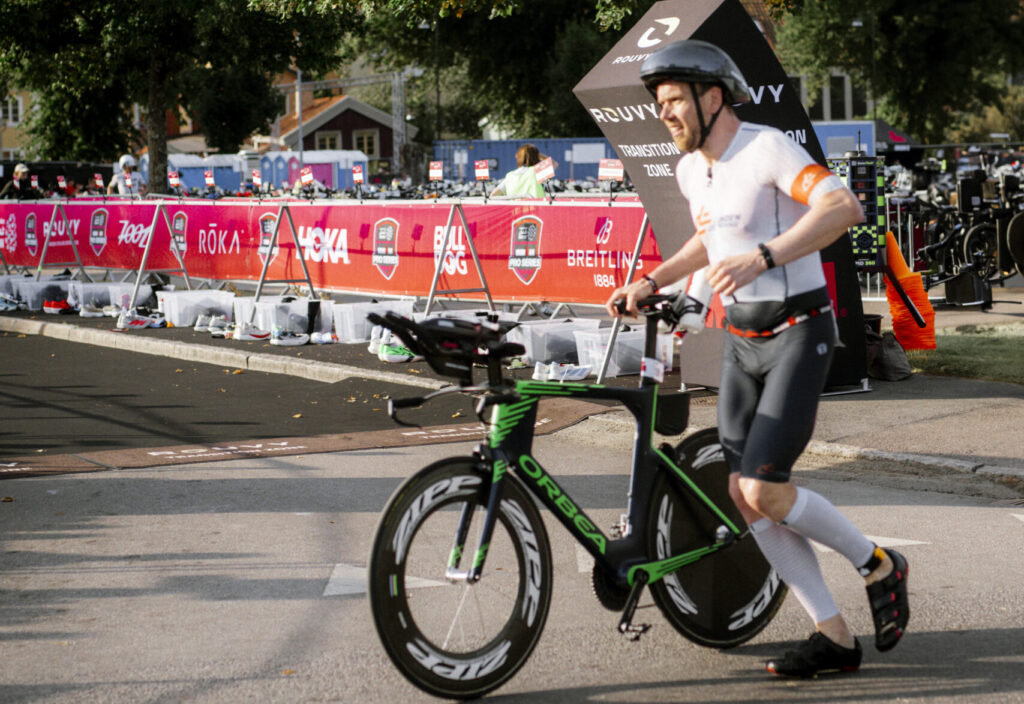
When competing in triathlon, anything more complicated than a flat tire in a race likely means it’s the end of your day. It’s not the Tour de France, so you don’t have the luxury of being followed by a team car with spare parts, wheels or even a different bike. There may be a mechanic floating around the course, but there is no guarantee that they can help you.
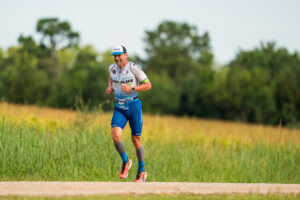
Many people left stranded on the bike course of a triathlon will call it a day and hitch a ride back to transition. There are some people, though, who refuse to even consider that option. André Du Rietz is one of those athletes. After breaking a tire valve at IRONMAN Kalmar on Saturday with 21 miles left to go on the bike, he started running. He ran right to T2, racked his bike, then carried on for the full marathon. He crossed the line a little over five hours later, and although his result was far from what he had hoped for at the start of the day, he still laid down a performance he can be proud of — and one that turned a lot of heads.
Bad Luck
Du Rietz is in his second life as a triathlete. He first tried the sport over a decade ago, starting his career with the goal of racing the IRONMAN in his hometown of Kalmar. He was set to compete in the 2013 edition of the race, but after collapsing at the finish line of a warmup event just two months before the IRONMAN, he was diagnosed with a heart infection.
“I obviously didn’t race that year,” he says. “So I did it in 2015 instead.”
With an IRONMAN checked off his bucket list, he “pretty much quit triathlon” and turned his focus to other endurance challenges. In 2016, he set off to “cycle around the world,” but a knee injury forced him to call that journey off by the time he hit the Mediterranean.
After that, Du Rietz drifted away from the sports altogether, but after a few years, he says he looked in the mirror and didn’t like the level of fitness that he saw.
“I was dissatisfied with my health and I gained a lot of weight so I started running a little bit,” he says. “I enjoyed it and thought maybe I would do the IRONMAN again.”
He bought a bike, did a half-distance race to get back into the swing of things and then signed up for Kalmar once more in 2024. He was all set to race, but he crashed his bike just one week before the event and broke his collarbone. That delayed his return to full-distance triathlon another year, but even that race was put in jeopardy after he developed another infection.
“I had an airway infection for three months,” he says, laughing about it now. “I almost wasn’t able to do it.”

Du Rietz didn’t train from April through to July. It was only weeks before the August race that his doctor gave him the green light to resume training. For most people, months off of training ahead of their IRONMAN comeback would be a recipe for disaster, but Du Rietz managed to piece together an impressive 9:06:51 finish. This result flipped a switch in his head, he says, and suddenly he believed he could reach new heights as a triathlete.
“I never thought that I was good enough to qualify to Kona,” he says. “I did not grow up as an athlete or anything. Up until recently, I didn’t even view myself as an athlete. It had never dawned on me that it was a possibility [to make it to Kona] until last year.”
As impressive as his 9:06 was, it wasn’t enough to qualify in the men’s 30 to 34 age group last year. However, he says he believed that he could go even faster this year, assuming he didn’t have yet another stroke of bad luck ahead of the race.
Kalmar 2026
Going into the race on Saturday, Du Rietz had a goal of 8:30. Based off of last year’s top results in his age group, he figured this time would be enough to secure him a spot in Kona. It was a lofty target, but the day got off to an excellent start.
He was seventh out of the water in his age group after a 56:37 swim split (a full six minutes quicker than his swim in 2025). On the bike, he flew through the field, eventually making it to second place among the 30- to 34-year-old men.
“I was holding second place doing about 20 to 30 watts below what I had planned,” he says. “I was saving myself for the run because I knew that was where the race was going to be decided.”
He was in a great position, but with only 21 miles to go on the bike, he got a puncture.
“I was running a tubular,” he says. “I don’t recommend that.”
He had a canister of inflation foam on him, but a combination of stress, rushing to get the job done and a clunky setup with the can and his disc wheel led to him snapping the valve and escalating the situation from a minor inconvenience to a disaster.
Once again plagued with bad luck, Du Rietz says he didn’t lose his cool. He knew that he was a mile or two from a village, so he decided to run there with his bike with the hope that volunteers would be able to call the on-course mechanic to come help him.
“I thought they might have a spare wheel that I could use,” he says. When he got to the town, some volunteers contacted the mechanic, but they said to “keep running” and that they would meet up with Du Rietz down the road. Faced with no better option, Du Rietz shrugged and carried on. The course took him to a turnaround, and by the time he looped back through that same town, a marshal caught up with him and reached out to the mechanic again.
“He said they were on the other side of the course and that it was going to be one and a half or two hours before they could reach me,” Du Rietz says. “I was like, ‘I guess I’m going to be running.'”
Running in his bike shoes, he covered 21 miles to the transition zone. After around two and a half hours, he finally made it to T2 and, although his feet were raw and bloody and his body ached from holding his bike in the same awkward position the whole way, he “never thought” about quitting. Instead, he put on his proper running shoes and set out on the marathon course.
With a final bike split of 7:46:59 (just 45 minutes short of what he had hoped to do for the entire race), Du Rietz’s pre-race goals were well and truly obliterated. With that in mind, he says he focused on having fun throughout the run instead of wallowing in his disappointment.
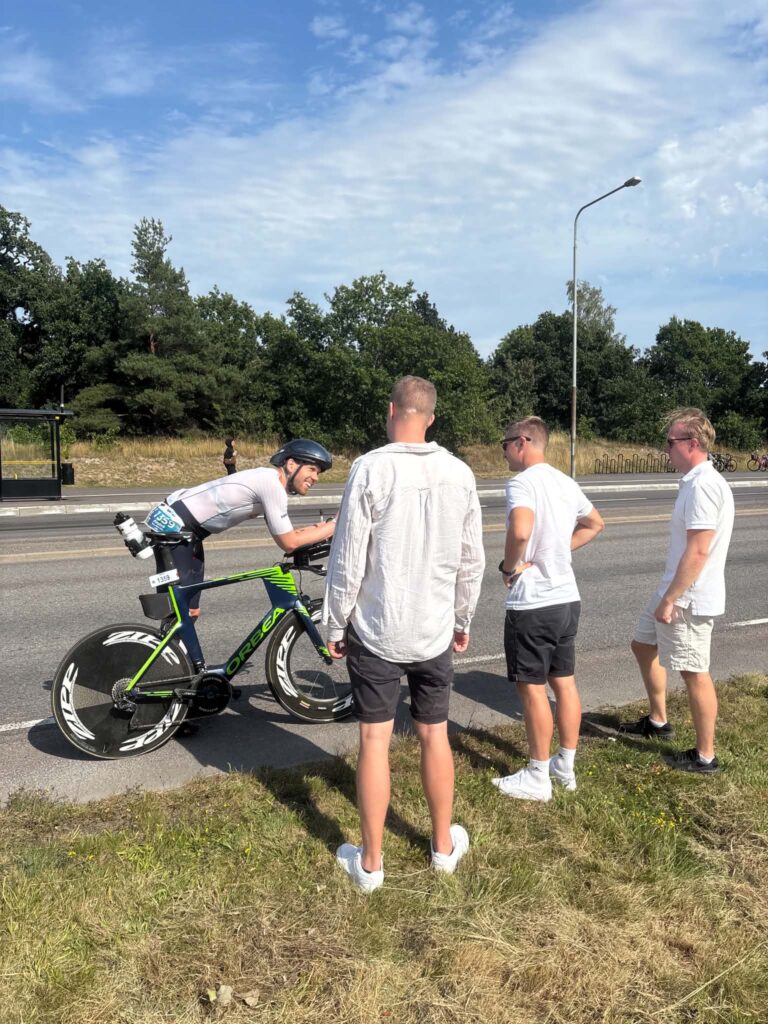
“I was like, ‘I’m going to get the best out of this,'” he says. “I ran to one group of friends and stopped and told them some jokes about what happened, then ran to another and did the same. That kept me going.”
Du Rietz’s positive attitude carried him to a 5:17 marathon and 14:22:31 overall finish. The result was far off what he had hoped to achieve ahead of the race, but he says he is still “very proud” of what he accomplished.
“I’m just happy that I managed to do it, because I have DNFed so many races because of sickness and injuries and crashes,” he says. “That was also going through my mind during the run with the bike. It wasn’t what I had planned for, but reaching the finish was still in my control. I just had to suck it up.”
Du Rietz may not have qualified for the IRONMAN World Championship on Saturday, but he is not discouraged. He says he already has IRONMAN Hamburg on his calendar for next June, and he also has a return to Kalmar planned yet again.
He says he hopes one of those races will deliver that long-awaited Kona slot he has been looking for — and maybe a little bit of good luck for once. He is certainly due for some at this point.