
ENVE Launches the SES 6.7 PRO, Focused on Road Racing Glory
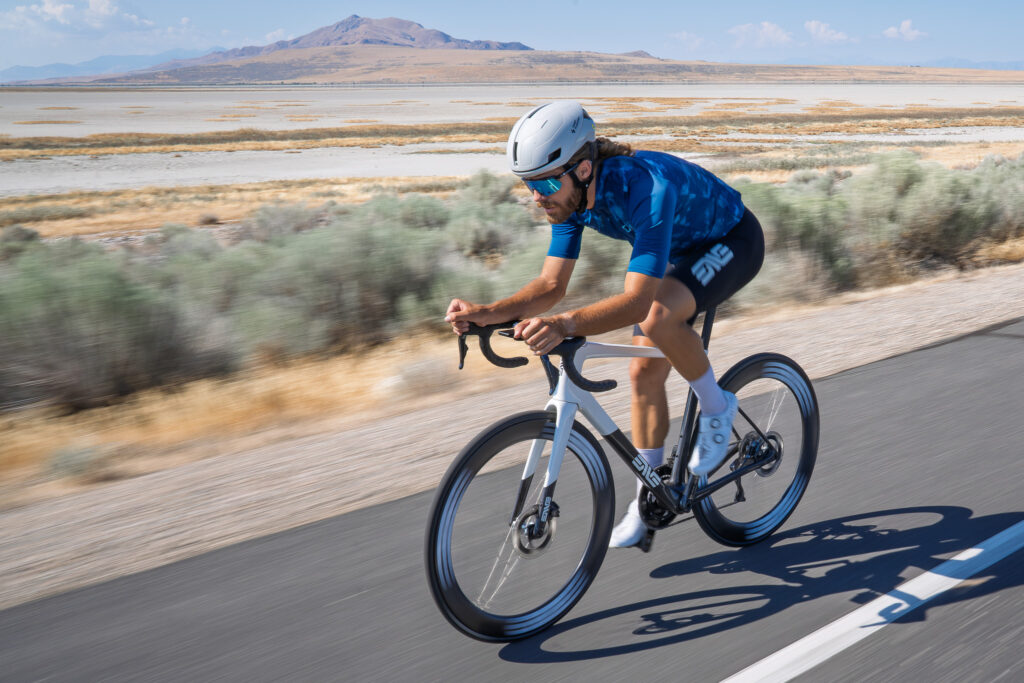
ENVE has worked with UAE Team Emirates since 2023, when the WorldTour team conducted in-house testing and discovered that ENVE was fastest on the road, in the wind tunnel, and preferred by their team riders, including Tadej Pogačar. When you sponsor the greatest road rider of the current generation of cyclists, that comes with a great deal of responsibility. You need to offer them, and in turn, your buying public products that conform to their preferences.
It also means that you need to confirm to the UCI rulebook. And it’s that labyrinth of a document that, in part, informs some of the decision-making that you find in today’s launch, the SES 6.7 PRO. In fact, it’s all over the release the ENVE has about these wheels, calling them “ENVE’s fastest UCI-legal wheelset.”
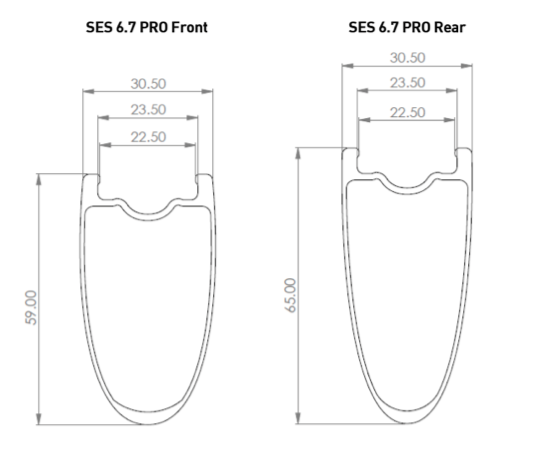
The 6.7 SES PRO was created in response to the UCI’s rim-depth regulation changes that took effect earlier this year for mass start road races (the time trials naturally get an exception). That change means that there is a maximum rim depth of 65 millimeters. In ENVE’s case, after the announcement, the company decided to develop an entirely new front and rear rim shape to optimize the aerodynamics at that depth, rather than attempting to modify the prior-generation SES 6.7. The result of that effort means you find a 59 millimeter front rim profile matched with a maximum 65 millimeters in the rear.
Why not matched depths, you might ask? According to ENVE, it’s a result of optimizing SES rims specifically for their respective positions on the bike. Stability in wind conditions are also a key input, alongside outright drag reduction. Aerodynamicist Simon Smart, who has worked on ENVE’s wheels since 2009, and team developed the wheels with a combination of CFD, in-frame testing, and then real-world riding. Like all of ENVE’s wheels, the 6.7 SES PRO is manufactured in Ogden, UT, with rim design, engineering, testing, carbon manufacturing, wheel assembly and customer support all operating under one roof.
But rim depth was only one part of the conversation, though; the optimization effort also meant that ENVE had to deeply investigate rim width and mating it with the appropriate tire.
Yes, It’s Tubeless Only and Hooked
The 6.7 SES PRO settled on an optimal 28 millimeter tire offering. That decision came after testing multiple sizes across speeds that are representative both of professional and amateur athletes. Commenting on this development, Head of Biomechanics and Aerodynamics at UAE Team Emirates David Herrero said, “The new SES 6.7 PRO wheels are the result of our continuous pursuit of aerodynamic efficiency. Our track testing demonstrated a notable advantage compared to the prior version. At the highest level of professional cycling, these are the marginal gains that make a real
difference. Working closely with ENVE allows us to turn innovation into measurable
performance and give our riders every possible competitive advantage.”
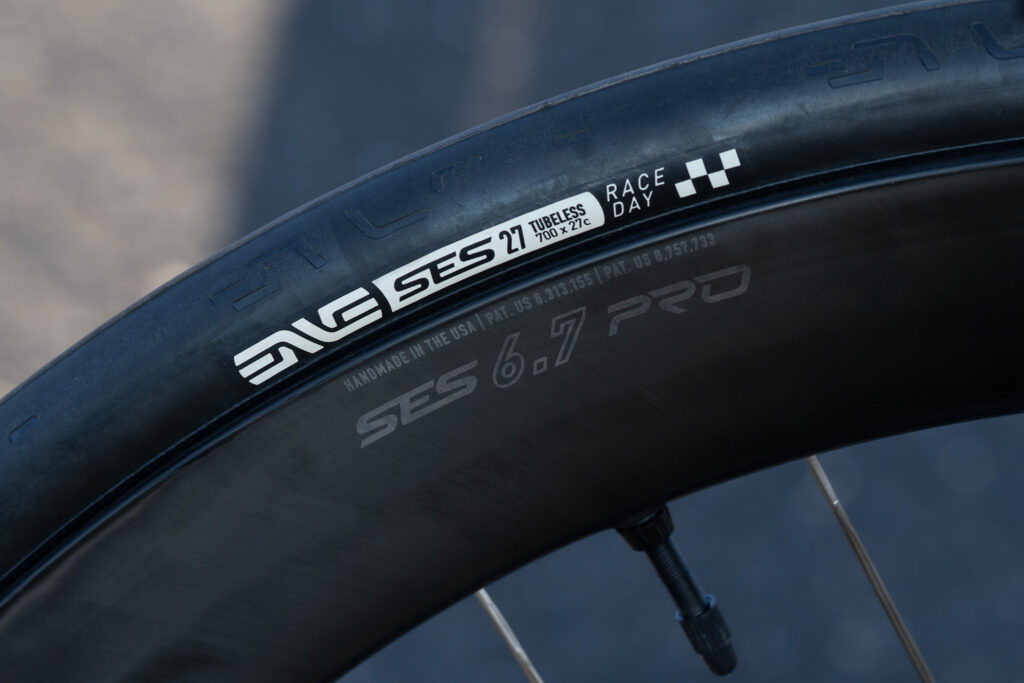
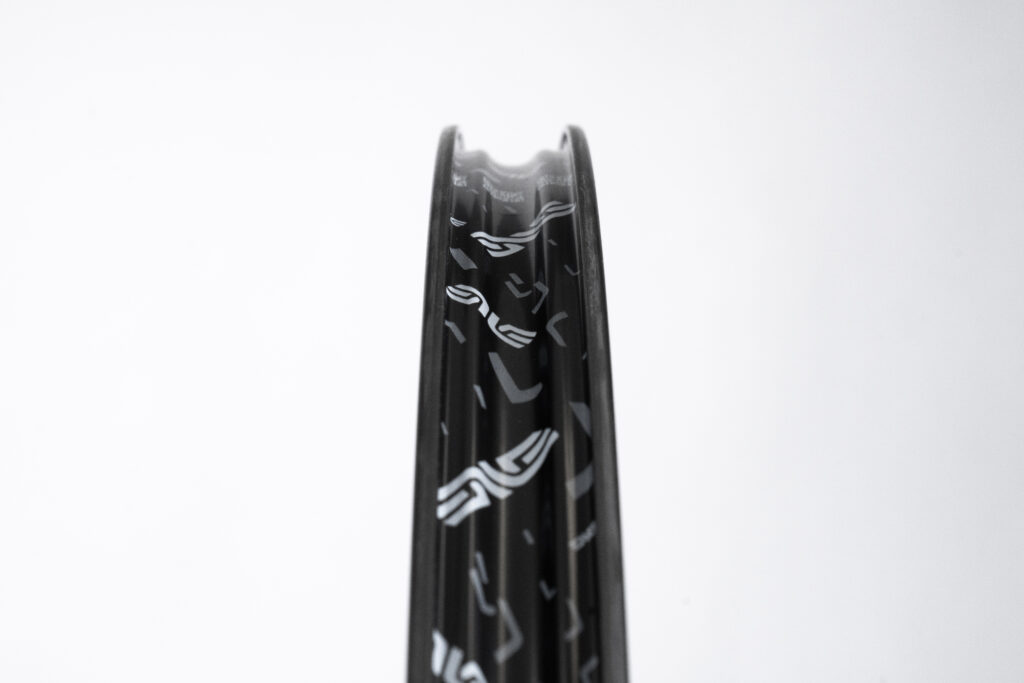
That tire width optimization then made the choice on rim width — and, in turn, it meant that we also see microhooks, first introduced on the 4.5 SES PRO, also show up here. The internal width, measured from these microhooks, is 22.5 millimeters. The hooks themselves are 0.5 millimeters in width, resulting in a 23.5mm wide rim bed.
That combination of internal width and optimized tire also has a direct result on air pressure — the maximum allowable pressure goes up to 100 PSI / 7 bar.
Now, interestingly, that also means that there are three different inner rim widths spread across ENVE’s current model lineup. The standard ENVE SES 4.5 is hookless, with a 25mm inner rim width, is optimized around a 30mm tire size, and maxes out at 72.5 PSI / 5 bar. The SES 4.5 PRO shares microhooks, the optimized tire, and maximum tire pressure of the SES 6.7 PRO, but it is an extra millimeter wide on the inner rim.
Perhaps the biggest issue will be educating both retailers and consumers about tire choice for each wheel — though you’ll have everything narrowed down to tubeless only. ENVE, of course, will happily sell you the SES Tubeless Road Tire to go along with your new wheels.
Everything Else Got a Makeover, Too
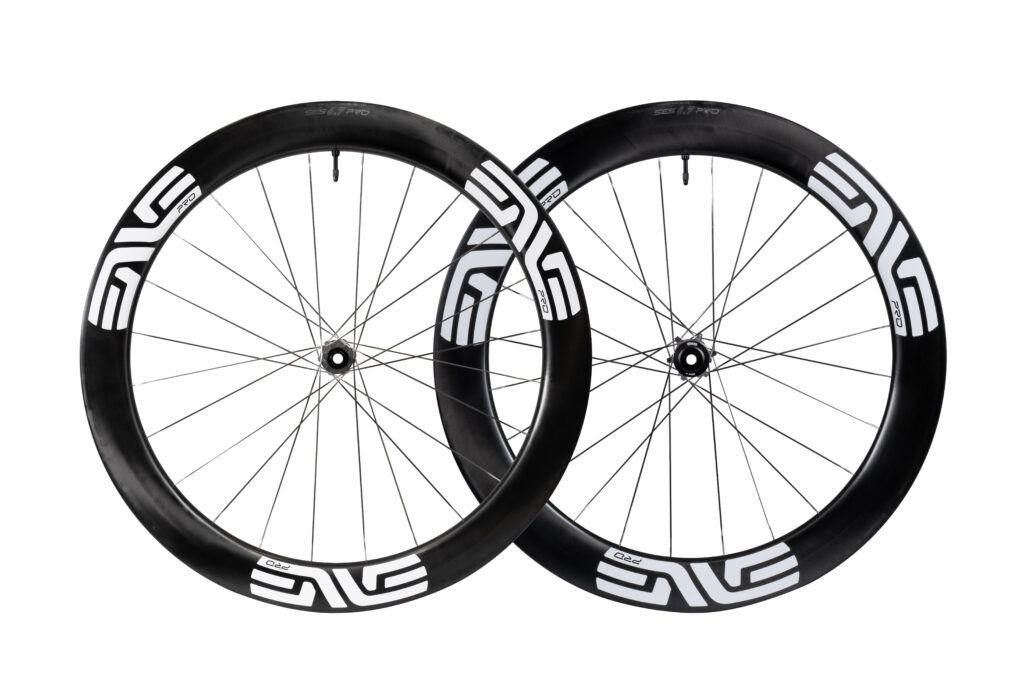
It’s not just the rims that got an overhaul for the new SES 6.7 PRO. The wheel marks the introduction of INNERDRIVE PRO, the latest version of ENVE’s hub. The claim is that the new hub is lighter and lower-drag than the previous generation. It gets there with an ultralight wheel and a redesigned 40-tooth ratchet and spring system. ENVE says that the new INNERDRIVE PRO saves 60 grams when compared to the prior premium version of INNERDRIVE.
To go along with the new hub are new ceramic bearings. These ENVE PRO ceramic bearings were evaluated with ENVE’s professional race teams after a lengthy development process. You’ll find Grade 5 ceramic balls, hardened stainless-steel races and low-friction polyamide cages. The bearings have low-contact seals on the outboard side for contamination protection, while the inboard seals are non-contact for efficiency.
In total, including tubeless valves and tape, the wheelset weighs 1,495 grams (plus or minus 3%, according to ENVE). That makes it 200 grams heavier than the SES 4.5 PRO. It’s also around 75 grams heavier than the lightest version of Zipp’s 454 NSW, once everything is installed.
The End Result
We all know why you’re here. You want drag charts. We got drag charts.
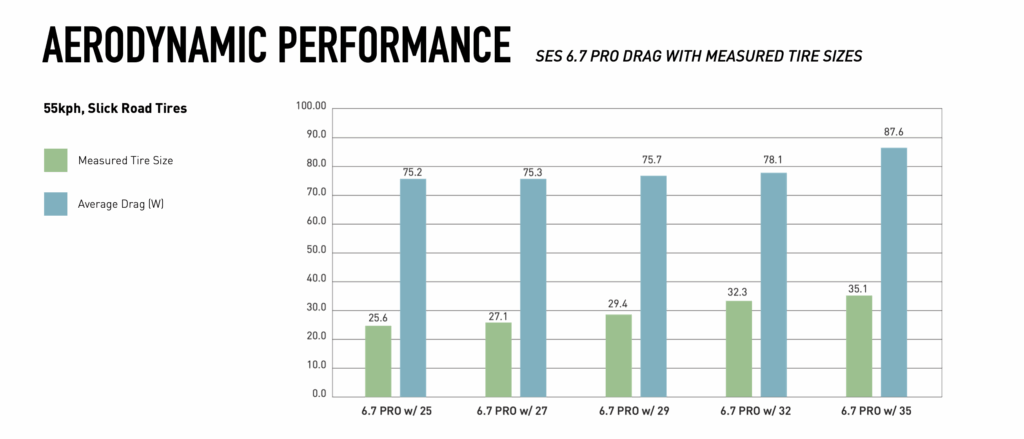
First, let’s take a look at that tire width optimization effort. Here’s how the wheel lines up with some various tire sizes; essentially, you’re within the margin for error if the tire is right in that 28-30 millimeter bucket, and you’re not giving up much if you decide to go a hair wider at 32mm.
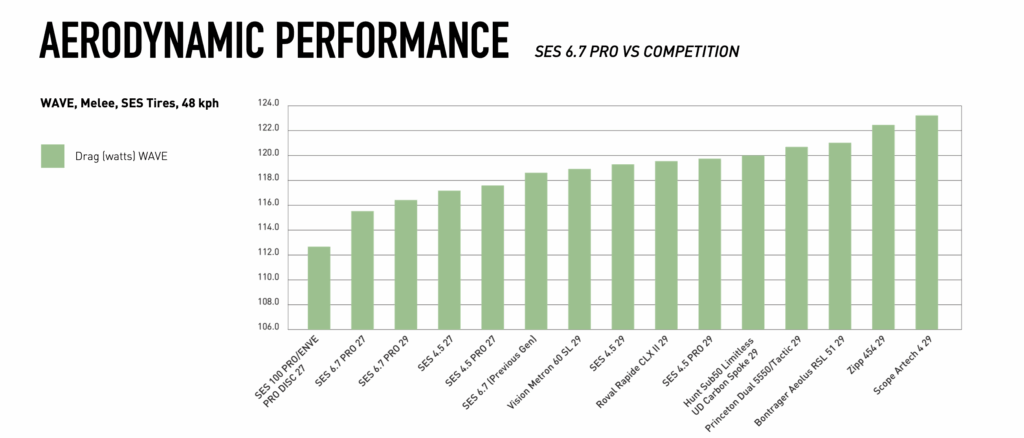
Now for the chart we’ve all been waiting for: 6.7 SES PRO versus other ENVE wheel sets and the competition. It handily beats everything that isn’t the time trial exclusive SES 100 PRO and ENVE PRO Disc, with the closest comparable wheelset Vision’s Metro 60 SL. Numbers below indicate tire size used in the test.
In summary, it’s a fast wheel. And it better be: it’s $3,750 USD for a set. (You can buy the wheels individually, too, with the front costing $1,700 and the rear $2,050). Yet, perhaps surprisingly, it is the “bargain” against some other comparable wheels. For instance, the 6.7 SES PRO is still $450 less than a comparable Zipp wheelset.
Wheels are showing as being available approximately 8 to 10 weeks from today.
All Images courtesy of ENVE.
Tags:
bikeENVEWheelsRelated Articles:
Continue the discussion at forum.slowtwitch.com
3 more replies



just to get a (micro) hook in, has enve told us what the optimal tyre pressure is for the 6.7 for an 82kg rider , good road surface ?
From what I can tell, it doesn’t look like ENVE has updated their tire pressure page as of yet to reflect the new wheel.
Glad they are finally doing wind tunnel testing at my typical race speed of 48km/hr.
Of all the chart crimes ever committed, this one has to be the most bizarre.
I mean
WTFLOL
I am curious, what do you find bizarre ?
Other (more common) chart crimes:
This doesn’t even account for the preposterous choice of speed to inflate watt differences
Thanks
I was so distracted elsewhere I would have missed all that
Well, it seems to be going into the direction that only ST will be the supporting fans for performance hookless road wheels:-).
It is now only a matter of time waiting on Zipp to follow…..
I’m trolling but in all seriousness this being the second hooked wheel set with a hook, and i expect all their new to introduce in the future will be the same, is the trend performance road wheels go.
The industry has taught its lesson
1.) I don’t think Zipp is going to follow, to be honest. At least, based on what I’ve heard on this.
2.) CADEX also is hookless and I don’t see them going back.
3.) ENVE still offers a bunch of road performance wheels that are hookless.
4.) I remain firmly in the camp of hookless simply being an option for road wheels (and that hookless sure can be fast), and you and everyone else may choose wheels accordingly. Heck, we’re still a rim brake HED Jet latex tube race wheelset household over here.
some would argue that latex tube setup is still one of the fastest! the ride quality of that combo is solid.
looking forward to testing out some enve’s in the near future!
I was fortunate enough to spend some time at UCI/Worlds with a friend from the Spanish team
We had to go downstairs and arrived at pumping time. The mechanic had his little sheet with tire pressures.
A discussion ensued with some of the technical folks. I told them they should consult ST
I am guessing the Colnago/Enve was on the 6.7 ?
Also notice the tire choices for the road race
Although you would never be able to tell from ST’s review, Shimano’s newest wheels are hooked -
Looks like Shimano - the largest bicycle component manufacturer in the world, and the one with the deepest pockets - is staying firmly in the hooked camp. Historically, they are an uber conservative company, but even they sometimes get it wrong (long term use of Hollowtech cranks). None the less, you’ll know hookless is ready for prime time when they offer it - which IMHO looks like never.
It is clear talking to people at the very elite end of road cycling that Hookless is perceived as a competitive disadvantage. The manufacturers know this and adjust. The first hooked version of the Enve appeared in the summer of 2024 and took 18months to become more mainstream.
Several of the riders at UCI worlds were over 5 bar. Ask Quecebers how pristine their roads are
The mechanics were talking about “prototypes” of other wheels out there. It’s just a matter of time.
In the mean time people can come up with clever ways of saying “see, we didn’t get this one wrong”. My favorite is “micro hooks allow us to make a ligher wheel”. Wait….didn’t hookless allow you to make a lighter wheel ? And “micro hooks aren’t really hooked”. Question : is a micro hook half a hook or half a non hook ?
BTW, Hunt went away from hookless for road.
I believe the subsiduary of Scott (forget the name) is hookless.
Syncros, and, yes, they are hookless but to be honest i have not seen these in the wild yet.