
The Mount to Coast C1 is an Original Generation Saucony Kinvara for the Modern Age
Throughout our collective running history, there have been a few landmark shoes that have been transformative to the industry and shaped the way nearly every company offered a shoe. From the original Nike Waffle Racer to the iconic Air Pegasus to the birth of the super shoe in the Vaporfly, these shoes wiped the slate clean on what a shoe could or should be doing for you.
Arguably, we don’t ever get to the Vaporfly and carbon-plated footwear without talking about that strange transitory period from minimalism to near-maximalism in shoes. When Born to Run released in 2009, nearly overnight every runner was interested in running barefoot. Well, nearly barefoot, anyways; everybody remembers the sudden surge in Vibram FiveFingers, right? It caught the entire industry by surprise, with manufacturers and retailers scrambling to try to bring out product that would fill consumer demand. Merrell was one of the first to respond, with their Glove series of shoes.
Some brands, though, took a slightly different approach. What if we took the geometry of minimal shoes, but added lightweight cushioning to the platform? And the first of those shoes was the original generation Saucony Kinvara, which hit store shelves in 2010. Weighing in at 7.7 ounces for men, it combined a low heel-toe offset geometry like minimal shoes, but with a plush (at the time) cushioning experience and an open, wide, airy upper.
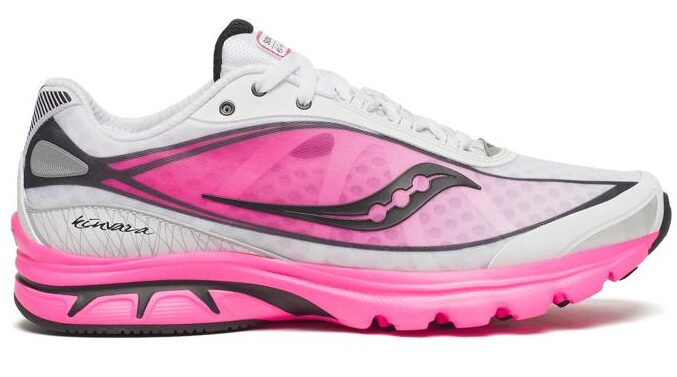
It was, in many respects, a best of both worlds approach. And it worked — the Kinvara franchise is still here, 16 years later, and is still routinely one of Saucony’s best-selling shoes. I also think it’s somewhat fair to say that without the Kinvara, we don’t then get to HOKA, or then onward into the modern super shoe. We, as an industry, needed a shoe that was lightweight and really well cushioned. Because before the Kinvara, it was an either/or statement.
Of course, as time has evolved, so, too, has the Kinvara. Over time it got softer, with more weight, as more competition entered the fray. The latest generation, the 16, feels like a return to roots: it’s 7.3 ounces in a men’s sample size, with a new version of Saucony’s proprietary foam that promises a more responsive ride.
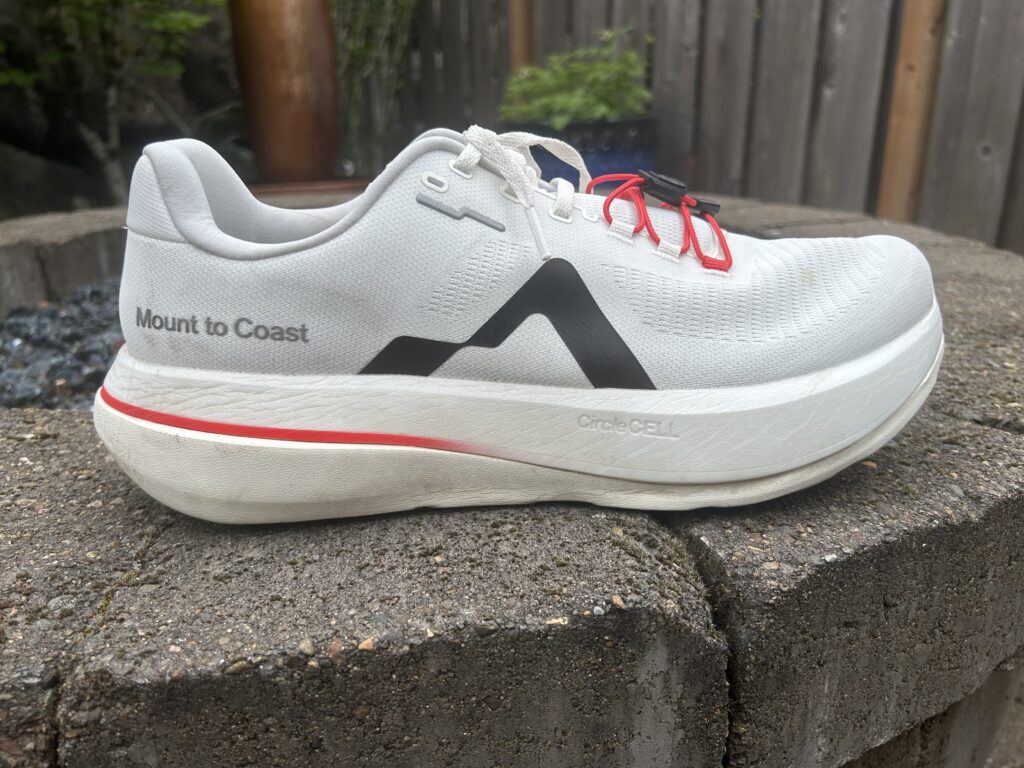
But there might be a shoe on the market that might be a better tribute to that original generation Kinvara than what even Saucony has come up with. Something that maintains lightweight, an airy forefoot, and may just disrupt things a little bit along the way. It’s Mount to Coast’s C1 — a so-called “super trainer built for ultra distances.”
The Tech Stuff
Mount to Coast is a newcomer to the running world, with their first prototype shoe only starting design in August 2022. The following November, their prototype (which eventually became the R1 racing shoe) won the ISPO Award for its design. Justin Montague then went on to wear a single pair of R1s on his way to shattering the stage and course records at URL JOGLE, an 854-mile multi-stage event. The R1 has continued to gain marketshare in the ultra marathoning world, setting world records for two days, six days, and at Backyard Ultras.
It’s not totally dissimilar from how HOKA was founded — they started with the specific needs of ultra marathoning and have then evolved that technology into other footwear. The team at Mount to Coast identified three particular areas of footwear that they felt needed addressing:
- Midsole degradation was forcing athletes to need multiple pairs of shoes during events.
- Upper fit needed to support foot swelling during the race, as otherwise athletes would be forced to select larger sizes or cutting the shoe upper, creating the potential for injury.
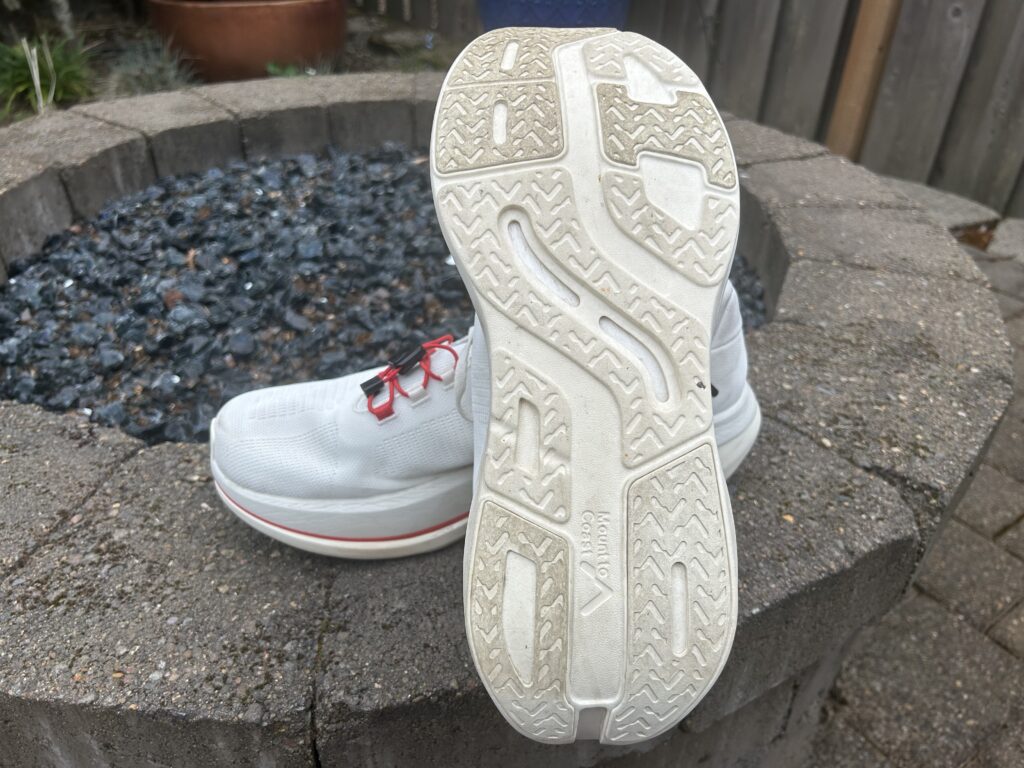
- Outsoles would last a few weeks, seeing significant wear long before the midsole had given out.
Mount to Coast first focused on foam. They turned to, of all places, car racing suspensions for a material that they dubbed ZeroSag. It’s supposedly anti-degrading and, according to Mount to Coast, “ensures consistent cushioning and support over hundreds of miles of running.” Logically, though, it makes sense; if it’s a material that can handle endurance racing like Le Mans, it probably can handle a human body for a few hundred miles.
On the C1, Mount to Coast uses two different blends of foam to provide the cushioning. Closest to the foot is called CircleCELL, and it’s their supercritical foam. If you’ve heard that term before, it’s what every super shoe on the market uses today. Mount to Coast claims it provides the energy return of a traditional PEBA-based foam, while providing double the running lifespan of PEBA. Underneath CircleCELL is a “rubberized EVA” bottom layer. If that sounds mostly like an exposed midsole as an outsole, I’d be inclined to agree with you.
For my money, the coolest innovation they have is what they call TUNEDFIT. It’s a dual lacing system that has its own adjustment for the forefoot and the midfoot. For the forefoot, it is a pull tag based system, which allows for quick adjustment on the fly. The midfoot features a more traditional lacing, with the now ubiquitous flat elastic laces. Paired with a relatively free formed upper, and it means you can fit more foot shapes into a Mount to Coast shoe, and be able to account for foot swelling and still allow for proper forefoot splay.
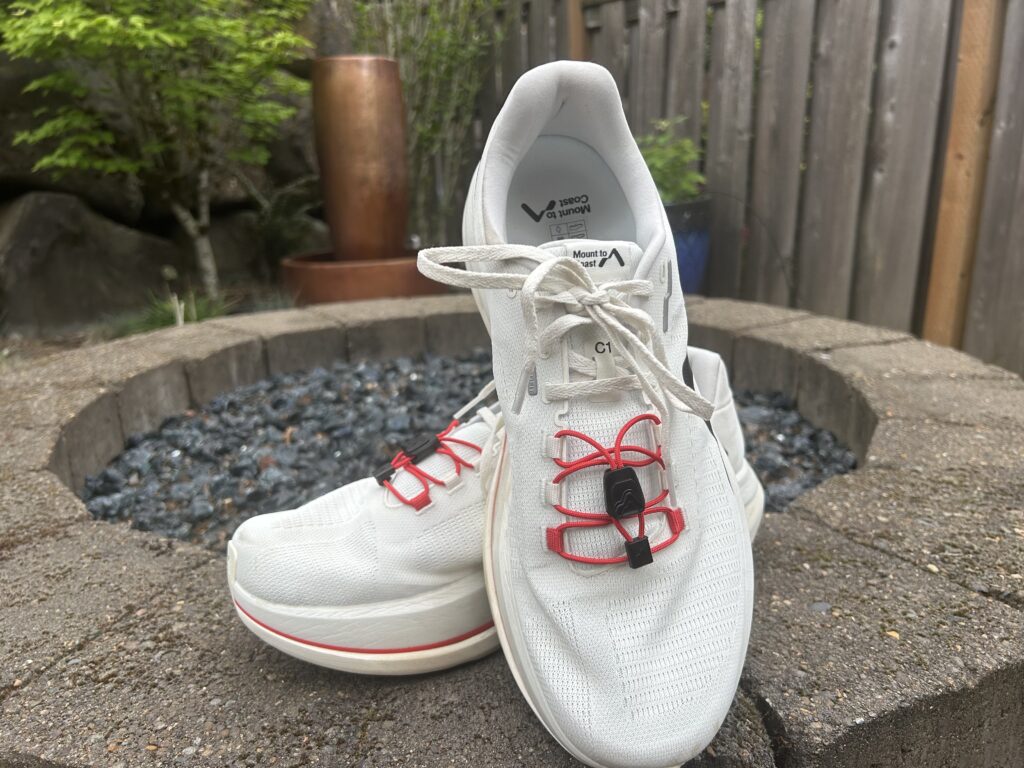
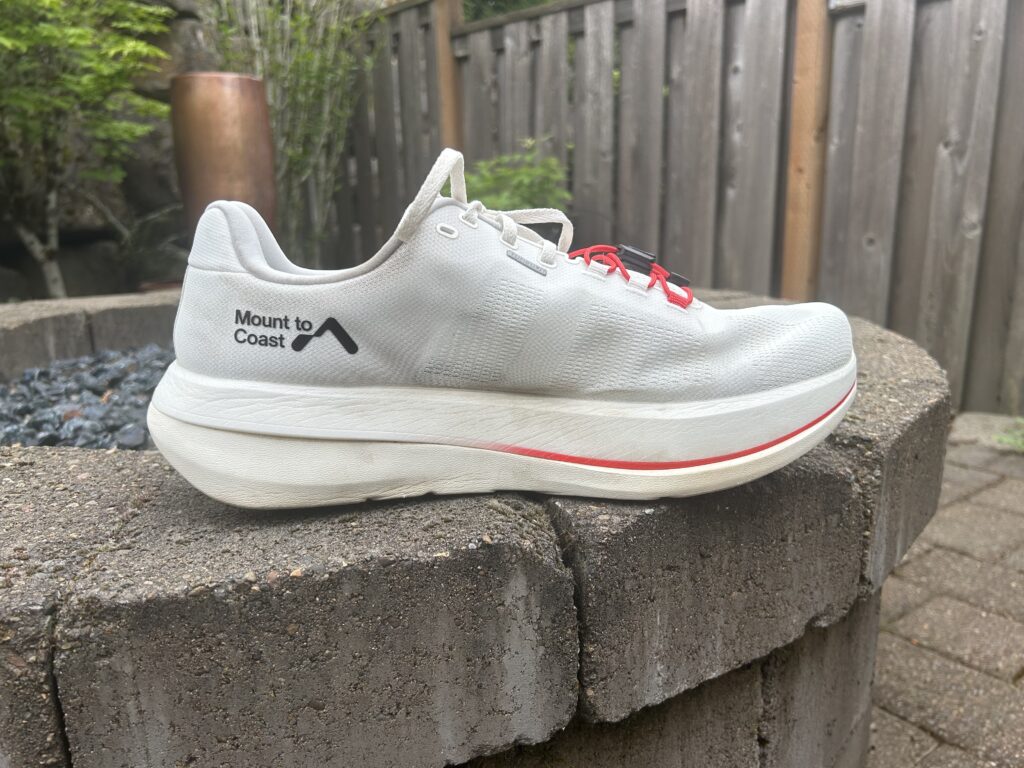
Specific to the C1, you find a manufacturer claimed 42mm stack height and a 6mm drop. It technically does not sit on the World Athletics approved list for footwear, so you’d wear it at your own risk for triathlon competition. The reported weight is 9.4 ounces in a sample size.
How Does it Run?
There’s a reason why I led off with all those Kinvara comparisons at the start, and it’s because of this: the C1 is, stride-for-stride, a shoe that woke from my memory banks. If you like the intersection of cushioning, responsiveness, and lightness, you came to the right place.
Slipping on the C1 for the first time, and there’s three things that I noticed. First is that TUNEDFIT lacing system. It’s an honest-to-God revelation that allows you to dial in fit without ever creating pinch points somewhere else. I like a very broad forefoot and aggressive midfoot wrap in my uppers. My wife, on the other hand, needs more depth over the top of her foot while retaining a wider forefoot. Each can be accommodated without much trouble, and it also doesn’t then require constant re-adjustment.
Once in, you notice one key difference between a Mount to Coast shoe and, say, a HOKA — you definitely are on top of the midsole, and not in it. That’s where my first Kinvara thought came from; it’s a decidedly different way to make a shoe platform. Typically, with so much midsole stack, that might make it unstable, but Mount to Coast uses a full contact patch on the outsole and plenty of width in the overall platform. This is a shoe that’s planted.
The arch height in here tends toward the lower side. I like that, though some may feel it is too flat for their taste. I did toss a pair of Superfeet in to see just how receptive the shoe was to an orthotic, and it seemed to seat itself quite well in there. The heel collar is soft touch, and there’s nothing for you to really rub on to create a blister in the upper. You can tell that the Mount to Coast team thought about wearing this shoe for a long time in one go.
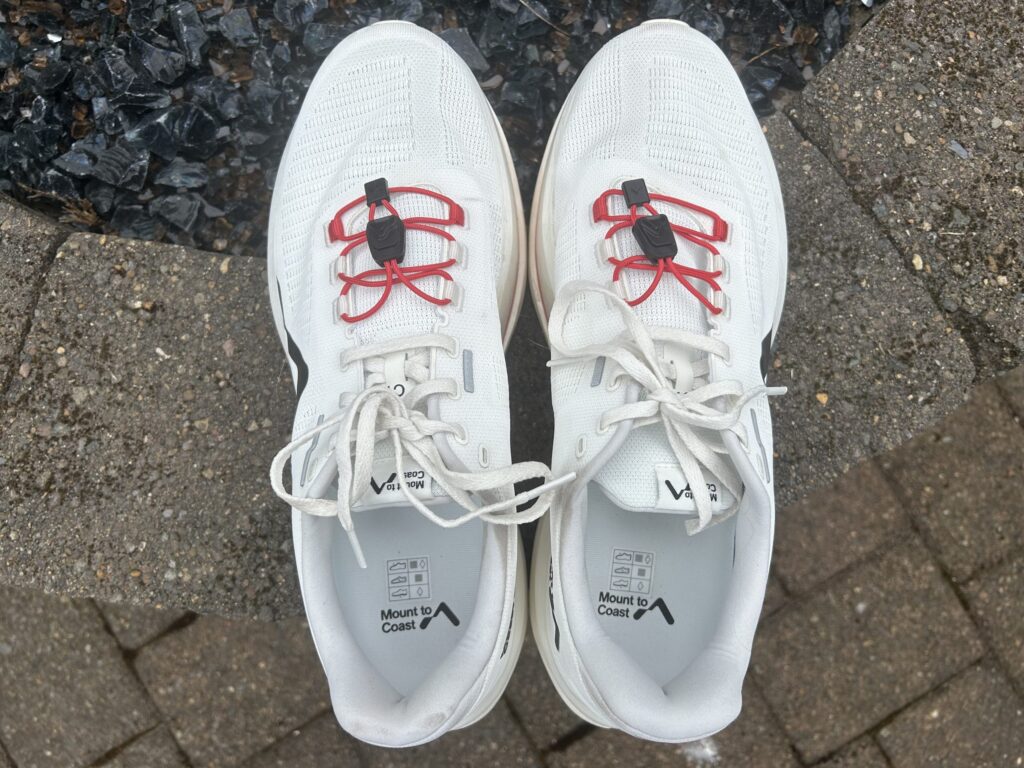
Running in the C1 gives a shoe that I liken to the Goldilocks zone. It’s soft, not spongy. It’s bouncy, but not propulsive. It’s flexible without being flimsy. And it’s simply comfortable. It’s a shoe that tackles a mix of surfaces and terrain extremely well. It also feels much lighter than its published weight; I think this is in part because of the somewhat exposed outsole. The weight is just so close to your foot that you don’t really feel like you’re having to lug it around.
It’s also a shoe that I adored running up hills in. Although I respond extremely well to carbon plated shoes, one thing I have noticed is just how hard those shoes are to run in going uphill; it feels like you’re fighting them the entire time. The C1, meanwhile, simply wants to eat up the mileage without question. Now, to be clear, this isn’t a shoe that is going to make you run faster. You’re going to have to earn your pace in the C1. But it’s an enjoyable experience to do so in.
The only major criticism I have? The outsole traction here in the mossy, still somewhat boggy and sad Pacific Northwest does leave a little to be desired. It’s a shoe I’m a little more careful in if I’m running after a little bit of rain. But considering we’re about to enter the dry season, it probably won’t be an issue anymore.
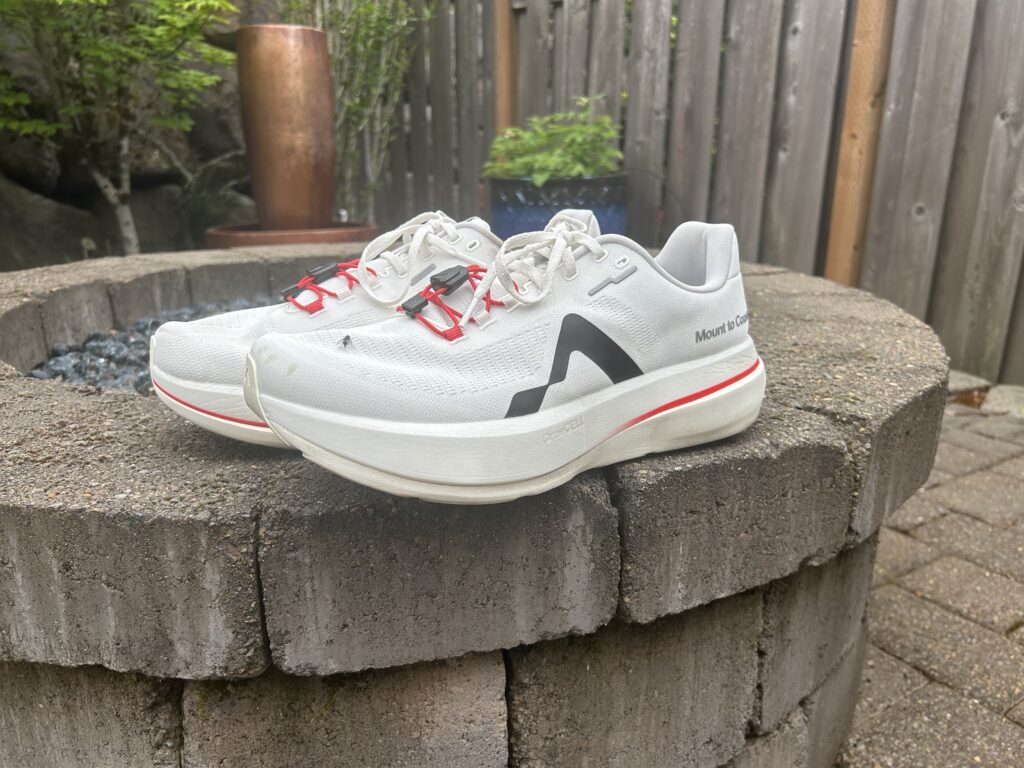
And then there’s the price and availability. Mount to Coast is available online, but unfortunately their return policy is somewhat stringent; must be within 30 days and in new, unworn condition with all original packaging. If you’re thinking about them, I would highly recommend using their Retail Store Locator instead to try and find an outlet for purchase. The C1 will set you back $180. I think it’s worth it. But if we’re doing a Kinvara comparison, it’s $50 more than that. Your mileage may vary.

Start the discussion at forum.slowtwitch.com