
Becoming the Best Swimmer You Can Be With eo SwimBETTER
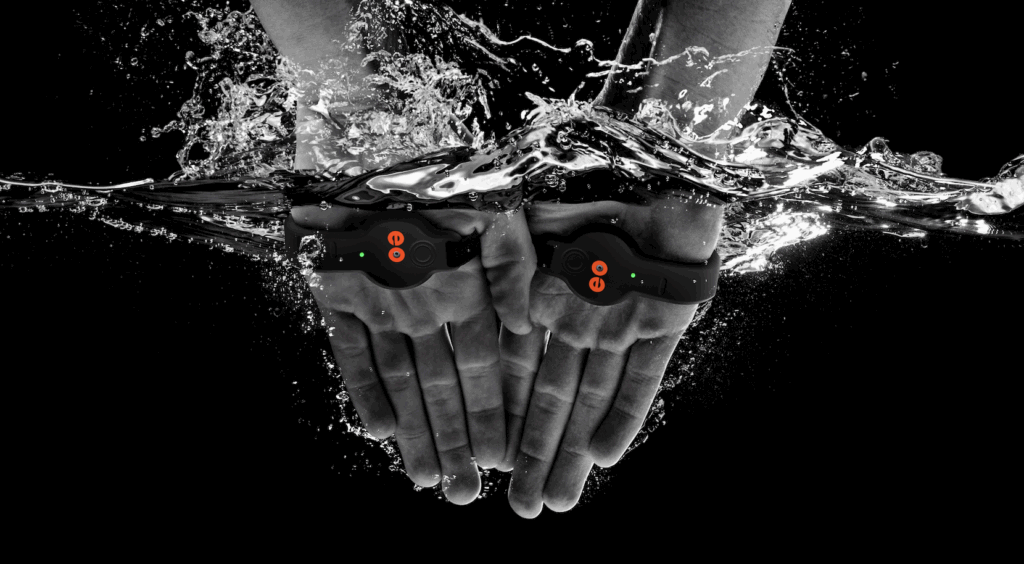
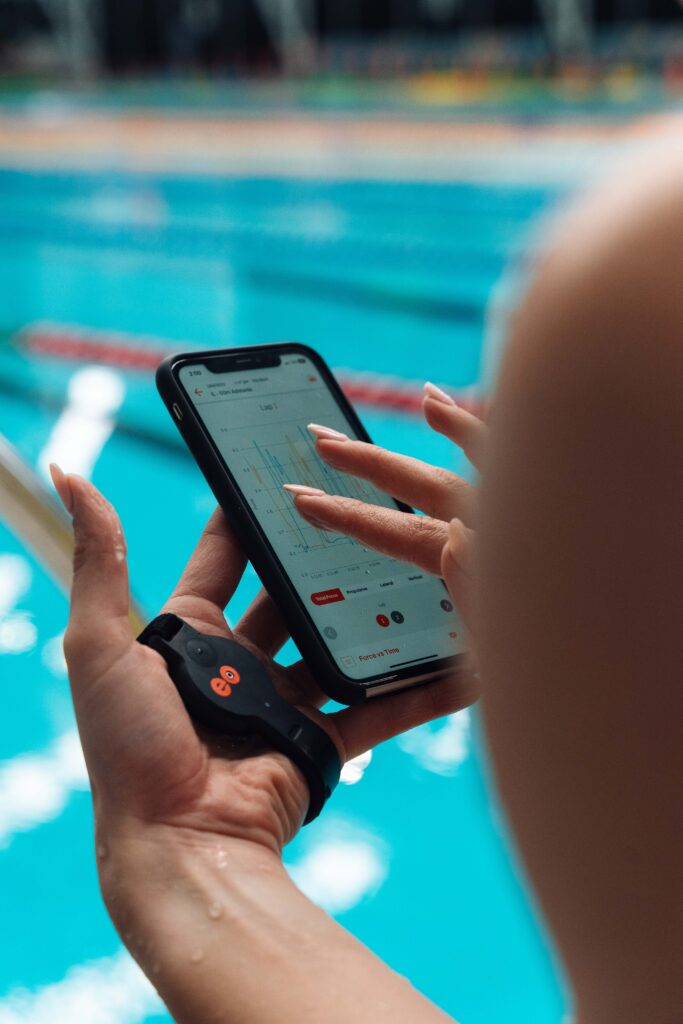
Triathlon has no shortage of gear, tech and gadgets. With three sports to train for, there will always be another product you feel you have to get, but there comes a point when you need to ask yourself, “Will this actually help me get better?” Every triathlete has a device or two that they bought in the hopes it would revolutionize their training, only to realize it really isn’t all that great. Every now and then, however, you stumble upon something that truly lives up to the hype. For me, that is the eo SwimBETTER handset — a swimming tool that will change your stroke for the better, no matter what level of swimmer you are.
Creating eo SwimBETTER
The eo SwimBETTER story started in Australia with the company’s founder, Jaimie Fuller. Fuller acquired the patent to a device that “sort of went around the hand that had a wire going up the arm under a sleeve to an external hard drive sitting strapped to your bicep.”
This device measured a swimmer’s hand path and movements in the water and saved it to the hard drive. Fuller says he knew this could be a big deal in the swimming world, but he had to find the right team to back it. He linked up with Kenneth Graham, who was then principal scientist for the New South Wales Institute of Sport, and former Adidas CFO Dean Hawkins, marking the start of eo SwimBETTER.
Graham introduced Fuller to Neil Baker, a former collegiate swimmer with a PhD in physics who also writes software and codes. For a company looking to develop a device that can track every move swimmers make, an elite swimmer with that kind of academic and professional resume is pretty much the perfect person to team up with for the project.
Fuller, Baker and the team got started on the handsets in 2020, and it didn’t take long to get a working model that they soon passed out to elite swimmers. Swimmers like Pan Zhanle of China, Australia’s Kyle Chalmers and American Paige Madden used the handsets in training leading up to the 2024 Paris Olympics, and they all left the Games with medals. (In addition to winning gold, Zhanle set the 100-metre freestyle world record in Paris, swimming 46.40).
While the first step was to work with the elite swimmers, Fuller says he always viewed triathlon as the key to making eo SwimBETTER a broader success.
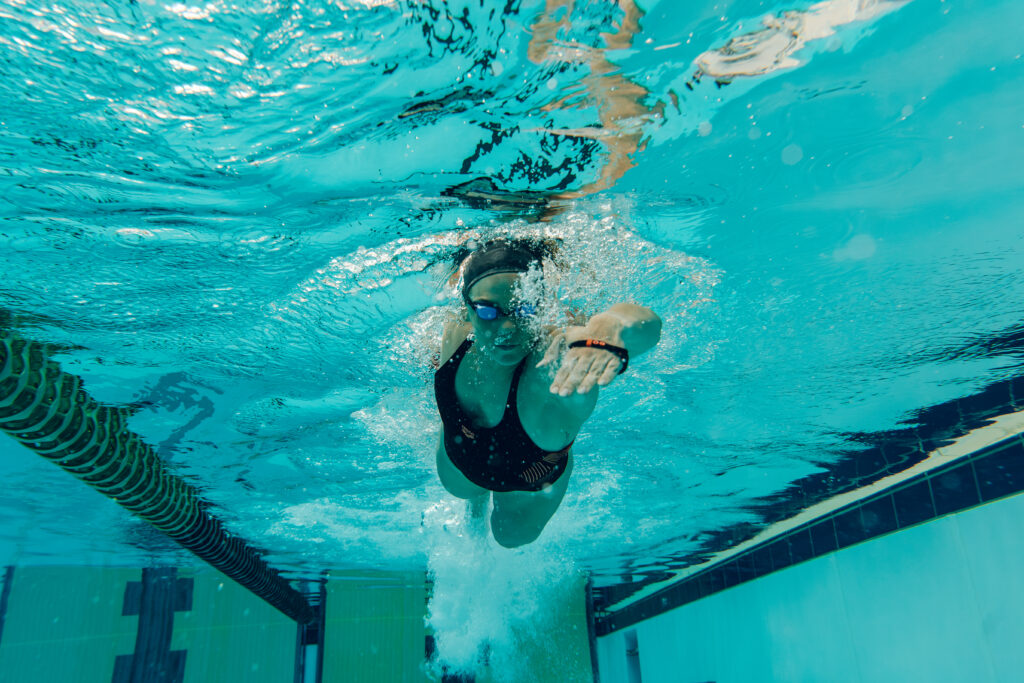
“You will always find triathletes speaking to pure swimmers and asking for advice,” Fuller says. “We had to establish our credibility and validation with pure swimmers first.”
Fuller says they are seeing “unbelievable results” with triathletes who are “literally saving minutes” thanks to the eo handsets. And why?
“Triathletes’ technique is, 99 percent of the time, really, really shit,” Fuller says with a laugh.
That might sting to hear as a triathlete, but anyone in the sport knows it’s quite an accurate statement. So many new triathletes have no swimming background whatsoever, so it only makes sense that they will have poor technique. Now, with eo handsets, triathletes can see exactly what they’re doing wrong in the water and learn how to fix it.
Using the Sensors
I thought I was a good swimmer before using the eo handset. Not great, but solid. After one swim with eo SwimBETTER, I realized I’m actually not all that great. Sure, I’m clocking OK pace times, but one look at the eo data and I saw that my stroke was far from pretty. My high elbow is not so high, my left arm is way weaker than my right, I create significant drag in the glide phase of each stroke. In short, I’m a mess in the water.
This revelation bothered me for about five minutes, but the whole purpose of the handsets and the eo app and website (where you access all of your data) is to help you pinpoint every part of your stroke that needs tweaking. After locating areas that need improvement, the website’s AI data analysis system — which is called eo Intelligence, or eoi — will generate a report in less than 30 seconds, telling you how you can go about fixing those issues.
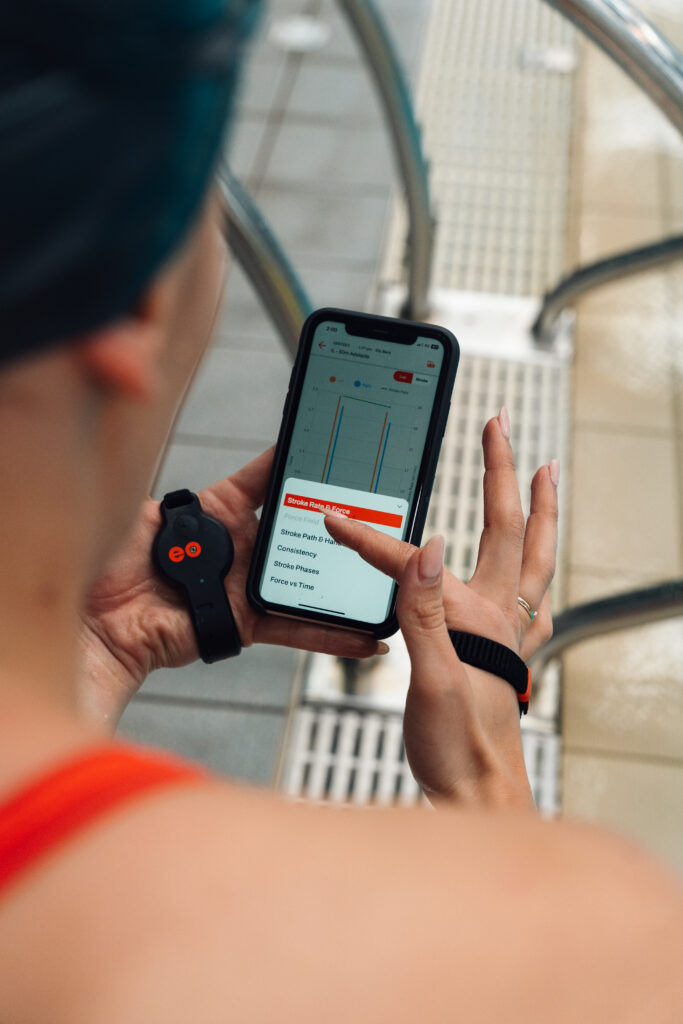
In addition to getting unlimited eoi reports, Fuller offers to talk all eo SwimBETTER users through their data hauls on video calls. I had a call with him after a week of swimming with the handset, and I found it very helpful to have him break down what all of the data and graphs meant.
Looking at the Data
The only negative I have experienced with the eo SwimBETTER system is the sheer amount of data that is thrown at you. When you first get the handsets and sign up in the system, you’ll receive a package that breaks down all of the different datasets and what they mean, but it can be tough to know which is the most important to pay attention to and how to analyze the data when it’s on your phone or computer screen.
That’s why the chat with Fuller is so helpful. The eoi reports are great, but everything became much clearer after he took me through several swims and pointed out the areas in which I need to improve and why a dip on a graph in one section is bad and a spike on another graph is good.
Fuller also acknowledged that there is a lot of data to comb through, so he pointed out the most important sections for triathletes: Stroke Rate and Power (SRP), Force Field and Consistency.
“Stroke Rate and Power is for balance,” he says. “Force Field is for direction. Consistency is for giving us an idea of what our hand’s path looks like.”
Let’s take a look at my data from two different swims. The first was my first day with the handsets, when I had no clue just how much I needed to fix.
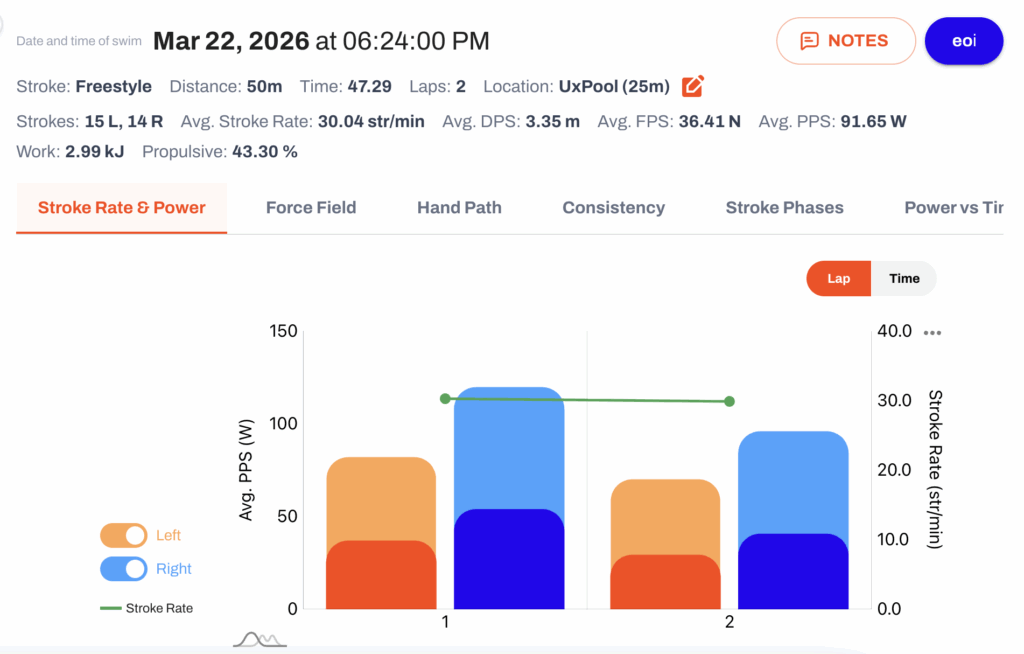
Looking first at SRP, it’s clear that my left arm is significantly weaker than my right. In my first-ever eoi report, the system said a snorkel may come in handy to identify why there is an imbalance here and if it comes down to breathing patterns. The report also said to simply focus on putting the same effort and power into each stroke, which may seem obvious, but I never would have known of the discrepancy without the handset.
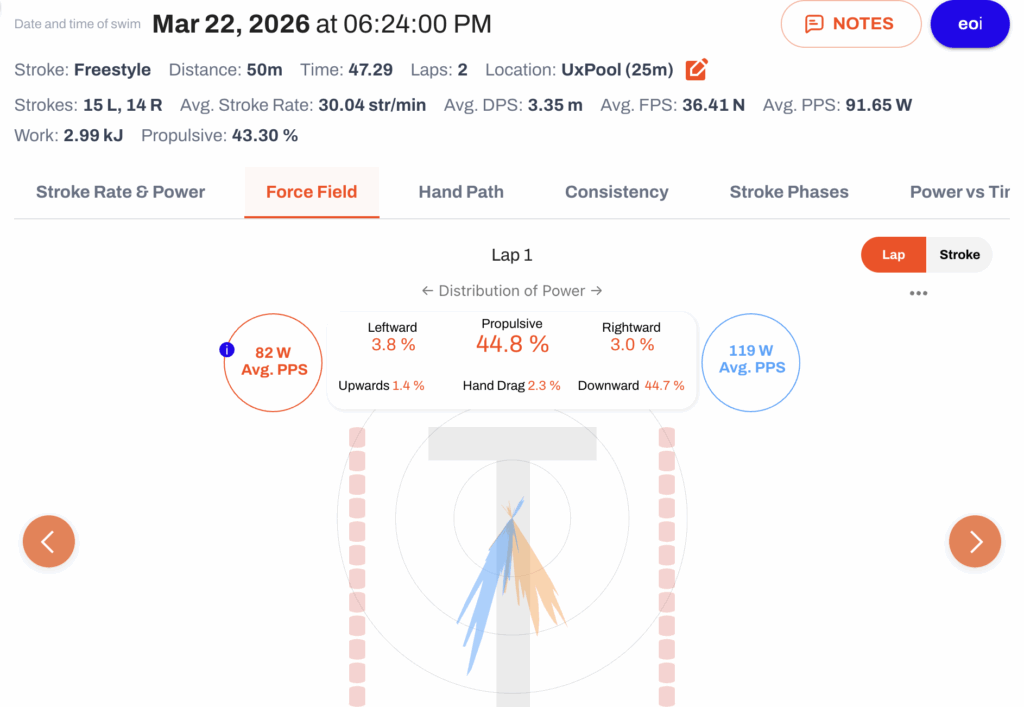
Next up is Force Field. The key numbers to focus on here are Propulsive, Downward and Hand Drag. Propulsive data is essentially your power reading. As shown here, that first swim had a propulsion rating of just under 45 percent. For distance swimmers, this is not great, as Fuller says the number triathletes should be shooting for is 70 to 75 percent.
When it comes to my hand drag, that 2.3 percent is also far from ideal. This datapoint refers to how much drag your hand creates when it first goes into the water at the top of your stroke. Many triathletes will be like me, as I consistently put my hand in the water at too weak of an angle, which causes it to tilt upward and cause drag in my glide phase. In a perfect world, that number would be at or close to zero percent.
Lastly in this section is my downward rating, which is at a very high 44.7 percent. Fuller says distance swimmers should aim to get that number between 17 and 22 percent. This number tracks how much you’re pulling down with each stroke rather than backward. The more downward force, the less propulsion. This is why the high elbow is so important, as it sets you up to pull more than you push down.
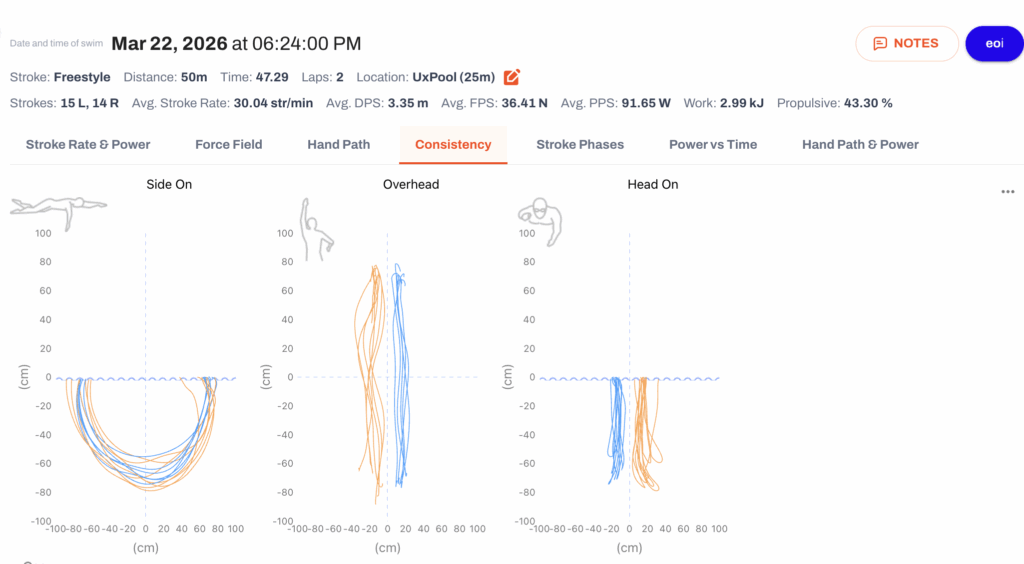
Finally, let’s look at Consistency. As shown above, you get three angles of your stroke. This shows all of my strokes from both arms for the 50-metre lap, but you can opt to look at only one arm and also individual strokes.
The big revelation with this section after my first swim was how deep my stroke was — especially with my left arm (which is another reason for my lower power in the left). This highlighted just how much I need to focus on a high elbow, which will fix the excessive downward motion (which is also illustrated in these charts).
Now let’s take a look at my fifth swim with the handsets (and my first after my one-on-one data analysis call with Fuller).
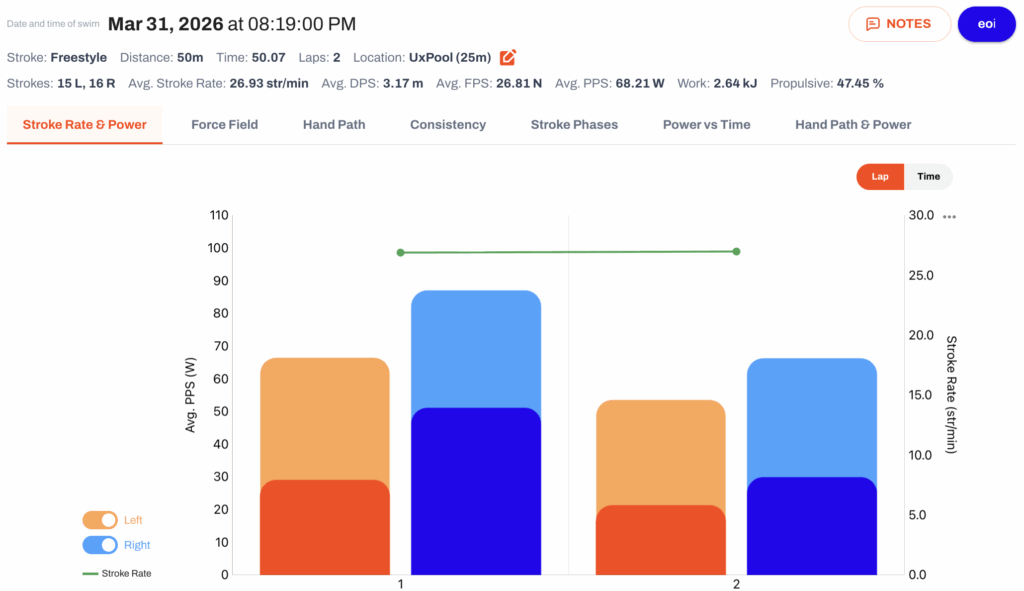
As shown in this screenshot, my left arm is still weaker than my right, but fixing this gap will take some time as I both focus on matching the power with my left and work on improving my breathing pattern to allow my left to pull just as hard.
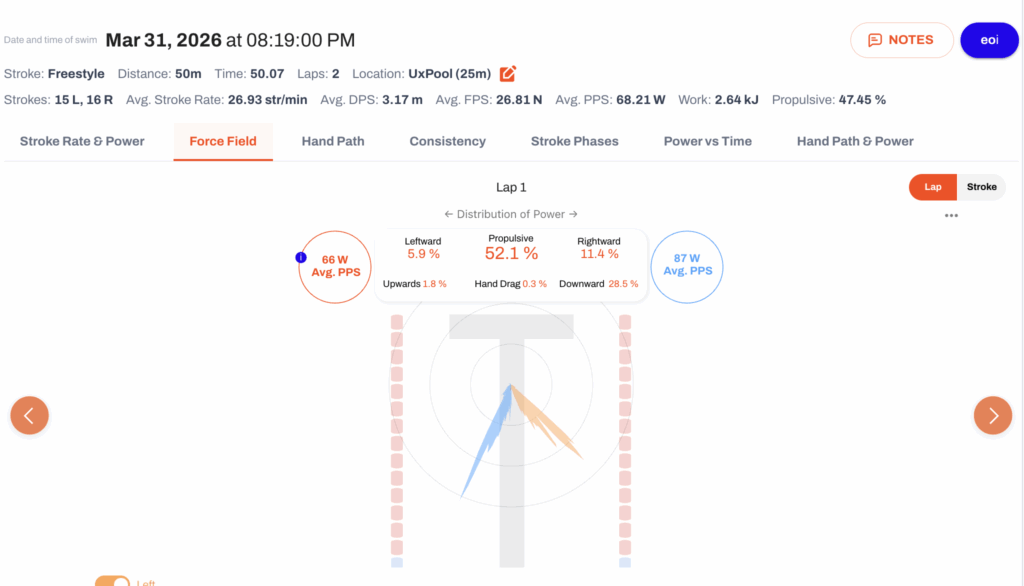
The Force Field section is where the numbers really changed after just a few swims. Propulsive is up considerably from 45 percent to 52. My hand drag also dropped, getting very close to the zero percent every swimmer should be chasing. Finally, my time spent pushing downward dropped 16 points to 28.5 percent, which contributed to the overall propulsion.
I achieved these changes with a single tweak in my stroke. As mentioned earlier, I was putting my hand in the water at too weak of an angle, creating hand drag while also setting me up for a poor high elbow. Making this small change and starting my glide at a slightly sharper angle reduced the drag and made it so my hand was lower than my elbow in the water, which promoted better high elbow and a better pull overall.
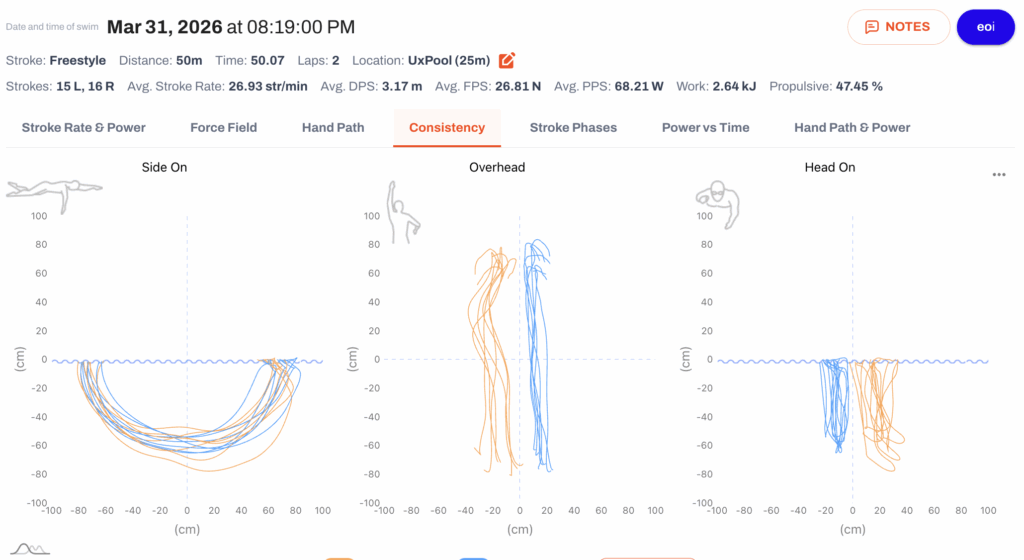
Finally, looking at my consistency, you can see that I still have some work to do. Despite the better high elbow, my arms still dip too deep at times — especially when I get tired and sloppy — and my left arm (the orange lines) doesn’t deliver as straight of a stroke as my right. However, this is only five swims in with only one adjustment made, so there is definitely a lot of promise for future improvements.
The Cost
One thing some people may scoff at is the cost of the handsets. There are two versions available: the eo SwimBETTER15 and the eo SwimBETTER90. The first can record up to 15 minutes of swim time and retails for US$799. The second records up to 90 minutes and goes for US$999.
There is also a membership available for US$140 annually. A membership allows users to see all of their data and access their eoi reports. The handsets still work without a membership, but users will only be able to see SRP.
Fuller is quick to acknowledge that this is far from cheap (even if you opt to go without a membership), but he makes a valid point on that note.
“Triathletes will spend well over $1,000 on a power meter for their bike,” he says, pointing out that those devices only provide a single piece of data to users. It’s easy to say $1,000 is too much for a swimming tool, but when you consider the money spent on other gadgets and devices in the sport and how much info they give athletes compared to what the eo handsets offer, it’s really not that bad of a deal.
The Verdict
This is without a doubt the most game-changing piece of tech I’ve ever used in triathlon.
I have used power meters on the bike. I have used some of the best GPS watches available. I have tried goggles that show you your pace. Some of these gadgets were great, others not so much. None of them compare to the eo SwimBETTER handset and what they can do for you as a swimmer.
Triathletes are always looking for ways to improve. This is by no means a quick fix — you are going to have to work to make the appropriate changes in the pool — but the eo SwimBETTER is, in my opinion, the best way to, well, swim better.



The ‘tweeks’ that you made to your stroke - were those suggested by Fuller or did you just ‘try some different things out in the pool’ until you saw an improvement?
I think that these sound great but my concern as an AOS is that I can look at the data but not know what specific technique changes to make. It seems like this device would work best with an ‘on-deck’ swim coach suggesting technique changes and the swimBETTER providing the data to back-up the suggested changes.
I did find all of the data a bit overwhelming at first and didn’t really know where to start with the changes. The most obvious before speaking with Fuller was the high elbow (or lack of high elbow), so I focused on that. When I spoke with Fuller, he said that hand drag was the first problem to fix, so I switched focus to that in subsequent swims.
After speaking with Fuller, however, all of the data and graphs made much more sense, and since then I have been able to better understand what they’re telling me. (I’ll even keep my phone at the end of the pool lane and look at data in between laps so I can make real-time adjustments, which I have found very helpful rather than recording a full workout and looking at the data later, only to have to wait a day or more before I can put the learnings to practice.)
I do agree that working with a coach who can look at your data would take things to the next level, but I don’t think it’s completely necessary. Fuller was able to dumb it down for me on our call, and ever since, the eoi reports and charts have been more than enough to help me continue to progress.
I find this product interesting but I kind of fear it would give me rigorous data in support of what I already know, which is that my stroke is woefully inefficient. I agree with the previous comment that this is a great tool in the hands of a coach instructing me, not so sure it would help me on my own, even with the occasional call to go over the data. I’ll probably still buy it though:)
How might it work for a swimmer who also suffers from a terrible kick? Do you need to do something like use a pool buoy or similar device to take that out of the equation while you address issues implied by the hand sensors?
So after sitting on the fence for about 18 months, having added my cart 3 times and then not pressing ‘buy’ I finally sprung for a pair last week. First swim with them today, and in fairness was pretty much just learning how to record a swim, download, etc.
And whilst it all seems very straightforward, then in reality there’s a few fishhooks. Really obvious, but the units can only talk to each other above water as they ‘chat’ to each other via bluetooth. The manual doesn’t actually say that, just gives instructions about both hands being out the water, then both going in at same time, then press just one button, etc etc. Honestly, it’s not that complicated once you do it in a pool and figure out the logic, but seems a bit trickier when reading before.
Anyway, one other thing is that the sensors don’t work in sunlight. I’d not seen any reference to that before. And as I swim in an openair pool year round, and specifically wanted to use them to work out what happens to make me 10s/100m slower in openwater/wetsuit, then it was a bit of a surprise, but they have sunshade clips to wear over the sensors to keep the light out. So it works fine, and just means you need to pop the cover off to recharge which is a 2 second task. But, does mean that you can’t see the logo so it’s easer to swap the sensors and wear them on the wrong hand (not that it really matters, there’s a ‘swap channels’ switch on the app).
So onto swimming with them. I actually did find the first few laps a bit different not ‘feeling’ the water on my palm. Seemed as though I was slipping through the water more. After that then kinda get used to them. Was a bit of fiddling around starting/stopping to begin with, not helped by it being a squad swim technique/drill set. But then (and after looking at data) I realised you actually just leave them running all set (up to 90mins) and the app cleans it all up and drops into freestyle lengths, and ignores the non ‘freestyle’ drill stuff (sculling, etc). Was my big fear, and where early on I was trying to mess with both the sensors, and the garmin. Which before 6am was beyond my brain.
Now being really clear, today was one ‘partial’ swim. I am not expecting a full understanding of the (many many many) deficiencies of my stroke. Probably worth stating that I’ve been doing squad 3 times a week for about 7 years, swimming that frequency with about 8-10km a week for just over 20 years which was when I got into tri as I turned 30. I’ve varied, but after a long time stuck at 2:00/100 for race distance then got to 1:35 and am now about 1:42.
So plan is to basically just swim with them for a few weeks to get a good baseline and understand how to understand what it’s telling me. And then work through with my coach what to do about it. However, it’s going to be a bit tricky not to immediately start trying to fix a few things. There are some clear specific things, but the main headline is only about a third of the power I am putting out is actually trying to propel me forward. The rest is being wasted pressing down, up (yes up), and ‘inward’.
The headline just from today is that there is a lot of speed left on the table with no new ‘fitness’ needed. And for me, with the way my mind works, then the ability to get the feedback on if what I’m changing is working I think should fit well.
And second update after a few more swims.
I really think the decisions to brand this a ‘power meter’ is a miss. Or maybe it’s just my mental picture of the way I use the bike power meter and this, but they are hugely different. You can get value from just having the power meter on the bike and just training as normal, glancing at the head unit as you ride. Is there more depth to be mined, sure, but you can do that after.
With the Swimbetter then I know understand why the 15min memory version is there. In a lot of ways I think, that’s more than enough after you’ve been through an initial ‘baselining’ phase. Potentially there will be some more gold to be mined in relation to fatigue effects, but even then I suspect in reality that I’d do that with swimming for a couple of km, then starting recording for 500m.
And the web portal for the data almost supports the shorter data recordings as it’s a pain if you have had it recording for 3000m+ as moving between laps isn’t direct. you can go to start, go to end, but you can’t go to lap 80 directly. And you can’t label blocks as specific things, only put notes on entire sessions. So where at the weekend we did 1000m warmup, then 5x400m then some other stuff, I can’t label that in any way. Nor can I delete the last 300m where we finished with 25fly-25fc.
So going forward, I don’t see me using them in every squad swim. What I do see is me focussing on one of the specific things I want to work on at a time. And then head to the pool on my own to really focus on some changes with the swimbetters, do 1-200m and then stop, review, repeat. See if the changes I think I’m making are actually happening. Which is why I think the 15min is almost the way to go as it really forces that intentional use which is I think how they will be most effective. They are certainly not ‘fit and forget’ devices.
But back to what I’ve learn’t. First, my left arm and right arm have entirely different strokes styles - flaws and positives. And that’s really valuable as when you are drilling for a specific purpose I was perhaps mentally picking up I was doing OK from the one arm that actually was.
Next up is no real surprise, but is a surprise. My right arm is 30% weaker than my left. This is consistently across 10km+ of swimming, start, middle and end, fast and slow. So no surprise in the sense that I’m 2 years on from it being dead weight after a stroke, but it’s a surprise as in life, observation, etc I didn’t realise it was that different still.
So early days, but for me I’m seeing that unlike spending faster dollars on the bike which are fit and forget, these are going to need some focussed commitment to get to the pool on my own and some real intentional drills/changes. Which in itself isn’t a bad thing, and with them then I’ll at least know that there is some value coming back from the time. Others may differ, but for me it’s rare when I’ve spent time working on technique in the pool in the past that I’ve been doing the right thing.
Finnish company Trainesense invented this tech over a decade ago (I’d be curious on whether Fuller based EObetter on their lack of or lapsed patent …. “EO Lab (eo) was founded in 2020 by Jaimie Fuller and his co-founding team”)
The subscription approach for data/reporting access is what impacted Trainesense ability for product to take off in my humble opinion. I used it with a few pros and elite AG’ers 2016-2019 before it died off.
Here’s example of the data they produced.