
A Beginner’s Guide to Not Panicking During the Swim
Unless you got into triathlon via swimming, the first leg of your first race is likely going to give you the most anxiety. Yes, the bike and the run will be hard, but neither should feel dangerous. The swim isn’t inherently dangerous, either, but if you’re underprepared for it, you may feel like you’re risking more than a bad time on race day. Because of this, a lot of new triathletes may suffer from extreme nerves before, and even during, the swim leg of their first race (or even first few races), and it could get so bad that it leads to a panic attack.
The good news? You can work to combat those nerves well before you arrive at your first race. Slowtwitch spoke with open-water swimming legend Gerry Rodrigues to get tips that triathletes new and old can use to feel more comfortable the next time they dive into a lake, ocean, or any other body of water.
Start Small
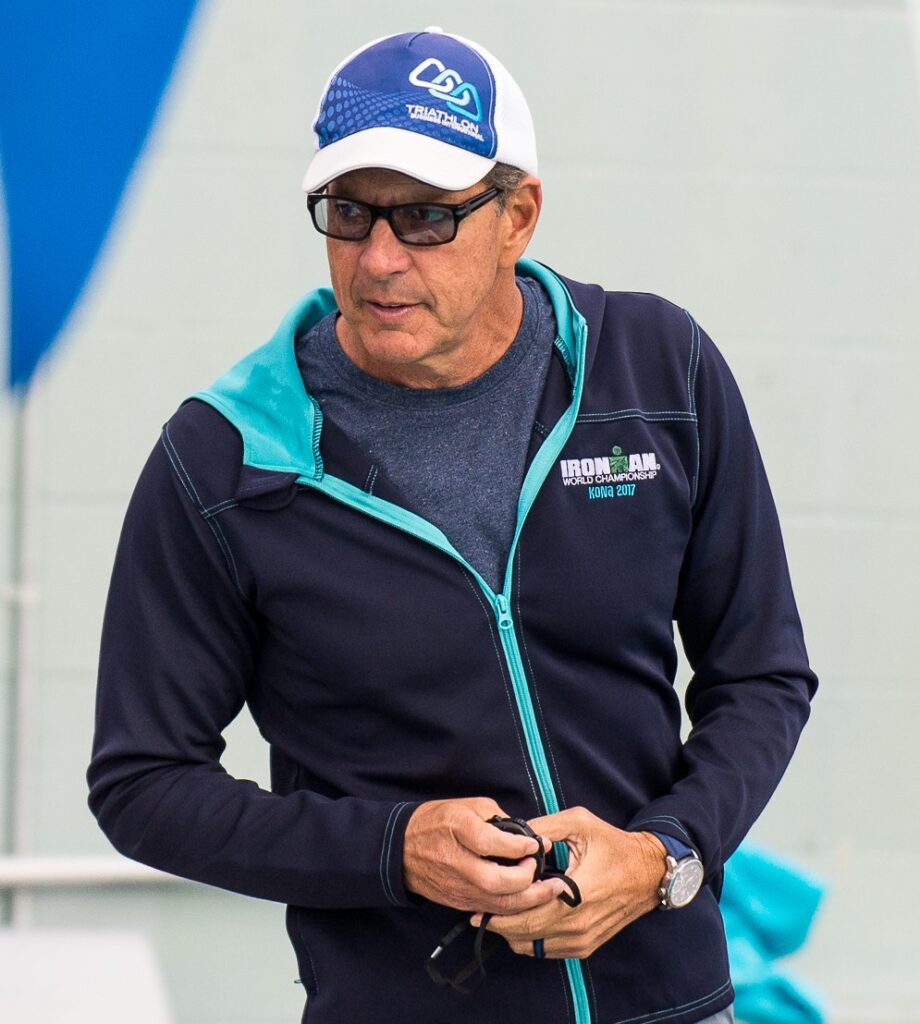
Rodrigues has been swimming his whole life, and with staggering number of open-water wins (his grand total is over 100 victories), he is the perfect person to coach swimmers and triathletes. He is the founder of Tower 26, a triathlon community and coaching service that has helped countless athletes from all around the world swim, bike and run to their full potential.
Something Rodrigues recommends to all rookie triathletes is to start small. IRONMAN has done a great job branding itself as the triathlon, but there are many stepping stones on the way to a full-distance race that Rodrigues says he thinks are worth completing first.
“The IRONMAN label has become a thing,” he says. “So many beginners come into the sport and bite off a little bit more than they can chew by starting with an IRONMAN or even a half-IRONMAN.”
Rodrigues points to running, noting that most people probably don’t get started with a marathon. That distance may be the ultimate goal for many new runners, but most of the time, people will kick their running journey off with a 5K, 10K or half-marathon before jumping to the full 26.2 miles. There are, of course, runners who do skip those shorter races and dive right into marathon racing, but Rodrigues says this is much more manageable — and much safer — than getting into long-course triathlon right away.
“Everybody grew up running as kids, so you can actually start on a marathon,” he says. “But the risk when doing that is much lower than going from nothing right into an IRONMAN, because if you get tired in a marathon, and you can just walk. With swimming, that’s not an option, and the swim in an IRONMAN is a long way.”
The pull of the IRONMAN brand and the glam that goes along with it may be strong, but Rodrigues recommends that rookie triathletes spend some time at other races so they can become more comfortable swimming shorter distances before going all in on a 2.4-mile swim.
“Be true to yourself and pick something that’s in the ability of your range to start with and then build upon it to the ultimate goal,” he says.
Practice Swimming
Rodrigues’s next tip is to, well, swim. That seems pretty obvious, doesn’t it? The thing is, a lot of people don’t do it nearly as much as they should when starting their triathlon journeys.
“What we find is that many folks doing a triathlon, they just don’t swim enough,” Rodrigues says. “They look at the distance they have to swim — so let’s say they’re doing an Olympic and going to be swimming 1,500 metres — and they go to the pool and see if they can accomplish that distance without stopping.”
In many cases, Rodrigues says, if the individual can complete the distance in the pool, they check swimming off of their to-do list and “then they spend their time on the other stuff.”
Cycling and running take up so much more time on race day, so many people will dedicate far more training hours to those two disciplines while leaving swimming on the back burner.
“The problem with that,” Rodrigues says, “is you’re not necessarily fit for swimming, and secondly, you don’t have exposure to open water.”
Which brings Rodrigues to his next tip: practice in open water. Again, this may seem like a no-brainer to some, but many triathletes don’t test their open-water abilities until the start gun fires on race day and they’re charging into the lake or ocean.
“At some point, when you’re at a high comfort level in the water after plenty of time spent in the pool, it’s helpful if you can go to an open body of water,” Rodrigues says. “A reservoir, a lake, wherever it may be. And, especially for beginners, it’s good if there’s a lifeguard present.”

Lifeguard or not, Rodrigues adds that “a must” is to have a buddy for these swims. You’re brand new to open-water swimming, and no matter how confident you are in the pool, it’s going to be different outdoors.
“They should be with you the whole time,” he says. A further precaution Rodrigues mentions is to bring a buoy that clips around your waist. These are not only great to have for flotation (you can hold onto them if things get sketchy or you get tired), but they’re also usually brightly coloured, helping boaters and anyone else on the water to see you clearly.
“Safety is paramount,” Rodrigues says.
One last matter of safety pertains to ocean swimming, he says, where the “risk element is even higher … with waves and currents” than in other bodies of water. He points to online resources that provide beach-specific information and stats every day.
“You can see the water temperature, wave height, amplitude of the waves,” he says. “There’s a bunch of data that’s pretty much free.”
These are all excellent tips to ensure you will not only be prepared for open water when you get to it on race day, but that you’ll be safe whenever you hit the open water in training, too.
Prepare for the Cold
Even as a world-class swimmer himself, Rodrigues says he has had instances in races when he became overwhelmed and his nerves took over. A lot of this had to do with the cold.
“We had to race without wetsuits in super cold water back when I competed,” he says. “So, yes, I’ve had experiences probably similar to many folks where the water is cold and you’re not fully prepared or acclimated and you get that tightness in the chest, shortness of breath, and you think, let me just swear for a moment, you think, ‘Well, f—, I’m going to die.'”
The good news is that, nowadays, wetsuits are legal in almost all races. It’s very rare that age group races will prohibit wetsuits, even if the pro division is barred from using them.
A wetsuit is an excellent way to keep you warm on race day, and it will also help increase your buoyancy, giving you a better, safer swim overall.
Another tip Rodrigues has for colder days in open water is to get in the water beforehand. It may be uncomfortable and you may not want to spend anymore time in the water than you already have to, but this could save you from a panic attack — or worse.
“For any water temperature in the low 60s Fahrenheit, this is a must-do and a non-negotiable,” Rodrigues says. “You must get into the water. You don’t have to swim, but you have to get in, scoop down, get the water at neck level and dunk your head in the water a few times.”
This will get rid of any sort of “brain freeze,” Rodrigues says, that you might experience from the cold (or at least get it out of the way instead of waiting to let it happen once the race has started).
Nothing New on Race Day
Finally, Rodrigues’s last few notes are a classic that applies to any area of triathlon: don’t try anything new on race day. What he points to specifically is sighting and wetsuits.
“A lot of newbies don’t know that they should wear their wetsuits prior to going to a race,” he says. “A wetsuit may feel a certain way when you first put it on, but when you get into the water, it could feel very different.”
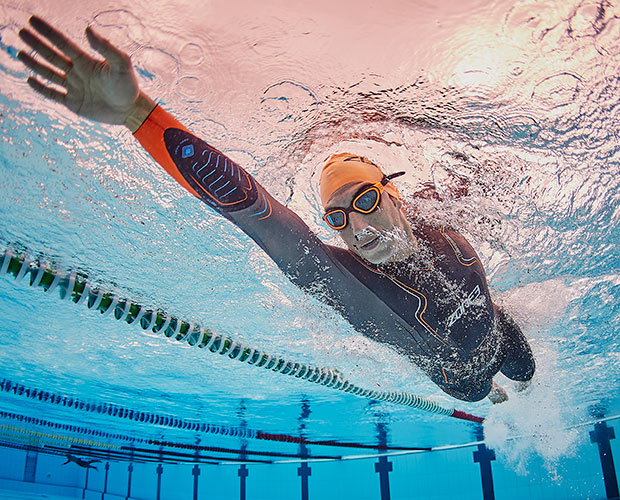
He says it’s very important to take your wetsuit to your pool and wear it for multiple swims. This will give you time to get used to how tight it is, or, if necessary, replace it with one that fits you better.
The second thing he recommends practicing before your race is sighting. You don’t want to show up to your first race without having ever tried poking your head out of the water mid-stroke to see where you’re going. Unlike the pool, there is no black line at the bottom of a lake that you can follow to the finish line, so sighting is a skill you’ll need to have nailed down before you hit the start line of your first triathlon.
How To Avoid Panicking
If you hadn’t noticed yet, Rodrigues’s tips are not designed to help you deal with a stressful situation in the moment on race day. Instead, they’re all set up to prepare you well enough so you don’t feel those nerves or that anxiety or any sort of panic when you’re in the swim leg of a triathlon.
The swim may be the shortest part of your race, but it can be the most dangerous. It’s not something to be feared, but rather something to be respected, Rodrigues says. Give the swim and the environment the proper respect by preparing properly for your race and you will feel great.




There is something much deeper here than “just swim more.” Some of us need something oriented toward more experienced swimmers. I think there is a problem that transcends experience, but warm-up and practice often helps…
I am a reasonably fast swimmer, usually top 5-ish in my AG out of the water. But I also have occasional swimming panic attacks that have no rhyme or reason for me. It is purely psychological. Usually, they occur in the first few hundred yards, and I just need to pull up to get air and then try to swim again. If I can get past 500 yards, I am usually golden.
This year at Gulf Coast 70.3, it was a total dumpster fire. I simply could not swim. I did three recon swims in the Gulf and went into panic mode every time. I felt like I was hyperventilating and could not get enough air, even though I was not swimming too fast at the time. The race was my worst. I could not put my face underwater without the panic. Fortunately, the shortened it to 500 meters, so I could breaststroke the whole way with head above water.
Then 2 weeks later at Victoria 70.3, I was 4th out of the water in my AG with a solid swim. (Not my fastest, but good enough.) It was like Florica never happened.
I would like someone to explain WTH is going on inside my noggin!!!
“Rodrigue’s says”
Felt like a drinking game meant to get us all wasted..His first name is Gerry, great guy too…
First time poster here. Your comment about the panicking resonated with me. I wondered if your earlier swim this year was more to do with water temperature? I raced Vic 70.3 as well, and found the 19c water to never induce any of the tight chested feelings in the practice swims leading up, or race day.
I had been training in 12-14c open water prior and been fighting to calm myself down in it all spring.
Seems to obvious, but thought I’d ask!
Side note I had a friend suggest humming on exhale as a means to give yourself something to control while working on self regulating.
According to my Garmin, my swims at Panama City Beach were around 23.5° C. Victoria was probably one of the coldest swims I have done at 18.5° C. I have done Panama City many times, with and without wet suit, and this was the first year there that I had the issue. I was prepared for a cold water freakout at Victoria, but it went perfectly smoothly. That water was refreshing!
I usually breathe every stroke. But, I was planning to try something like breathing every other stroke or every 1.5 strokes (alternating sides) to change my breathing pattern to disrupt the panic. But, fortunately I did not need to.
No kidding. Jeeze! There goes my theory.
Side bar, did you get stuck in the queue of people in the funnel from transition to swim start? There must have been close to a thousand people trying to jockey for their start zone.
I got in line just in time to avoid the crush. I saw a few folks climbing over the fence or trying to push through the crowd to get to the later swim seeding times. My wife was watching and said it was a total mess. There really isn’t any space there, so it must be the same every year.
Makes me feel better about my first race this year a couple weeks ago. I went from doing IMAZ in November to not being able to freestyle for 100m in a sprint 6mo later. The water was way colder than expected, and just felt like I couldnt breathe enough in between strokes. Took it easy and backstroked my way in.
The quote is so real, but being confident enough in yourself to at finish up, or know to call it off is important