


A Year in Triathlon: The Biggest Controversies of 2025
As we near the end of our look back at 2025 that’s included the top earning athletes, the biggest losses, the top comebacks and the biggest wins, today we’re going to focus on a few of the controversies that rocked the sport. From political scandal to disputed calls to Kona qualifying questions, there were a few issues that got the folks in our forum madly posting. Here are a few of those that caught our eye.
World Triathlon Election Scandal
Senior Editor Ryan Heisler reported on this story in July after the “court for Arbitration for Sport (CAS) … ruled that a member World Triathlon’s Executive Board committed anti-bribery and anti-corruption infractions in the lead up to last year’s vote to install current President Antonio Arimany.”
“Liber Garcia, who serves as President of the Uruguayan Triathlon Federation and Americas Triathlon, was found to have breached World Triathlon’s Anti-Bribery and Anti-Corruption Policy, Code of Ethics, and Code of Conduct for his actions during the 2024 World Triathlon election,” Heisler reported. “However, CAS also ruled that the infraction was so minor as to reduce Garcia’s sanction from a year suspension from his role with World Triathlon to a warning.”
Garcia was found to have “violated the respective code of conduct and ethics policies” when he communicated to Michelle Cooper, the President of the Australian Triathlon Federation and Oceania Triathlon, that there was an agreement between “Africa, Asia and America” that “the president they support will be elected.” Cooper was asked to step down as a candidate for president of World Triathlon and she would be supported to remain on the board.
Cooper did not step down and didn’t receive any votes for the presidency, which was won overwhelmingly by Spain’s Antonio Arimany, nor was she re-elected to her Executive Board role. She filed a complaint to World Triathlon, which suspended Garcia. He appealed the decision to the CAS, who overturned the suspension and reduced it to a warning because Garcia “did not use any particularly aggressive tone in the messages he sent,” nor was there any “financial benefit extended to Cooper to drop out, and that the violation had occurred once.”
In September Peter McCrory, the president of Triathlon Canada, told Triathlete that he had been part of the group that “colluded” to get Arimany voted in as president. McCrory filed a complaint to the World Triathlon Tribunal regarding “intimidation he has received for offering support to another whistleblower” (Cooper).
“We had a transparent and democratic election and have a certificate from the entity that clearly states that it was done according to the rules without any problem,” Arimany told Reuters in an interview heading into this year’s World Triathlon Congress held during the world championships in Australia in October. “Everyone was able to vote freely, transparently and without any kind of pressure or whatever.”
At that congress Max Freund, the head of Triathlon Denmark, put forward two motions around the controversy that were both dismissed. Two counter resolutions censuring Triathlon Denmark and Triathlon Canada for “improper conduct, damaging the image and functioning of World Triathlon” were approved by Congress. The minutes from the World Triathlon 2025 Congress can be found here.
We’re hoping to have more on this particular controversy to report on next year.
T100 Dubai Chaos
We reported on the racing at T100 Dubai, which featured the three leaders on the bike doing an extra lap, then all but four of the field doing one lap too few on the run.
Things started to go awry when race leader Hayden Wilde didn’t head into transition as he finished the bike ride, later stating that the transition area didn’t appear to be open and he was motioned on by people he assumed were with the race to do another lap. That meant Wilde, Mathis Margirier and Marten Van Riel, who were about two minutes up on the chasers, all rode an extra 8 km lap, which put them out of contention for the win.
Out on the run course Morgan Pearson took the lead, only to apparently do an extra lap himself as Mika Noodt ran across the finish line in first. In the end four athletes ended up running the entire course, while 13 others ran one lap less after being directed to the finish line by a digital lap counter. In the end the race was decided “based on the results after the seventh of eight laps of the run.”
In a much lauded move, PTO CEO Sam Renouf apologized for the gaffes from the weekend, promising to do better in the future.
“What every one can be sure of is that we learn from the mistake … no one is more disappointed than us, and you can be sure that we’ll learn from the experience and it will never happen again,” Renouf said.
Wilde Wears Non-Sanctioned Shoes
Hayden Wilde had another controversial issue at a race this year – in winning the T100 French Riviera race the Kiwi wore a pair of Asics MetaSpeed Ray shoes that weren’t authorized for competition at the time.
Ryan Heisler reported extensively on this story, too:
The shoes were to become legal a couple of weeks after the race, and are well within the standards of approved shoes. As I reported in September, “the new shoe is under the 40 mm stack height limit and doesn’t contain multiple carbon plates, but despite that Wilde did offer to disqualify himself from the Frejus race in an email sent to his fellow competitors, World Triathlon and the PTO.”
Wilde explained the mistake in a post on Instagram:
Since the start of the year, I’ve been racing in the approved ASICS prototype shoes, including during my win at T100 London. To be clear, those prototypes were fully approved and listed with World Athletics as they are fully compliant with all technical regulatory requirements.
At the weekend, however, I raced in the new METASPEED RAY, believing it was the same prototype I’d been using all season. It was an honest mistake I only realised after the race.
While my partner ASICS emailed me in due time with instructions around the use of the METASPEED RAY and other shoes and prototypes, I misunderstood the message and didn’t realise it applied to the shoes I raced in.
That was my mistake. As a professional athlete, it’s my responsibility to make sure the equipment I use is fully approved, and I take full accountability for not double-checking.
Here’s the official statement from World Triathlon:
At the T100 French Riviera event, the Asics Metaspeed Ray was worn in violation of the rules, as the shoe had not been on the market for the required minimum of one month according to the list of World Athletics. In this case, the athlete’s shoes were not specifically checked by the Technical Officials due to an oversight of some of the procedures at the event. As the protest deadlines have passed, World Triathlon is not in a position to open an investigation. (The 7-day deadline in section 6.4 refers to cases opened before, during, or after the competition, but within the protest timelines.)
Section 12.10 of the Competition Rules doesn’t allow the World Triathlon Technical Committee to open a protest procedure regarding “Equipment used by an Athlete”.
World Triathlon and PTO will work closely together in the future to prevent such oversights, especially in relation to non-Field of Play officiating matters.
Kona Qualifying Changes
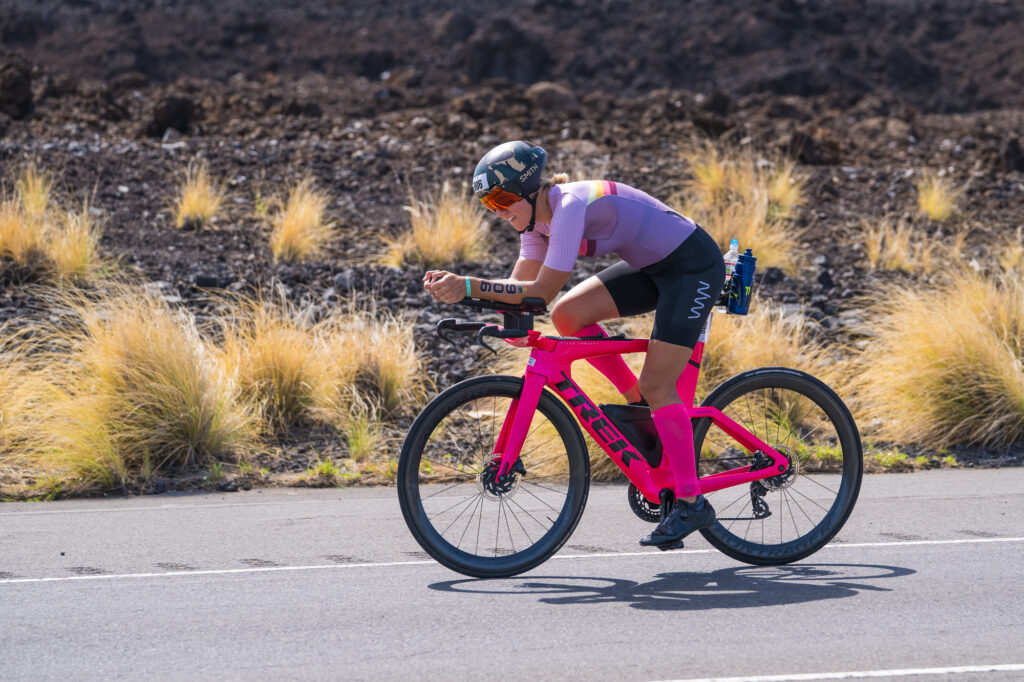
Age-group competitor Julie Worth competes at the 2025 IRONMAN World Championship in Kona. Photo: Kevin Mackinnon
When IRONMAN announced its new Kona Qualification system in early July, the concept of a performance-based qualifying system based on both age-group winners along with “athletes, who on a relative basis within their gender and age group, are most competitive” seemed to make sense. Just over a third of the way into the 2026 qualification process for Kona, though, IRONMAN decided to change the system to ensure more women earn qualifying slots in the “performance pool” of those most competitive athletes.
IRONMAN elected to make the changes because through the early part of the Kona qualifying cycle for next year there weren’t as many “peformance pool slots” going to women. That, combined with a larger percentage of women not accepting their slots, meant that there was a reduction in the number of Kona slots going to women.
Heading into IRONMAN Arizona, IRONMAN split the performance pool slots by gender, kept the automatic qualifying slots that rolled down within each gender and provided retroactive slots to athletes who would have qualified under the new system. You can read about the changes here.
Meissner Stripped of European 70.3 Title, Then Wins it Back Through Appeal
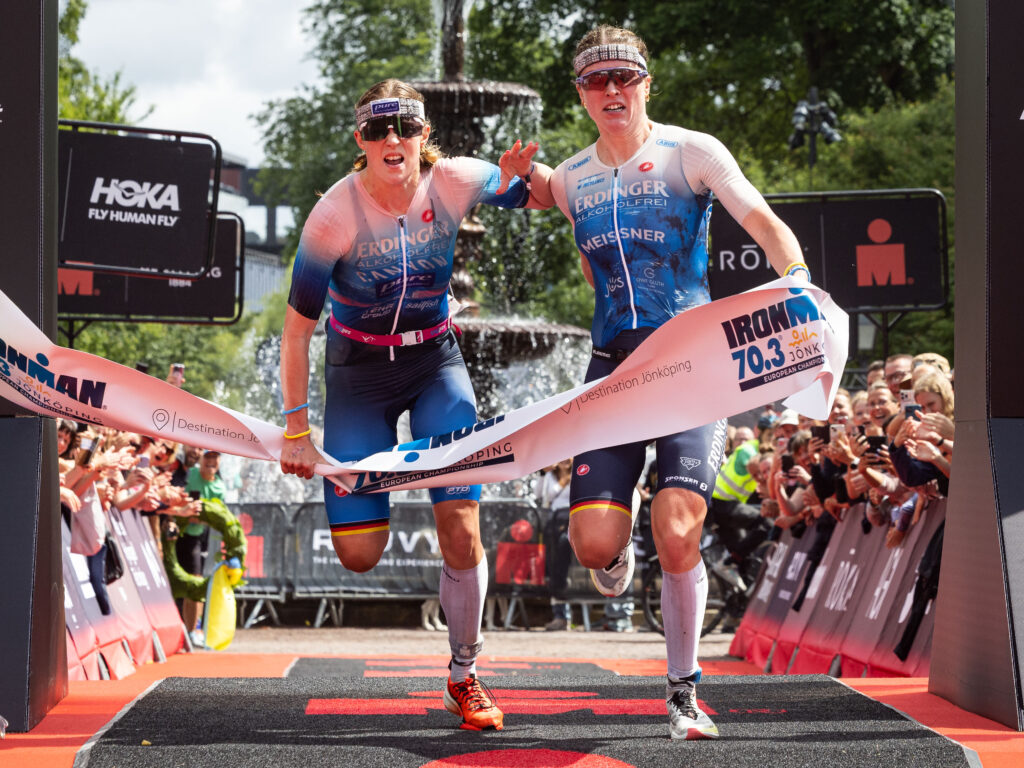
Caroline Pohle of Germany and Lena Meissner of Germany run neck and neck as they finish at IRONMAN 70.3 Jonkoping on July 6, 2025. Photo: Michael Campanella/Getty Images for IRONMAN
IRONMAN 70.3 Jönköping served as the 70.3 European Championship this year, so there was a lot riding on the win. A pair of Erdinger teammates – Caroline Pohle and Lena Meissner – found themselves sprinting for the title. The Germans came across the line at virtually the same time, but Meissner appeared to have crossed the line in first. Initially officials declared her the winner, but after Pohle protested, it was determined that Meissner had inadvertently impeded Pohle’s progress to the finish tape, so officials switched their places, declaring Pohle the winner and putting Meissner in second.
Meissner then appealed that decision to the Swedish Triathlon Federation, who reinstated her as the champion.
Magnus Ditlev’s Overturned DQ in Frankfurt
It takes a lot to get Magnus Ditlev worked up, but an official at this year’s IRONMAN European Championship Frankfurt managed to do just that when he showed the Dane a red card during the run.
Here’s how Ryan Heisler described the penalty in a story earlier this year:
Magnus Ditlev rolls through an aid station. It appears something drops behind him. An official immediately blows a whistle and calls him for littering. Magnus starts arguing with him. The official tells Magnus to pull over and serve the time penalty (run course time penalties are served at the spot of the foul). Magnus refuses. The official blows his whistle again, shows Magnus a red card, and informs him of the disqualification. At which point, Magnus utters the phrase we all were thinking of.
“Disqualification? What the f*** are you talking about?!?”
It’s perfect.
Magnus later follows up with “you can’t disqualify me,” before shaking his head and continuing to run. The disqualification would later be overturned, and he’d keep his eighth place finish on the day.
Let’s lead with the obvious: the littering penalty was a bad call. The action takes place at an aid station. It does not appear to be intentional nor careless. It looks like, well, how every pro triathlete in the last 20 years has rolled through an aid station. I completely understand Magnus’ incredulousness at the situation. The referee then further escalates the situation by immediately going to the red card, without giving it more time to explain the why he was doing something. That’s an opportunity for the referee to continue the explanation over a longer period before deciding to pull that card out.
Hydration and Storage Rules
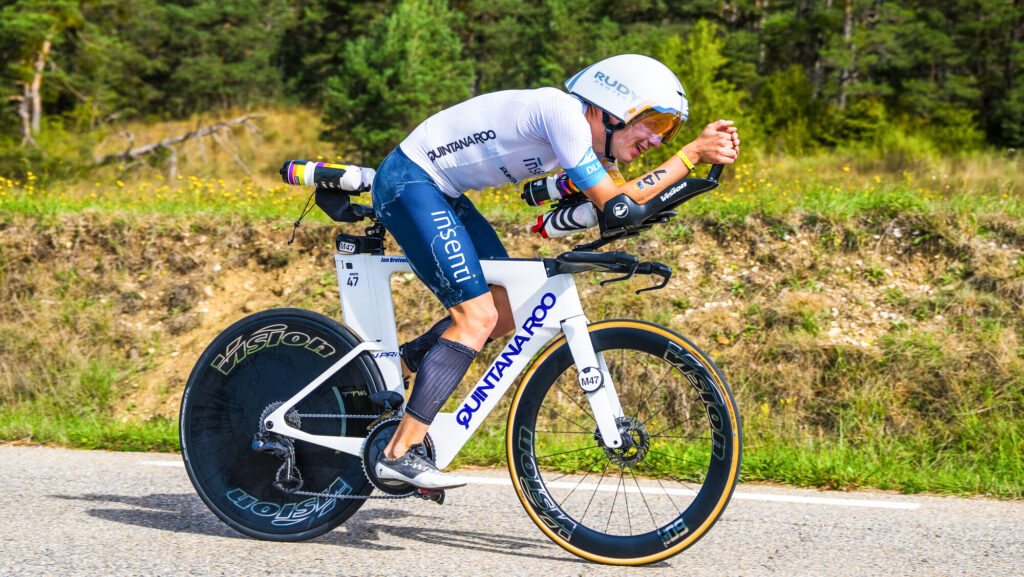
Jon Breivold on the bike at the IRONMAN World Championship Nice. Photo: Kevin Mackinnon
World Triathlon and IRONMAN updated the rules around water bottles and storage on bikes at the beginning of the year. The German triathlon federation, the DTU, updated the rules later in the year, further restricting the placement of bottles. In April, World Triathlon offered an “interpretation” of the new rules that included a 30 x 30 cm box that a rear hydration carrier and a frame storage box had to fit into.
Then, in June, World Triathlon offered up yet another interpretation of the rules that excepted storage boxes that are integrated into bike frames, which meant athletes didn’t have to choose between storage or a water bottle behind their saddle.
The new rules also affected the front end of the bike – no more than 2 litres of fluid is allowed and “all attached bottles, carriers, etc. must fit within a box that starts at the furthermost edge of the aerobar, extends no more than 25 cm in the direction of a saddle, is no more than 20 cm tall, and is further than 5mm from the front wheel.”
You can read more about the update here.






Good article. It will be even better in 2035, when it’s a trip down memory lane. Save that in the database! And the World Triathlon debacle, that’s the first time I read about it in such detail.
How can there be no mention of hookless in this list?
Uuuuummm…
#Notacontroversy
A protracted decision which took an inordinate number of months to determine that Simmonds bore no fault or negligence for the pico level of metabolites which resulted in the AAF.
Surely the most controversial decision is the return to an IRONMAN World Championships on a single day with the men having to race at the same time as the women and having their race coverage spoiled by having the broadcast spending disproportionate % on the women’s race. As opposed to separate days for each race, in alternating iconic venues, one of which has sensible environmental conditions for athletes to race probably the hardest mass participation endurance event in the world.
But it’s OK: the location is “exclusive” (with $$ to match) and it’s “reimagined”!
It’s hard to measure the level of controversy (signed, Captain Obvious). If you use the yardstick of to what extent did triathlon media, PROs, pundits, officials, etc. offer contrasting opinions on the subject, I’d say neither the Simmonds affair nor the return to a one day WC in Kona were that controversial.
If you use the yardstick of what did people talk about, it’s a different conversation (no pun intended).
Everything is controversial here on Slowtwitch, y’know…
Agree first assessment, less so second, and beautifully put.
Could spawn another article covering what topics/subjects bumped twitchy gums most in 2025.
The lesson, as always, is there ain’t no drama like triathlon drama.
Also filed to: Jesus, I guess I like to stir shit up based on what I cover
The words I’ve emboldened are not what @rrheisler says in the article.
Reference point is “the lowest edge of the arm support”. you might say “close enough” but we saw that Wilde needed to be ‘economical with rule following’ to stay within the 250mm limit.
If they re-rewrite this, I prefer that World Tri use “the lowest point of the athlete’s elbow in the rider’s intended aero position” as the “lowest edge of the arm support” can be manipulated by having a long scoop behind where the elbow’s point will sit.