Aging in Triathlon: Enjoying Life After PBs
Triathlon is a unique sport — even if you are nowhere close to battling for the overall win or an age group podium, you can still fuel your race with competition. Not necessarily competition with others (although there will always be fellow triathletes nearby to chase down and race), but rather with yourself. Like all endurance sports, triathlon is a game of personal bests (PBs), and it’s that self-competition that drives so many athletes.
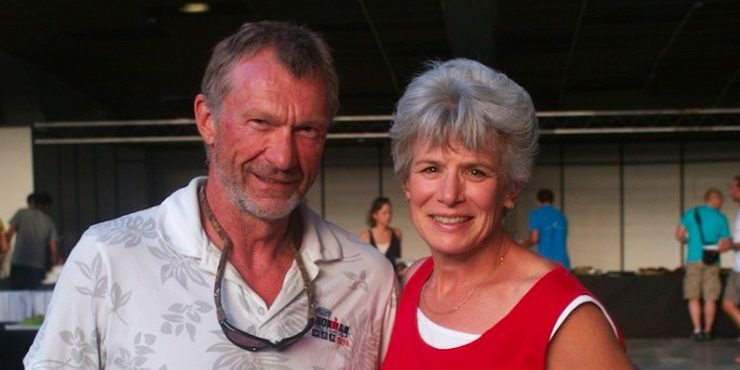
But what are you supposed to do when PBs are suddenly no longer attainable? Whether you’re Kristian Blummenfelt or a back-of-the-pack weekend warrior, there will come a time when you realize you’ve raced to your last PB. This may be tough to accept, but it doesn’t have to be the end of your motivation as a triathlete. Don’t believe that? Maybe it will be easier to buy hearing it from American Cherie Gruenfeld and Canada’s John Wragg, a pair of legendary age groupers who have spent years racing and staying driven well past their primes.
Noticing a Dip
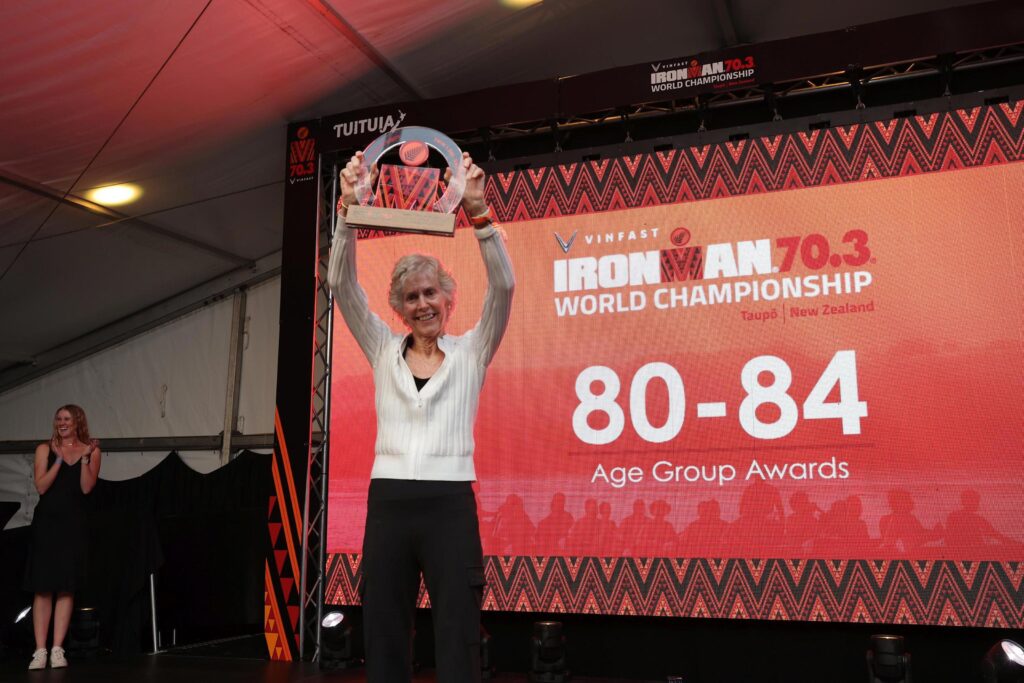
It may have taken Gruenfeld, now 82, more than 40 years to find her way to endurance sports, but when she finally did discover them, she quickly made up for lost time. In her next 40 trips around the sun, Gruenfeld finished countless running races and triathlons, including multiple appearances in Kona that saw her become age group world champion 14 different times.
Toss in four 70.3 age group world titles, the record for oldest woman to reach the finish line in Kona (her age-to-beat of 78 was bested by 80-year-old Natalie Grabow on the Big Island last October) and years of triathlon-centric charity work and it is really no surprise that Gruenfeld is an IRONMAN Hall of Fame inductee.
With decades of training and racing to draw from and an ongoing athletic career, Gruenfeld is one of the most qualified people to discuss aging in triathlon and dealing with the loss of speed.
“It was just kind of a feeling as the years passed that things were not like they used to be,” she says. “It was not because of the finish times that I was posting as much as that the training got harder. I realized how much harder the training was than it used to be.”
Like Gruenfeld, Wragg, 75, also got started in triathlon later in life, completing his first race in his mid-30s. In the decades since, he has completed a record number of full-distance races, with 275 finishes on his resume. Before the COVID-19 pandemic, he and his wife, Elizabeth Model, had raced every IRONMAN on the planet at least once. (IRONMAN has since added new races, but Wragg and Model didn’t try to keep up.)
“I think the optimal age for endurance sports is 25 to 35,” he says. “So I was actually declining when I started the sport.”
With ever-evolving and constantly improving recovery science and methods, some athletes may experience longer peaks than Wragg and Gruenfeld did in the 80s and 90s, but as Wragg points out, “very few pros go past 40” and maintain the tenacity and speed they demonstrated the decades before.
Whenever it is that you hit this point in your career, Gruenfeld says you’ll be at a fork in the road.
“There’s one of two ways you can go,” she says. “One is you can say, ‘OK, I had a good run. I can’t do it the way I used to, so, you know, I’m out of here.’ Or you could say, ‘I can’t do it the way I used to, but I still enjoy this.'”
Gruenfeld says she felt the latter of those two options, and to this day, she still enjoys the triathlon lifestyle, the people in the sport and the place she holds in “this athletic family” and community.
“It wasn’t hard,” she says of her decline in speed. “I just made adjustments and dealt with it.”
Becoming Grateful
A big thing that keeps Gruenfeld going, she says, is gratitude. Gratitude to be able to get up and swim, bike and run every day and to continue to push herself.
“No matter how old you are, it’s important to keep that mindset,” she says. “I’m grateful that I can still do this. It takes me longer to finish a 70.3 than it used to, but I can still do it.”
Wragg echoes that sentiment of gratitude when asked if he would do his whole triathlon career over again. He has suffered several accidents and injuries in the sport, including a collision with a truck back in 2008 that left him in the hospital for an extended stay. He had a hip replacement and says he “was never the same” after that. He has also “destroyed” his right knee and right shoulder after years of wear and tear.
With those injuries and the lingering issues they left him with in mind, it would be hard to blame Wragg if he said he would take the route of “no triathlon” if given a do-over. While he says he would do some things differently (such as race only one or two full-distance events a season instead of the “15 to 20 ” that he says he did do for a number of years), he would ultimately still stick to the life of a triathlete. And why? He loved the sport in the 80s and 90s and he still loves it now.
Like Gruenfeld, he is grateful to train and race, which they have both proven to be a key to longevity in the sport.
Switching Things Up
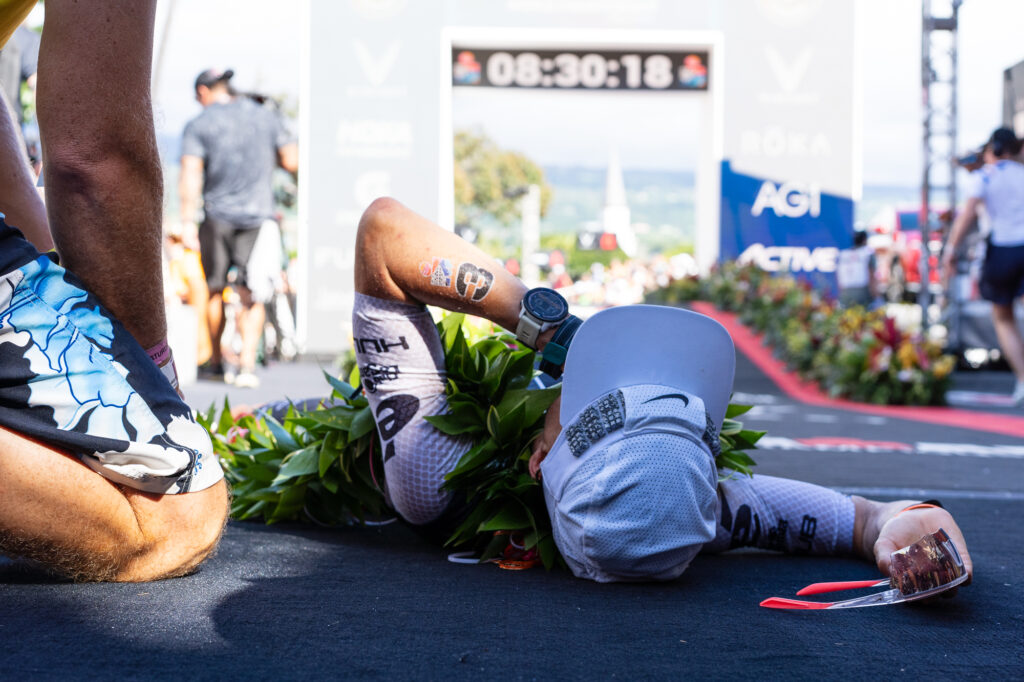
Wragg has another tip for staying motivated when you can no longer chase PBs: switch up your race schedule. He made a name for himself in IRONMAN racing (it would have been hard not to after racing close to 300 of them), but he says his time is almost up in that corner of the sport.
“I’m in the 75 to 80 age group now,” he says. “I think the full distance is too far for me.”
He has plans to line up for one more: IRONMAN Canada in Ottawa this summer. He and Model raced there last year, but Wragg didn’t make it to the finish line. He says he hopes this year will be different, but he doesn’t seem too stressed about it one way or another.
He has no immediate plans to retire from racing, though, as he and Model are still keen to compete in 70.3s and T100 events.
“The T100 races are a great distance,” he says, referring to the 100-kilometre format. “We’ve done four of those, and we would love to do more.”
Wragg may not be crushing personal bests at every race, but he keeps things interesting by mixing things up with some variety every now and then.
Finding Your Why
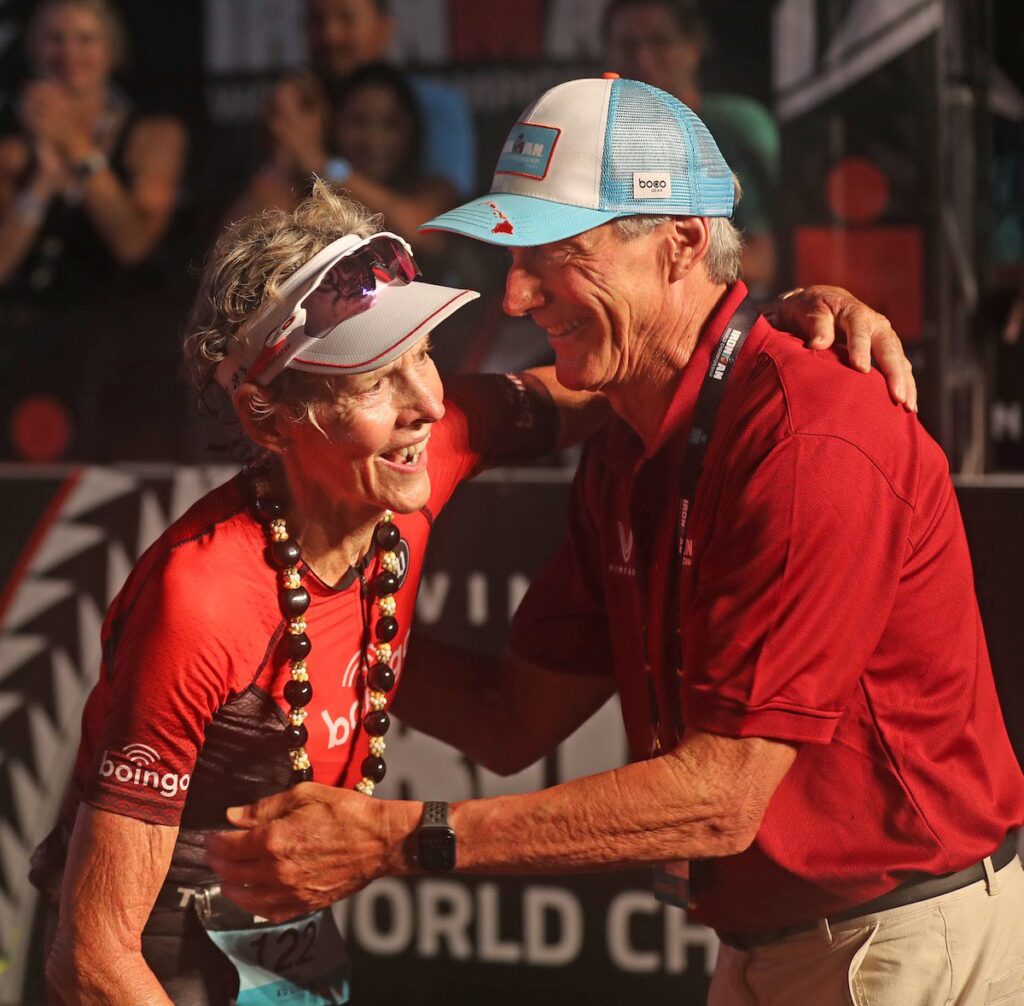
The last note comes from Gruenfeld, who says you need to reshape your goals when your lifetime bests are no longer beatable. You need a new reason to get up every day and train and a new reason to show up to races.
“When that decline starts happening to you, the first thing that you really need to think about is why you’re doing this,” she says. “You have to ask yourself, ‘Do I really want to keep doing this if I can’t be the athlete I used to be? Or am I just here out of habit?'”
Gruenfeld says that just because you “can’t compare yourself today to your younger self” doesn’t mean you can’t still challenge yourself.
“I think it’s really easy to find a purpose in it,” she says. “There’s still a possibility that you’re going to do great things, things that you didn’t think you were going to be able to do. You just have to start setting your goals differently than you used to.”
The beauty of triathlon is there will always be a time to chase, even if it’s slower than you’ve shot for in years past.
“Set challenging goal times and then push yourself to train for that,” Gruenfeld says. “If you can get close to that on race day, that’s great. If you fall short, that’s fine. It’s not a failure. And besides, there’s always another race.”