
Effortless Swimming Tips for Experienced Triathletes
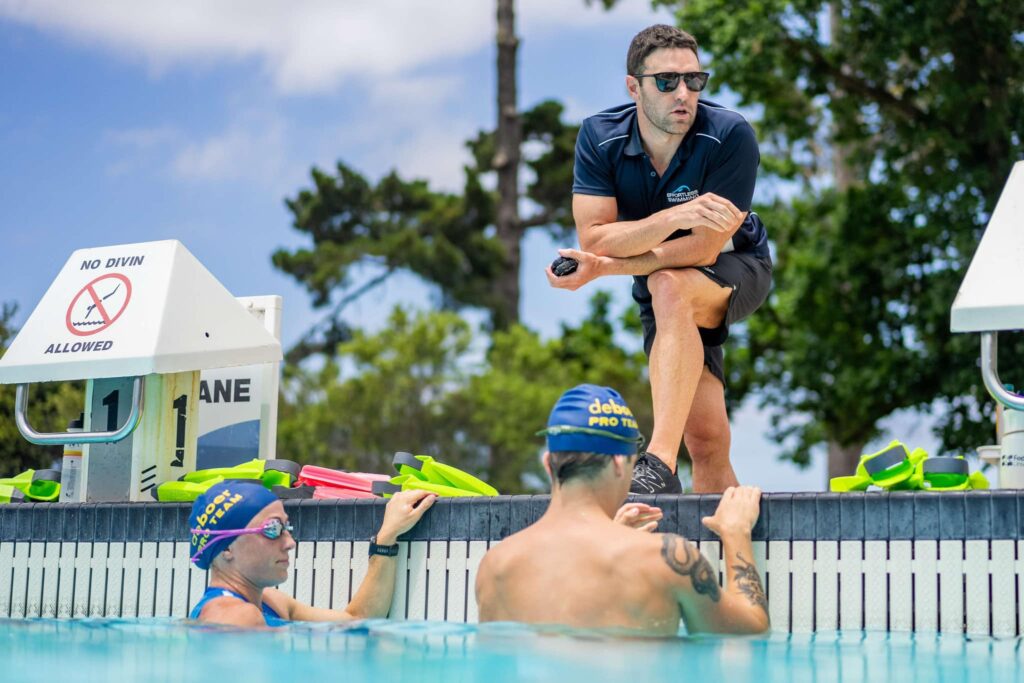
Brenton Ford has been coaching swimming for many years, but not just at his local pool. Ford runs Effortless Swimming, a YouTube and social media page that many triathletes will know well. Effortless Swimming has hundreds of thousands of followers and subscribers across multiple platforms, and it’s all thanks to Ford’s ability to break swimming down into simple terms.
Slowtwitch was lucky enough to have a chat with Ford in which he discussed swim tips, drills and workouts for beginners as well as more experienced swimmers. The beginners article can be found here, but if you have a few seasons under your belt as a swimmer or triathlete, you’re in the right place.
Room to Improve
Ford recalls a conversation he recently had with an athlete. This athlete is one of Ford’s online clients, so he also works with an in-person swim coach.
“His coach said to him that he wasn’t going to get any better and to just, like, be OK with that,” Ford says. This athlete swims in the 1:50 to two-minute range for 100 metres.
“He’s got so much room to improve,” Ford says. “But there are some coaches who just have that mentality. Like, ‘No, you can’t change, that’s the pace you’re going to swim.'”
Ford shakes his head at the thought of delivering a line like this to an athlete.
“It’s just the wrong message,” he says. “Even if that was the case, why would you say that? It’s just going to demotivate them.”
While the athlete in question was swimming in, or around, the two-minute mark per 100 metres, Ford says there’s no point at which a coach should say their athlete has plateaued. Yes, the faster someone gets, the more difficult it will be to improve, but there is always something that can be done, adjusted or tweaked to shave time. It’s even the case with the best swimmers in the world, as they are always chasing personal bests and world records.
The key to getting faster is technique. Anyone who has watched Ford’s Effortless Swimming videos will know he stands by this rule. He has multiple videos catered to specific barriers, whether an athlete is looking to break two minutes in the 100 m, 1:30 or another time.
While running and cycling certainly have technique and form that must be perfected if you want to get the most out of yourself, swimming is in a league of its own. As a full-body workout, it requires attention to detail from your head to your toes and everywhere in between.
“I think that’s a big part of why we’ve managed to kind of stay in business in a way for the last 18 years,” Ford says with a laugh. “Because it’s frustrating for people and they don’t understand why they can’t get faster, but it’s all about technique. Everyone can improve and get better.”
Tense But Relaxed
Ford says a big tip he gives swimmers is to “find that balance between tension and relaxation.”
He uses “soft hands” as a cue to help his athletes find this balance.
“It’s enough tension to hold the shape of the hands and the forearms together, but no more than that,” he says. “It’s like picking up a glass of water. You don’t grab it as hard as you can, just enough to hold it in your hand.”
Ford says a lot of swimmers — even people who have been swimming for years — will have tense fingers and tense shoulders. This is especially the case when trying to go fast — it almost feels natural, in a way, to tighten your muscles for better, quicker results. That full-on tension can make you faster, but it can also actively slow you down.
“It does take a while to get there to that sweet spot of tension and relaxation,” Ford says, adding that it is so worth it when you can nail it down. Like most things with swimming, you will need to focus on maintaining that middle ground for a while, but eventually, it will become your go-to zone in the pool.
Hitting the Pool and Gym
For triathletes, Ford recommends getting in the pool a minimum of twice a week.
“Two times a week you tend to maintain your level,” he says. “My general rule of thumb is three times a week and you’ll generally improve.”
Adding more swims, whether it’s four or even five times total each week, will, of course, boost your gains even more, but Ford recognizes that triathletes not only have to train for cycling and running, too, but also that they have other parts of life that may keep them from the pool that often.
When it comes to strength training, Ford says “it certainly doesn’t hurt” to get into the gym (or to work out at home) at least once a week. He says the focus for your swim-specific strength routines should be core and upper-body.
On the note of gym training, Ford points to Dutch swimmer Sharon van Rouwendaal, the reigning Olympic champion in the 10K. He has worked with her before and picked her brain on training load and techniques. She told Ford that she solely works her back and shoulders in the gym, as these are the muscle groups used in freestyle.
“I think that’s a pretty good take, especially for people who don’t have a lot of time,” he says. “Even if it’s just five or 10 minutes of band work prior to swimming, just working on strengthening those muscles that surround the shoulder blades is great. Working your lats, traps, back, shoulders can go a long way, especially for preventing injuries.”
Effortless Swimming Workouts
For experienced swimmers, Ford recommends a pair of workouts that will both challenge you in the moment and prepare you for races later in the season. The first is 20 x 100m on your best average with 45 seconds of rest between each rep.
“This is a challenging set that will help build real fitness for an Olympic up to to full IRONMAN swim,” he says. “Best average means to hold as fast as you can across the entire set, so the speed that you start at should be the speed that you finish at.”
The second set is just a tad longer, but since it features 200 m repeats, it will test your endurance even more. The set is 12 x 200 m with just 15 seconds of rest between each rep. The first three 200s are held at 70 percent of your maximum effort. The next three reps boost to 75 percent, followed by three at 80 percent before finally closing the set out with three more 200s at 85 percent.
“Distance sets with short rest where you progressively get quicker towards the end of it can be great at helping you maintain your speed in the back half of a race,” Ford says.
As always, be sure to do a proper warm up before both of these workouts and don’t skimp on the cool down afterward. To find more tips from Ford and Effortless Swimming, click here.





If a triathlete doesn’t have time to do an extra swim or two per week, how is it that the triathlete has enough time to hit the gym at least once per week? Especially since that gym workout will by necessity require recovery time to have a training affect, which detracts from the time to do all the other workouts and parts of their life.
To then immediately reference a world-class swimmer who does gym work is a bit misleading. World-class swimmers already put in such large volumes of pool time that more swimming will likely provide smaller marginal gains than would doing gym work. Not the case for the rest of the world. “Ten minutes of band work prior to swimming” could be displacing 500 meters of swim technique practice each workout.
His comments about technique are, of course, spot on. It’s called swim practice for a reason.
(off to the pool for me for some 100s holding best average with a lot of rest, it seems)
Strength training can often be done at home. Maybe the athlete doesn’t have the time that aligns with a pool’s schedule, or the commute there and back adds too much time. But most people can do a 30 minute core and band routine, or basic barbell complex, somewhere in their week.
If not maybe it’s worth replacing one an easy or junk-ish bike or run workout with a dedicated strength session.
Firstly, every triathlete should do their best to have at least one strength session a week. This is as much for getting stronger as it is for injury prevention. You’ll of course need to do running/cycling strength work, too, but there can be days that are dedicated to swim-specific exercises.
Secondly, who are we meant to look to for inspiration and guidance if not world-class athletes? I’m not recommending for just anyone to go and try an Olympian’s workout, pace times, or training load, but if there was ever someone who is a great model for success, it’s an Olympic champion, no?
Thirdly, regarding the band work, I have personally seen what minimal strength training can do for swim maintenance. I spent last May to September out of the pool almost completely (swam perhaps four times total all summer) and instead played tennis and did very basic strength work on playground monkey bars and with bands and 15lbs dumbbells at home. When I returned to regular training in the fall, I found myself keeping up with the same people I always swam with before and hitting the same (or better, in some cases) times I’d been aiming for before leaving the pool in May. Unfortunately, I am in no way an exceptional or natural-born athlete, so this maintenance/these gains cannot be attributed to any innate affinity for swimming, but rather to a very basic strength routine.
The reality is some kind of basic strength work should be the base of most endurance athletes, much like we talk about zone two training being the base of your speed pyramid. It allows you to train harder, more consistently, with fewer injuries.
How many triathletes suffer from tight hip flexors caused by weak glutes, or rotator cuff issues caused by their shoulders being pulled forward due to swimming induced muscle imbalances? I’ve had both. You know what usually heals Achilles tendonitis? Heavy lifting. What we usually write off as over training injuries is often over training in relation to our level of strength.
Often times the work isn’t particularly fun or sexy especially if you’re an endurance focused person, but it is incredibly important for longevity in the sport, and maintaining a healthy body later in life.
I get it, its just marketing, but I dislike the name “effortless swimming” because it perpetuates the myth that getting better at swimming is just a matter of finding that missing piece of technique.
He has put out a lot of videos over the years and helped people find interest in swimming. Effortless swimming - don’t you effortlessly swim 100s on 110?
Things that I like about the training approach of other online swim coaches such as Paul newsome is - emphasis on pacing for racing, paces for training (tempo trainer) and the slightly crazy obsession about specific types of technique (eg swinger / smooth). It’s just relatable - we all have very specific and wild theories.
Brenton seems less crazy, but more focused on broad brush technique. He has good contacts and his channel features a lot of very good Australian distance swimmers, the most recent being a 3:40 400 freestyler and another Olympic finalist women’s distance boss
RIGHT! 20 x 100’s best average with 45 seconds rest is a freaking awesome set. And the antithesis of effortless!
Yes, I tend to think doing that set more than once a week or fortnight is just a bit too hard if you just swimming by yourself. Maybe I’m getting soft.
I recall Tim Floyd writing a few years ago that although Matt Hanson improved a lot with him and did a lot of SRPT style training, which let’s be honest 20×100 on 45 seconds has some broad similarities to that, he could not keep up that training by himself long-term. Too hard.
As I said, I went off to the pool to do some “best average” intervals. Being 67 and no longer training, I only did a set of 10x100lcm on 2:15. I normally do sets of 100s on 2:00, coming in around 1:37-40. This was 1:34/33/32/32/32/32/31/31/31/31. The last three were pretty hard. I can’t imagine doing 20 of them very often. I did learn a couple of things today, though:
On the other hand, Paul Newsom promotes a style of training that is sub maximal and all about improving aerobic capacity and aerobic fitness. He has his group doing 10×400 and in his own swimming each week. He does a 2 km straight each week (the 2km he has been doing this for the last few years) outs that tempo trainer in and just chases the pace for 2 km
He is completely convinced of this way of training as I don’t know the science but when you build up your aerobic capacity a lot you reduce your anaerobic capacity, and your ability to produce lactate. So you don’t blow up
An example of his belief in this training is that he questioned Simon Lessing in a podcast that he did with them that his training in the lead up to Sydney particularly in the Swim may have been counter-productive and what led him to blow up.
Simon had an outside Swim spot so knew that he had to swim much faster than normal to get onto the feet of the swim leader Craig Walton. So instead of his just usual medium training sets in the lead up they were doing 5×200 on six minutes maximum. Obviously promoted more anaerobic than aerobic and generated more lactate. But he was reaching Swim levels that he had never done so before.
Sure you could ask this sort of question but when you listen to someone like Simon lesson you can tell he is a deadly serious person and that sort of question is quite rude, but this is an example of Paul having a theory and sticking to it
Completely agree.
If MOP triathletes need to do ONE single thing in general, it’s actually not to focus on improving their swim technique (even though yes, we’re ALWAYS trying to have the best technique we can whenever we swim). MOP triathletes need to get their butts out there and swim a LOT more, and a lot harder in general.
The 7-9k/wk a typical MOP triathlete swims is only going to get you so far unless you are a naturally gifted swimmer. (I actually think most kids on real competitive swim teams fall into this gifted category. If they weren’t gifted, they wouldn’t be on that team.)
Still love Brentons videos though.
The idea that Katie Ledecky has done more swimming on a Monday morning than a typical adult triathlete does in a week is kind of funny and she hasn’t even gone back for the afternoon