


Five Triathlon Lessons From a Vacation in Hawaii
The Wednesday after the women’s IRONMAN World Championship took place, my wife and I boarded a flight in Oregon, bound for the Hawaiian Islands. As I wrote in our forum at the time, the irony was not lost on me that I had not been in Kona for the race, yet here I was now about to be on vacation (almost) in the same place. (We wound up one island over.)
And after a whirlwind five days, it was over just as quickly as it had started; we drove our rental Jeep Wrangler back to the airport, boarded a flight, and headed home, just in time for the rainy season to begin in earnest here in the Pacific Northwest. In that short span of time, we managed to cram in a lot of activity, as well as plenty of time to think through some lessons from the trip that are applicable to triathletes, race directors, and our industry alike.
The Magic of Hawaii is Real, and Makes the Case for Why the IM World Championship Should Never Move
I get why Kona is Kona now.
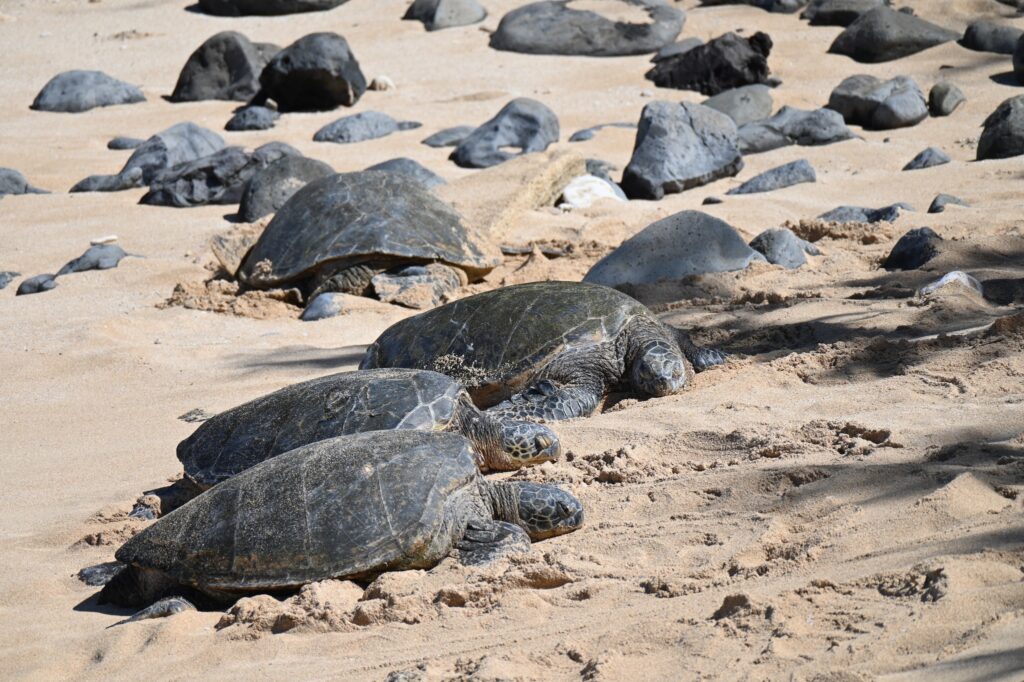
There is magic in Hawaii. Period. From the second we stopped off our flight, even late at night, until we got back to the airport, there’s a buzz in the air. Whether it’s lava fields, or the beaches, or the terrain around you, or the people you meet — Hawaii has something that can’t be replicated anywhere else.
And for IRONMAN, that’s true as well. Hawaii is the birthplace of IRONMAN, and Kona has been its landmark since the move from Oahu in 1981. They are forever linked together. And among IRONMAN customers, they’ve clearly spoken: for both the men’s and women’s world championships held in Nice, the fields were smaller than the respective fields when those genders went back to Kona. While I think at least in part those fields were smaller due to the dramatically different landscapes of those two courses, I also think it comes down to the fact that there’s something simply different about Hawaii.
The company might be based in Tampa, but its heart is in Hawaii.
Triathletes: Try Something New This Year
Please. I’m begging you.
We are a weird bunch. We’re the segment of the endurance sports marketplace that is least brand loyal; we’re most likely to try new things; we typically have disposable income to support buying gear and doing events. Yet then we see the same events, year in and year out, getting most of the race traffic, and then we wonder why certain events disappear.
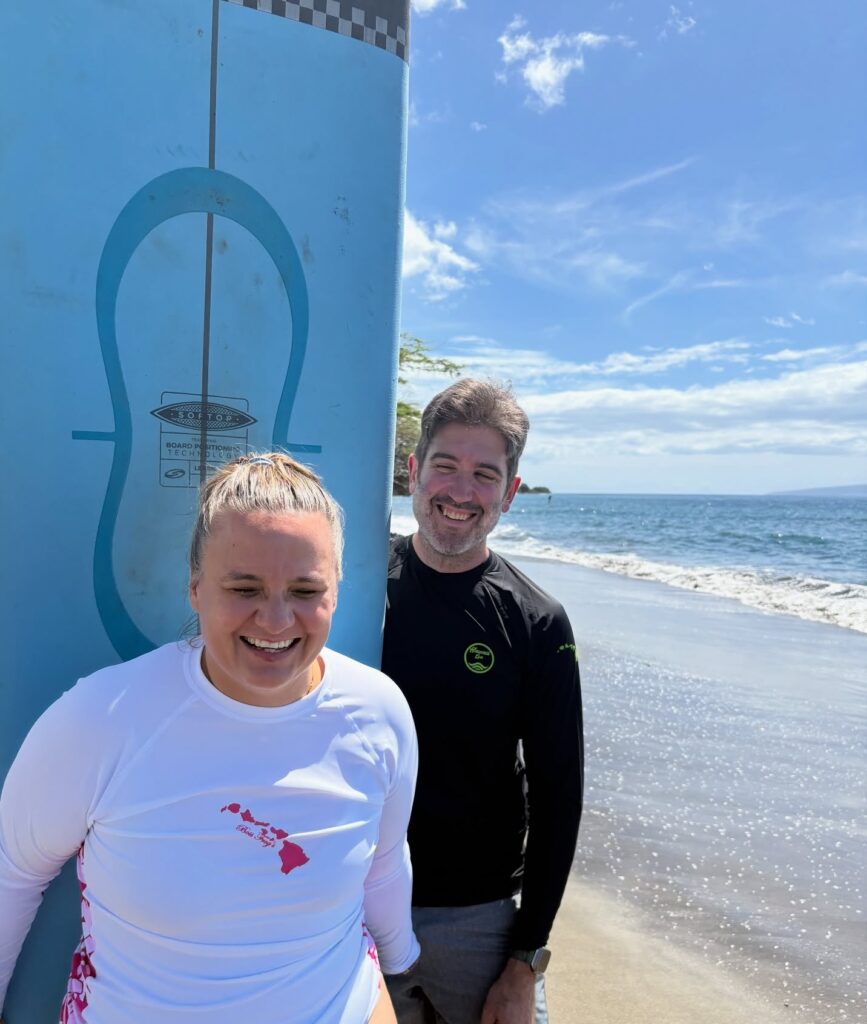
I learned how to surf while in Hawaii. And to say that I fell in love with it is a mild understatement. I’ve been researching boards like it’s my day job. (Editor’s Note: so that’s why you’ve not been writing as much…) Even the act of failing (read: falling) was exhilarating in its own right. It was moving my body differently, getting out on the water differently, and simply doing something for the sake of having fun.
It’s that last part that I think we lose sight of far too often when it comes to racing or triathlon, generally. It’s supposed to be fun. At our core, this is supposed to be tapping into the joy of play, of movement, of activity, of being outside, of being with a community. And while yes, there’s fun to be had in racing for the sake of racing, there needs to be balance to that. In my opinion, to have balance, you need to be doing some different stuff. Whether that’s my upcoming SkiMo season, or trying a gravel triathlon or cycling event, or hitting the trails instead of the roads for some running, it’s time to bring out some of the adventure.
Race Directors: Don’t Try to be IM — Be Something Different
Race directors, it’s the same edict for you: it’s time to try something else.
The truly successful independent events in our sport bring something else to the table than being just a race. There’s an experience of some sort; whether that’s by being a particularly difficult course (Norseman and the associated XTri events, for instance), or by excelling at customer service, or by having a race director that brings his or her own cult of personality to the table. The one thing they aren’t trying to be? A budget version of an IRONMAN.
If you try to compete with IRONMAN on the basis of price or convenience, you will lose that battle ten out of ten times. People know exactly what they are getting when they pay for an IRONMAN entry these days. And with costs continuing to escalate, independent races are forced to either raise prices or reduce amenities in order to run profitably. If that event is a 70.3 or 140.6 distance race…unless you have massive brand equity (Roth, I’m looking at you), or you are providing a white-glove level of service to all of your customers, it’s likely you are doing yourself a disservice by trying to have those events.
So do something different. Make your courses different; make them challenging or easy; make yourself uniquely marketable. Heck, in the running space, we have an entire race series dedicated to downhill marathoning and running Boston Marathon qualifiers. It’s identifying your niche and filling that space. Because otherwise…you’re playing IRONMAN’s game. And that’s not a winning scenario for anyone.
How Do We Improve on Sustainability?
One of the shocks to the system was the lack of single-use plastics anywhere. Coffee shops serve everything in paper or cardboard. Want water? It comes in a can, a cardboard box, or better yet, a screw top aluminum bottle that you are asked to refill. Whether it was at the hotel, or gearing up for an excursion, you’d be given one of these aluminum bottles, asked to write your name on it, and keep it with you for the trip.
It’s a far cry from the amount of single-use plastic waste that we, as triathletes, generate at your average race. There’s all of the water bottles at aid stations, particularly those for the bike. In places where there aren’t other sources of water to fill coolers, there’s all the fluid that needs to wind up in those coolers. There’s all of the plastic for ice; for the wax paper cups we use at aid stations; for trash itself. And it’s not like the answer is recycling, as for the most part, plastic recycling only accounts for roughly 5-6% of all plastic produced.
As an industry, we’re likely going to need to wrestle with the idea of modifying our race experiences to try and improve on this front. We’ve seen this in the ultra running world and in certain gravel races; namely where aid stations have you refill bottles as opposed to disposing of them for quick refills. There have been limited instances of this practice in triathlon, with mixed athlete feedback about it. But, especially where resources for disposal are limited, and recycling potentially even more so, it might be something worth considering.
The Art of Being a Good Neighbor
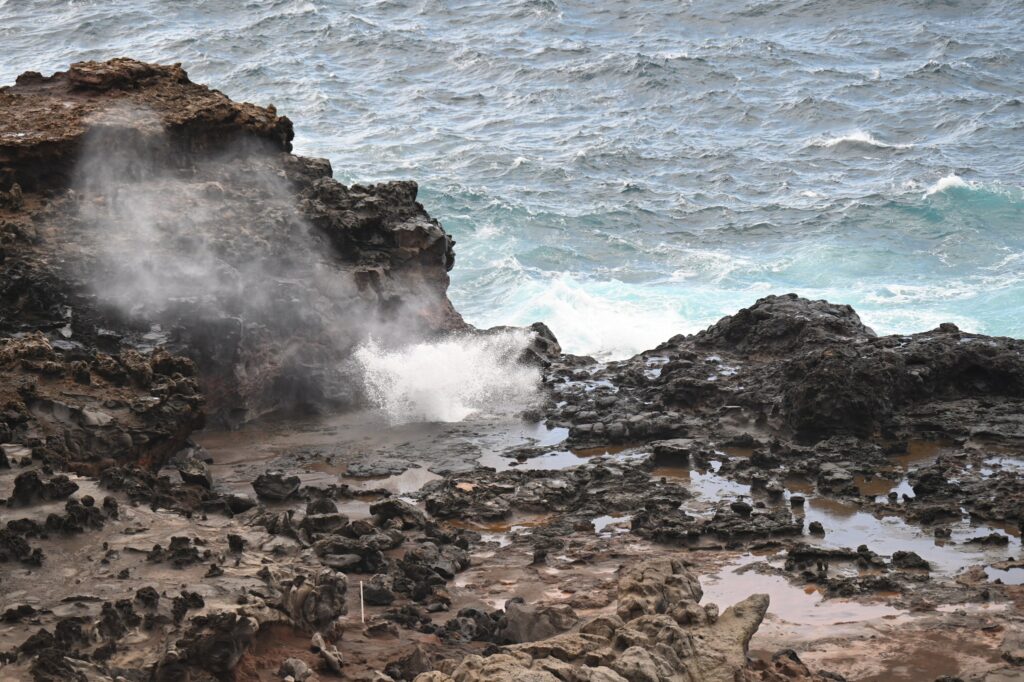
This is about all of us: athletes, race organizers, tourists, you name it. We need to be more respectful of the places we’re in.
Every year after the IRONMAN World Championships, there are stories and grumblings about poor athlete behavior. And look, we are well aware that a.) negative stories are almost always more likely to come out than positive ones and b.) that this is not indicative of all athletes. But, we also have to face some realities; athlete behavior in our race locations has been a sticking point for a while. We nearly lost, for instance, IRONMAN Lake Placid in part due to community issues as athletes came to town for training, or acted up during race week.
It’s not hard to be nice, to be curious, and to tip well (assuming you’re in a tip culture oriented place, which, yes, Hawaii and the rest of America is). If something is signed as being off limits, follow it. It goes a long way.
Tags:
OpinionRelated Articles:



Continue the discussion at forum.slowtwitch.com
18 more replies






Completely agree, but it is exactly why IM shouldn’t be in Kona.
Amen.
The US governement is doing its best to at least keep all visitors that travel on esta waivers away. This new policy is not very welcoming to tourists..
“The proposed changes to the visa waiver application include making provision of social media history mandatory and adding “high value data elements,” including the person’s phone numbers and email addresses over the prior five years, plus close family members’ names and birth dates, along with their birthplaces, residences and phone numbers over the prior five years.”
It’s not optional but mandatory.
Yep, for me as a European, there was always a risk they wouldn’t let you in (even when you had a visa or your country was in the visa waiver program). The immigration official at the U.S. border would ask you a couple of questions and, 99.99% of the time, wave you through. The risk of a different scenario was low and nothing to worry about. Was…
Now imagine spending $10k on IM fees and accommodation and flights and then being turned away at the destination airport because of your social media activity.
sigh not to turn this into a PIL thread…but goodness, that proposed policy is moronic.
As a US citizen, I am sorry you have to be concerned about this just to visit our country.
Thanks. At least I have different types of nonsense to put up with in my own country
Also, I’ve visited twice already and loved it.
I’ve flown across the Pacific around 30 times to race or volunteer for races eithrr in the USA or Canada.
Done events in Virginia,Idaho,Washington State,Oregon, Texas and Alaska. Cycled The AlCan and all around the PNW multiple times.I have visited California,Nevada,Utah,Florida,Montana,Hawaii and hell I have relatives in Austin,TX. Nothing but great memories BUT I will never go back to the USA guven the current visa rules and probability that I’ll get turned around. It just isnt worth it.
I was thinking about this the other day. The reason why Hawaii is special/different being a reason why Ironman should not be there.
Let’s wind up a bit. Originally this is the Kingdom of Hawaii, some westerns show up to plant sugarcane over multiple generations, then in 1898, European origin colonizers of the mainland decide to Annex the Kingdom of Hawaii. History is history, but now we’re in the 1970’s and a bunch of Navy guys from the very colonizers of Hawaii, decide to have this race stringing together 2.4/112/26.2. At this point, no one in the Kingdom asked for the colonizers to be there in the first place, nor did they ask for the Navy of the colonizers to be there and did not ask them to plunk down a race there.
But Hawaii is special because it was a Polynesian society living largely isolated for centuries on a few rocks in the Pacific.
Now we’re all over the place. Then again, colonizers are all over North America (my home country Canada included) and all over South America. Elsewhere in the world, the local populations have managed to kick out the colonizers (much of Africa, lots of Asia and South Asia), so when they ask for Ironman to come in, it’s out of choice vs having someone else impose something on them.
There are no right answers to this, and I realize that history is history and for the same reason Hawaiins don’t want radio telescopes on Mauna Kea, I can see why they don’t want us triathletes over running the place, which is special in the first place, because it is an ancient Polynesian society co existing with nature in rocks in the middle of the ocean.
I realize that I took @Lagoon’s point and took it down a path that may not be popular. Some will say, “if you can’t defend your land you should not have the right to keep it”. That’s another perspective. Whether it’s valid or not well this thread would have to end up in another forum (probably why I don’t foray to that forum), but it is worth looking at all of this from the perspective of a native Hawaiin too.
I constantly tell my kids to be very careful about what they post. Employers search your history - why wouldn’t the govt to “look for threats”?
Wait…had you never been to Kona?
Got offered three age group roll downs and didn’t take them.
Got a huge Pro rolldown in ‘95 and paid but shit happened and didn’t go. Lost interest in trying to Q around 2000.
Paid to go to The Deca in Hawaii 2004. Got injured in a crash and couldn’t go.
Paid to go to Ultraman 2010 and on the way to Kona from the Quintuple in Mexico I had to bail due to a family emergency.
I’ve spent enough money not going to Kona .
I’m just a bit surprised with @rrheisler being the EIC of one of the biggest triathlon websites that he’d never been.
I went for the first time last year for my honey moon and you could just feel it.
That happens I guess. People used to ask me why I never went to Kona a lot back in the day.I just told them,”I live in Cairns.Its tropical. Its bloody hot and humid and I have a mango tree in my back yard.I have no interest”. Some people just love it though.
It is like when I bumped into Kevin Mackinnon in Phuket one year only to be shocked that one of the prominent Triathlon journo’s had never been to one of the most iconic Triathlons in the world.
Still haven’t been to Kona.
My most extensive tri travel tends to be more industry related. That said, much easier trip now with the relocated PNW Division outpost versus Tundra Division.
So Oahu ?