
Mike Reilly Gave Up the IRONMAN Mic to Find His Next Finish Line
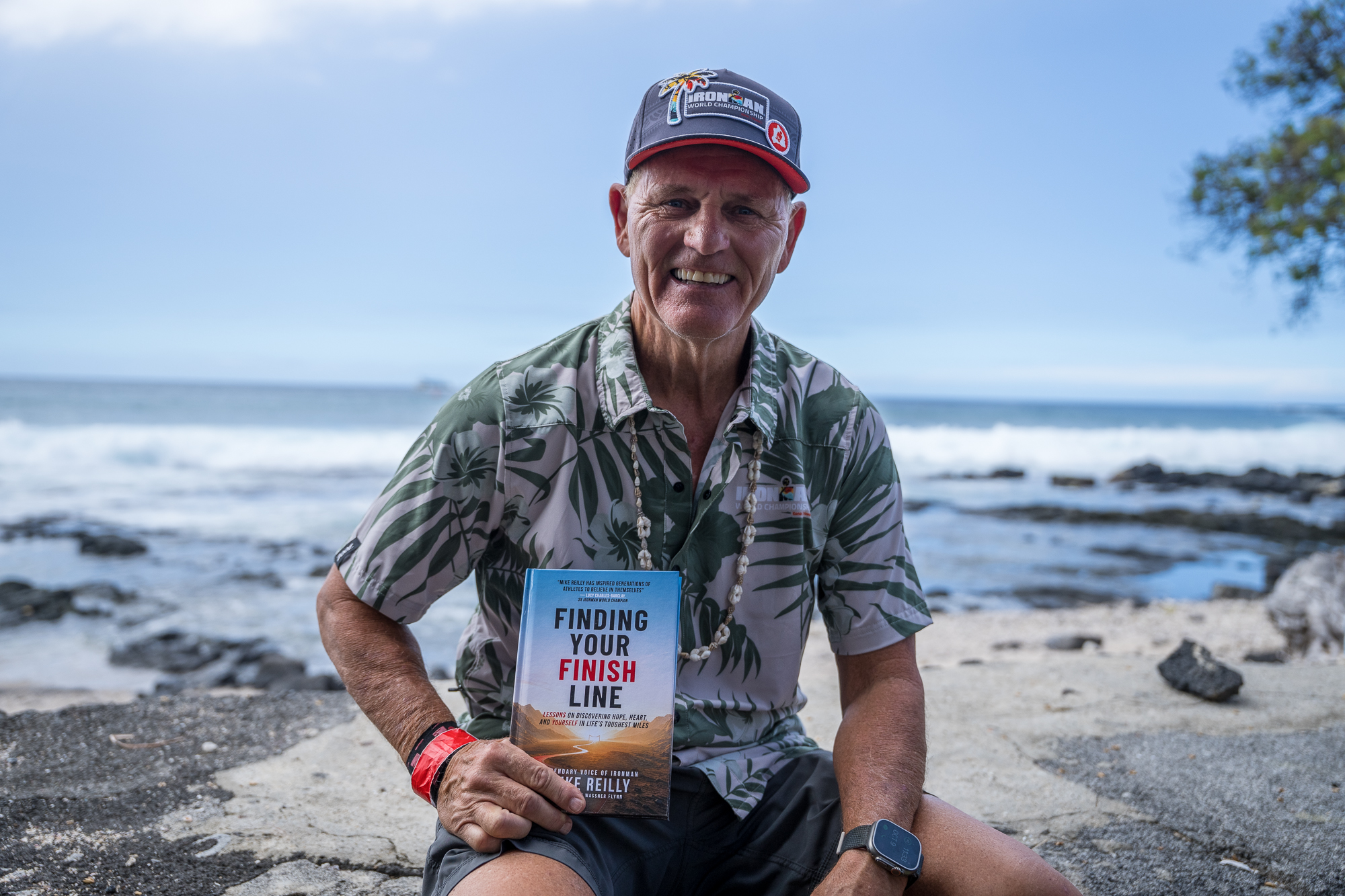
He’s known as the “Voice of IRONMAN,” best known for creating the words that have become synonymous with the achievement of finishing what, for many, is a life-changing experience – “YOU are an IRONMAN.” Mike Reilly, a San Diego-based former middle school teacher, first picked up a microphone at a race in the late 70s, and would go on to announce at well over 200 IRONMAN races, including 33 world championship events in Kona, Hawaii. He’s a member of the IRONMAN hall of fame, and the Running USA hall of fame and is the author of the book Finding My Voice (with Lee Gruenfeld). Reilly just published a second book (co-written by Sarah Wassner-Flynn), Finding Your Finish Line: Lessons on Discovering Hope, Heart, and Yourself in Life’s Toughest Miles, and it is every bit as inspiring and entertaining as his first book. (I wasn’t the only one who was a big fan of Finding My Voice – you can read Dan Empfield’s review here.)
“I was thinking about lessons: lessons other people show you by example, and lessons we know but don’t practice daily,” Reilly said of the inspiration for the book. “I wanted to connect stories I’ve seen and been around to what lessons they teach us, what they taught me, and what I think we should take away from them.”
“So this book has a different take (from his first book),” he continued. “At the end of each chapter there’s a section called ‘aid stations,’ with three or four tidbits, things like ‘listen to that persistent voice inside you’ and ‘don’t hold yourself back.’ I started getting really excited, because I’d seen people do things that were almost unexplainable, and I thought I should write a book about what we can learn from that.”
The book certainly offers up lots of lessons and inspirational messages based on the people Reilly met during his storied announcing career, but there’s also a lot more of Reilly’s own personal story included in Finding Your Finish Line.
“In this one I told more of my own story, including why I walked away from the microphone, something I had never shared with anybody,” he said. “There are bits in this book that my wife, Rose, never knew about. It was the work of Sarah Wassner-Flynn, who I worked with. She pulled it out of me. She’d say, ‘You’ve got to go there.’ I wouldn’t call it self-cleansing, but these were things I wanted to write about, and I wanted them to be part of a bigger picture. The book is about lessons on discovering hope, heart and yourself in life’s toughest miles, and about finding your finish line, not only at a race or event, but every day. People call them goals or objectives, but in our world they’re finish lines. Even when I give a corporate speech, I talk about finish lines rather than goals, and you see people nodding, thinking, ‘I’ve got to find more finish lines in my life.’ That’s what I tried to get across, and people’s feedback is that they’re loving the message.”
So why did he finally decide to hang up the microphone?
“It was an interesting process,” he said. “I battled it in my head for a year and a half, two years. The family was growing and grandkids were starting to be born, and I didn’t want to miss birthdays, anniversaries and parties like I did for 33 years … Then my voice started hitching. It took a lot longer to recover. My hearing was getting beaten up. I have tinnitus, and it rings constantly. Those finish lines are very physical, not only for the athletes, but for all of us working them. I want to be able to talk to my grandkids when I’m older. Did I need to keep pushing out 13 or 14 of those 17-hour days a year?”
“Some people said, ‘Why don’t you just cut back and do Kona and a couple of others?'” he continued. “But then I’m not in the game. When I came to Kona, I had announced so many races that I knew what every athlete was doing. You do your research. If I only announced New Zealand, Lake Placid and Kona, I wouldn’t be in the game, and being prepared was something I always took very personally. So I ripped the Band-Aid off and said, ‘2022, I’m done.’
Finding His Why
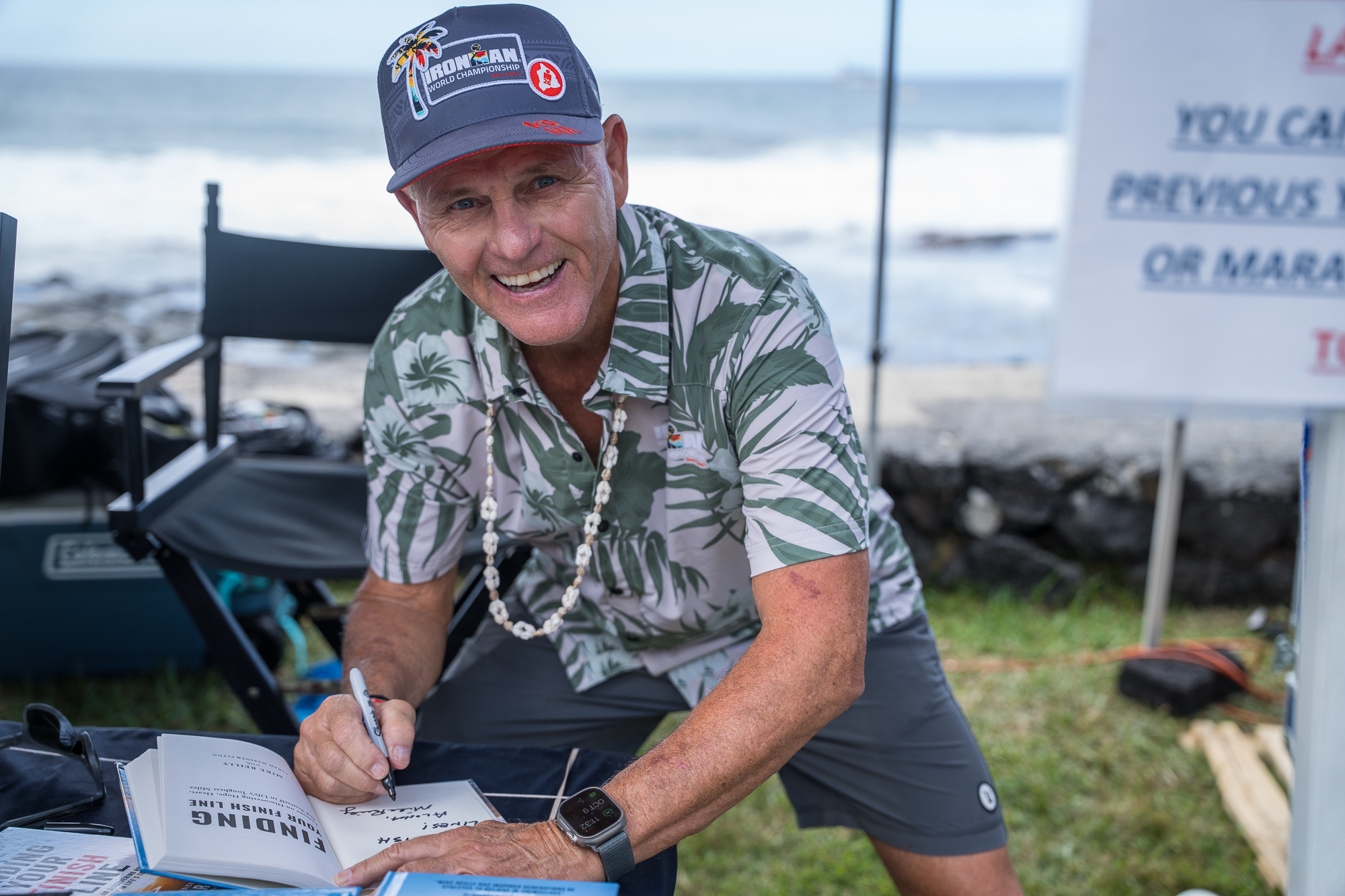
I wondered if there were any stories that resonated with him more than others from the book.
“The ‘finding your why’ chapter,” he answered immediately. “Everybody talks about finding a why, ad nauseam. But, when I came across Rob Ladewig and Josh Duda, the two stories in that chapter, which I put right up front in chapter two, Rob’s why was unshakable. I had never heard anything like it, and it really affected me.”
“He (Ladewig) was doing IRONMAN races for 24 or 25 years, and in the book I go back to the year he started,” Reilly continued. “Early on, I was at an IRONMAN, and two weeks later he was at another one. I said, ‘Dude, what are you doing so many Ironmans for?’ I’d ask people that, almost kiddingly. He said, ‘Until they bring my brother Melvin home.’ I said something stupid like, ‘Where is he?’ He said, ‘He’s MIA from Vietnam, August 24, 1968.’ He gave me the date. ‘I am going to do Ironmans until they bring his remains home.’ He went down in a fighter jet, and they’ve yet to find him. I’m standing there thinking, you’ve got to be kidding me. Every year he kept doing IRONMANs. That why was so rooted in love and duty. Melvin was a retired full-bird colonel in the Air Force, following in his older brother’s footsteps. They’ve yet to bring his remains home, but they think they’ve found the jet, buried in brush.”
“So, when people ask me which story affected me most, it’s that one,” Reilly said. “I became closer to Rob with every race. I had a bronze bracelet with Melvin’s name, the date he went missing, and his rank, and I wore it at every race Rob did. I never told anybody I was wearing it.”
“If you set up a why, it shouldn’t be soft,” Reilly concluded. “It should be tough, because it’ll get you to a finish line you never thought you could reach.”
So what has Reilly come up with as his new “why” and “finish line?”
“My why and my finish line is the support of my family,” he said. “The fourth grandson is arriving tomorrow or the next day, hopefully. They’re all right here in town, and we’re a big part of helping raise them and take care of them. The other why: so many times Rose would go on a trip with our friends and I couldn’t, because I was at a race. Now I’m included.”
“So, my why is staying healthy and riding my bike as much as I want, whenever I want,” Reilly continued. “If it’s too cold in the morning to go out on my gravel bike, I’ll go at 11 and work my schedule around it. I still do speaking and voiceover work. I’ve done the audiobook for three or four other authors, which is about a week in the studio. I’m always open to that, but on my schedule, when I want to do it, not when something else dictates.”
Luckily enough for all of us, that why still includes being part of the triathlon community and making a difference through these inspirational stories. Finding Your Finish Line is well worth the read for any triathlete, whether you’ve been in the sport for decades, or are just beginning. It will certainly provide inspiration to get you to your next finish line.



Start the discussion at forum.slowtwitch.com