
Paul Kaye Doesn’t Do This for the Glory. That’s Why He’s Such a Great IRONMAN Announcer
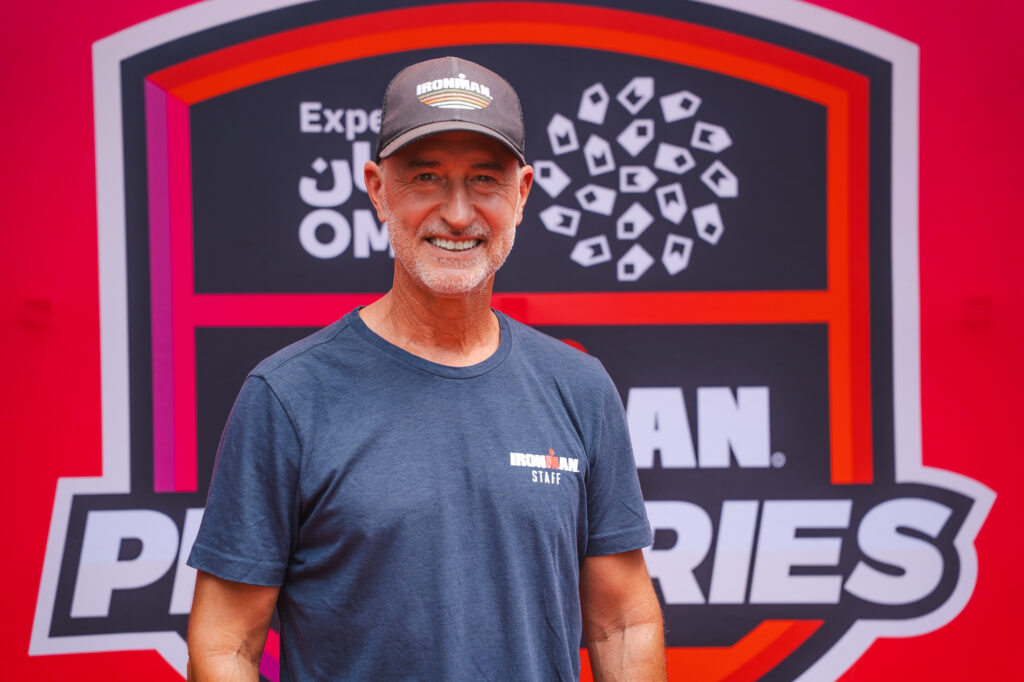
Don’t try and tell him he’s the new “Voice of IRONMAN.”
“There’s only one,” Paul Kaye is quick to say, when I jokingly start our chat. “The only ‘voice of IRONMAN’ is Mike Reilly. But there are lots of voices of IRONMAN. I’m one of them.”
Kaye is being modest. He is much more than that. While he’s quick to point out that he’s part of a team, he’s very much the leader. I’ve known Kaye since he’s early days on the microphone, back when the organizers of IRONMAN Austria, IRONMAN Nice and IRONMAN South Africa (Stefan Petschnig, Georg Hochegger and Helge Lorenz, the founders of Triangle Events) pushed to get him involved with more events in Europe. Kaye would take a leap of faith in 2009 and became a full-time race announcer, and ever since he has become beloved by athletes around the world as the man who welcomes them across the line for one of the most important moments of their lives. I caught up with Kaye in The Woodlands, Texas, where he’ll be the lead announcer for this weekend’s IRONMAN North American Championship.
You’ve been at this a long time. When did it all start?
My first involvement in the world of triathlon was the South African summer of 94-95. I was the TV voice for a South African sprint series. I knew nothing about triathlon, but a TV producer liked what I did for him as a colour presenter for the Cape Town Marathon for live TV and he said to me, “I need a fresh voice.” Those were the days of Betacam. There I was in his studio in front of a tiny cathode ray tube TV, watching a 26-minute program that I voiced from scratch, no script. You just had to go.
My first IRONMAN on the microphone was one of two IRONMANs in Gordon’s Bay, near Cape Town. 2000 was the first year. And in 2001, I announced my first IRONMAN. Then this past Sunday — the same weekend as IRONMAN Texas — would have been my 20th consecutive IRONMAN South Africa on the mic. I raced in 2004, which was a 70.3 test event, and then in 2005 I wasn’t one of the announcers — I think it was Don Rider with Mike (an announcer from Germany) — but they got me on board in 2006.
How many events are you announcing these days?
It varies, but the calendar is very full. We only have a certain number of summer months in the northern hemisphere, so most of my work is in the northern hemisphere, the Middle East and South Africa, along with Diana’s (Bertsch – IRONMAN’s vice president of world championship events) World Championship group. For the IRONMAN group I do between 26 and just over 30 events a year, including the Cape Epic and Swiss Epic — so two Epic Series races. The rest are all IRONMAN 70.3 and IRONMAN races. This year I should finish on about 15 full IRONMANs, including Kona, which I’m really looking forward to — both genders, same day, same weekend. It’s going to be amazing. It’s a big year, but as you know, some of us have been in the game a long time. There’s a lot of travel involved, they’re long days, and it doesn’t get easier. I’m happy with my schedule. I’ve got enough weekends.
How do you feel about the state of the sport right now?
A lot of that depends on where you look, because in different regions the sport’s been around longer and it matures a little sooner — you know the usual bell curve. In Europe it’s exploding. The races sell out in a heartbeat. IRONMAN 70.3 Versailles sold out in hours. The numbers are big — 3,000-plus, close to 4,000, because we know that if you sell 3,500 then 3,200 will arrive, 3,000 will start, and 2,800 will finish. In Europe it is off the charts.
From what I understand, in North America it’s a little slow at the moment, but this is a very mature market. The Middle East is on the precipice of just going wild. The demand for racing there is huge, and there are various reasons for that. I think a lot of people use triathlon as an excuse to go to a great destination — it’s a form of tri-tourism. You can justify what you’re spending on the trip, you can justify the carbon footprint, because you’re doing it for a purpose. And the Middle East intrigues people. It’s exciting. It also gives people an excuse to get away from their (awful) weather and go race in really lovely weather and experience a new culture. When things settle down there politically — please God let that be soon — I believe you will see some significant expansion.
South America, as big as it is, with the size of the population of that continent, is going to go bananas. And the only continent that has not really gone crazy is Africa, but there are various reasons for that. It’s a very immature sport on the African continent, which is extremely diverse. People don’t realise it has more countries than any other continent on the planet, more languages than any other continent on the planet. It’s also economically very, very challenged — and we all know this is not the cheapest sport in the world. But, from a destination point of view, can you imagine when Africa opens up? Think of Zanzibar, Mauritius, Namibia, Angola, Zimbabwe, Zambia, Kenya — the destinations are phenomenal. Even now in North Africa, Morocco and Egypt are fantastic destinations with huge potential.
What do you see as the real barriers to accessibility in the sport?
The sport can be as accessible as you let it be. It definitely lends itself to the tri-geeks and the people who love the gear — ‘all the gear, no idea’ — and it’s such a lovely sport in that regard because it’s very gear-centric. But you don’t need the best bike, you need the best attitude. You don’t need a fancy wetsuit.
I’ll give you an example. We’ve got a great venue in South Africa near Johannesburg, and it’s a lagoon swim where if you can’t swim, you can walk. That’s made it accessible. People who would never attempt a triathlon come and do it because they paddle a bit, they walk a bit, they paddle a bit, they walk a bit. I know the diehards in our sport go, “Oh, that’s not triathlon,” but you’ve got to give people a taste of it.
When I look at IRONMAN South Africa in its current version compared to 2005, the diversity and transformation is massive — both in terms of gender and participation broadly. We have one of the biggest female percentages at around 50/50. At the corporate triathlon, the females are starting to overtake male participation.
I think the biggest barrier is not people’s financial ability to access the sport. The biggest barriers are safe destinations to host the sport, safe water — water quality in Africa is a challenge, and something in the water not eating you is also a challenge — and safe roads. When I started doing triathlon, it was all on open roads and it was fine. You can’t do that now. So I think the barriers to the sport are not what people typically think. It’s more venue-related, in my opinion.
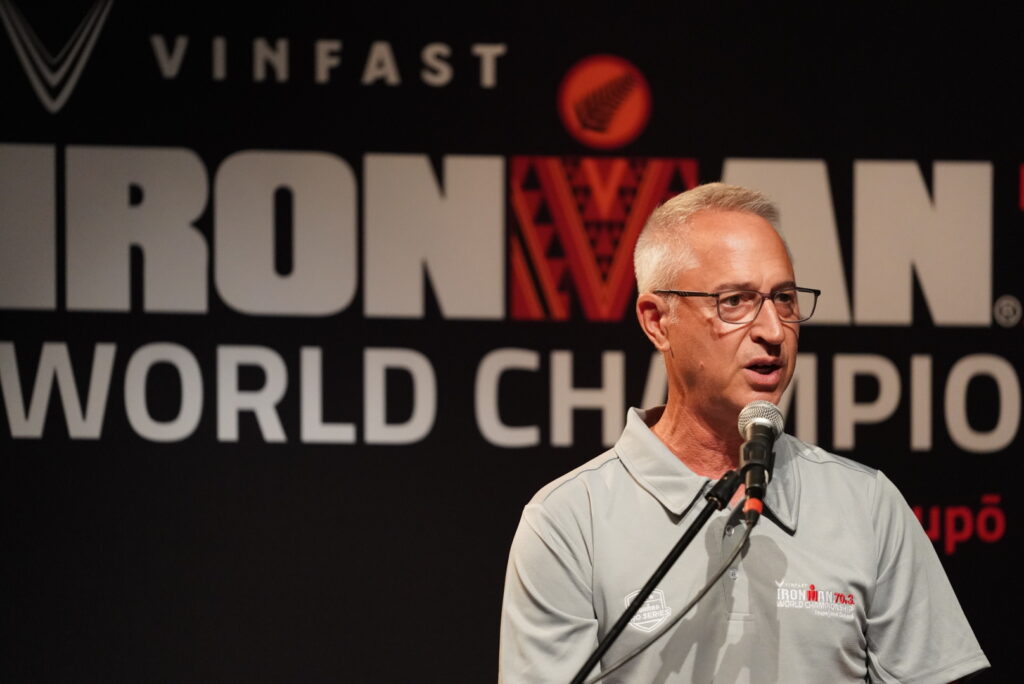
I/ don’t see one iota less enthusiasm from you than when I first heard you announce. Do you feel that way?
I absolutely love the sport, and I love endurance sport because it does so many things. It shows people’s character. And it unites. President Nelson Mandela always said there’s no greater peace movement on this planet than sport. I’m sure he was referring to the 1995 Rugby World Cup, where South Africa came united for the first time under the new flag — a year post-democracy — and we beat the All Blacks in the Rugby World Cup and became world champions. For the first time, personally, as a white South African, I was proud to be South African. I felt the power of sport.
When I’m at a race — and typically the European races are quite diverse, far more so than the North American races, which makes sense given that the US alone has 330 million people compared to the combined 280 million across 27 European countries — but, at a European race, you’re sitting on three-thousand-plus athletes and 80 to 100 nationalities. Take IRONMAN Barcelona: you’ve got 3,000-plus athletes, maybe 300 Spanish, and the rest are internationals. That coming together, that sense of unity, really inspires me. Because the more it seems the social media algorithms and the politicians are trying to divide and rule us, I think the more we come together through sports like endurance sport, the better for this world.
And every finish line, I see somebody changing their life. I can see it in their eyes — they hit that finish line and something changes. They realise they can do more than they thought they could, and they go home a better person. In the process, they make their world around them a better place. That ripple effect is a privilege and an honour, and in my small way I’m a part of their journey. That is something I do not take for granted. That’s what keeps me going.
You’re known for constantly drawing other people in, sharing the mic. Where does that come from?
I have a personal life philosophy: we, not me. I’m very much about team. You’ll notice at every race I work, we’re a team of people, and everybody brings something to the party. You don’t make a cake with one ingredient — you need many.
I come from a radio and TV background, and it’s a funny world where people, because of ego and often fragile ego, hoard their skills and their knowledge because they think that’s how they protect their place in the game. I learned very quickly in my radio days that nobody was going to teach me anything — I needed to figure it out myself. But, I felt that was wrong.
I’m actually finishing a book I’ve written on sports presentation … I believe that imparting what I know, sharing my knowledge, helping people around me be better forces me to always be better. The person I share with becomes like a mirror to me — I get to watch them work and think, “Oh, I like what they did there,” or, “I didn’t like what they did there,” and then I own my skill in the process. It’s symbiotic and mutually beneficial. I also believe in kaizen — the Japanese word for continuous improvement.
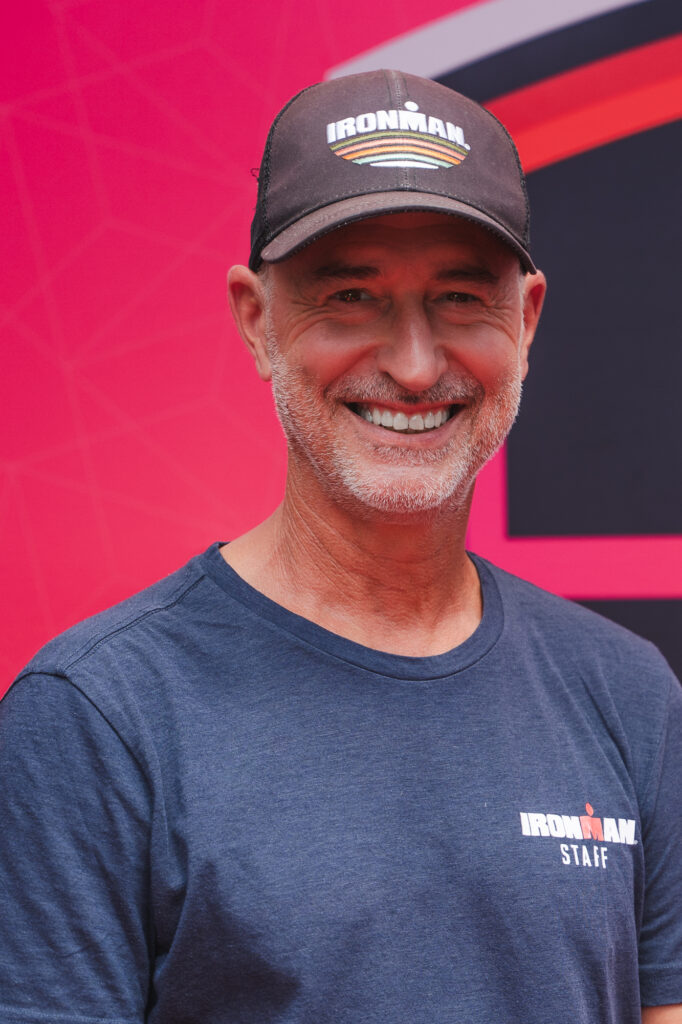
What keeps you coming back for 25 to 30 events, year after year?
Every race is a reunion, really. But it’s also a place where you meet new people and learn new things. I love that diversity. Maybe me being a South African has been one of the key arrows in my quiver, because South Africa is such a diverse country — so I’m comfortable with diversity, comfortable in new cultures and new countries.
There are very few sports I’ve worked in where there’s almost nobody I dislike. Kind of everybody’s nice, everybody’s amazing. And the other great thing about this sport — what I always tell people who bash IRONMAN — is that everybody who works at IRONMAN could make way more money working somewhere else. They’re doing it because they love it and they love hosting events for athletes. So just keep that in mind when you criticize. This sport is full of people who are very, very passionate about what they do, and that in itself is contagious. It’s like an elastic band that keeps bringing you back.
You’ve been to Kona multiple times now. What has that experience meant to you?
Can you imagine how privileged I am? My first trip to Kona was 2014, so last year was my decade of Kona — accounting for the year we missed because of COVID. And look at what I’ve got to experience in that short space of time. I got to experience Kona with both genders on the same day. I got to experience St. George when we went to Utah. I got to experience two days of racing — women one day, men the other — in Kona. I got to experience Nice and Kona alternating. And every single one of those experiences was amazing, and every single one of them IRONMAN and the sport learned from.
As much as IRONMAN took a hell of a beating for the Kona-Nice split, I think it worked. I don’t think we would have had the race we had in Nice with the Norwegians if we were in Kona. And I don’t think we would have had the race we had with Lucy and Taylor and then Solveig if the men had been there as well. Would each of those moments have got the attention it truly deserved? So, I don’t see any of that as failed. All we did was win and learn, win and learn, win and learn.
And if there was one destination you had to go to outside of Kona that had a true legacy in our sport, it’s Nice — in terms of the history and the rivalries and the racing.
I also feel very strongly that some of our athletes can be a little bit entitled when they get to the Big Island. I understand — they’ve worked incredibly hard for it and they spend a lot of money to get there. But how hard you work for it and how much money you spend does not make you any more important than anybody else on that island when you get there. I started to feel that attitude change when we got criticism for the way we overran the island during the two days of racing. I think the women taught us a wonderful lesson in humility during that first women’s-only race in Kona — fierce rivalry on the race course, but wonderful humility off it. And the islanders noticed. “We’re enjoying this attitude. We like this energy.”
What I always remind athletes is that sometimes you need to slow down to go fast. When you slow down and immerse yourself in the place that is hosting you, it can only fill you more and add something to your tank. And I believe it can only benefit you on race day.
Finally — what do you still want to achieve?
That is very, very difficult to answer, because it’s never about me. I don’t do this because I want to be remembered in some way or leave a mark. But in terms of a personal professional goal — when I gave up my daytime job in December 2009 to take a chance at the age of 40 and see if my hobby could make me a living, pay my mortgage, feed my family, look after my kids, I set myself two goals. One was to get to Kona within five years. I got there in 2014. The other was to play a role at the Olympics. I’ve yet to get there.
So if there’s one thing I would still like to achieve, it’s to work in multi-sport at the Olympics before I hang up my microphone.





I loved his call of Tri-Battle.
I am usually agnostic to race announcer but what I like about him is he manages to speak a few words of every language where he announces and manages to change between quit a few languages while he announces.
my friends who came to Nice 2025 WC commented the next day how GREAT they thought “that announcer guy was! he spoke like a dozen languages and cheered as hard for you as he did the winner”. They had never been to an Ironman before. No idea what was happening. IMO there is no better compliment to a race announcer than that. And I sure felt his passion, and Joanne Murphy’s, when I finished in the dark. They are a tremendous duo.
I met Paul at IM South Africa 2015. I consider him a friend now. He was only the announced for one of my full Ironman races (the above mentioned), and later that year I went through a series of accidents , a bit of bad luck and just life setbacks, but for whatever reason Paul and I stayed in touch and in 2020 right before the pandemic I did IM 70.3 Dubai in 2020 where he was also the announcer. Amazingly he remembered me from back in 2015 (can you imagine how many names he cheers across the line?). Paul and I have stayed in touch since then and he’s been awesome at all the 70.3 worlds I did since then, but to me the amazing thing is he remembers so many details about so many people that he meets sporadically in a mass of 1000s of people at event across the world.
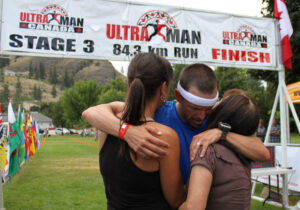
So when you get called in by Paul Kaye on the red carpet it kind of feels really personal and caring. I can’t really explain it. Mike Reilly did it another way. I view Paul Kaye and Steve King who did Penticton Ultraman Canada and several other events in the same category. Reilly elevated the entire event and I think that was his super power. There is only one Mike Reilly. There is also one Paul Kaye. What he does is just “different”. To me it feels like you got your own personal cheering gallery when you cross the line (or a few times in the swim corral like in Lahti he really got us pumped up and going).
Thank you Paul Kaye for your tremendous Leadership among the Endurance Sports Live Announcing Talking Heads! Loved reading this interview. Tremendously inspiring! Best wishes for an awesome year!
^this
Also for Kona slot receivers. If he can he pronounces your name in your language.
He manages to light the carpet such that the crowd gets a glance of all of the years of training, deceptions and dedication.
Dev - you are getting at the real value and impact of a Professional Announcer - at any Endurance Sports Race/Event - that REALLY get’s this. It’s about that CONNECTION that can be crafted and made literally in a few seconds! Participants REMEMBER that! As I always say, yes, we are in the Race/Event Business, but what we are really in is the EXPERIENCE business!