
Triathlon’s Attitude Problem is Going to Cost Us Places to Race
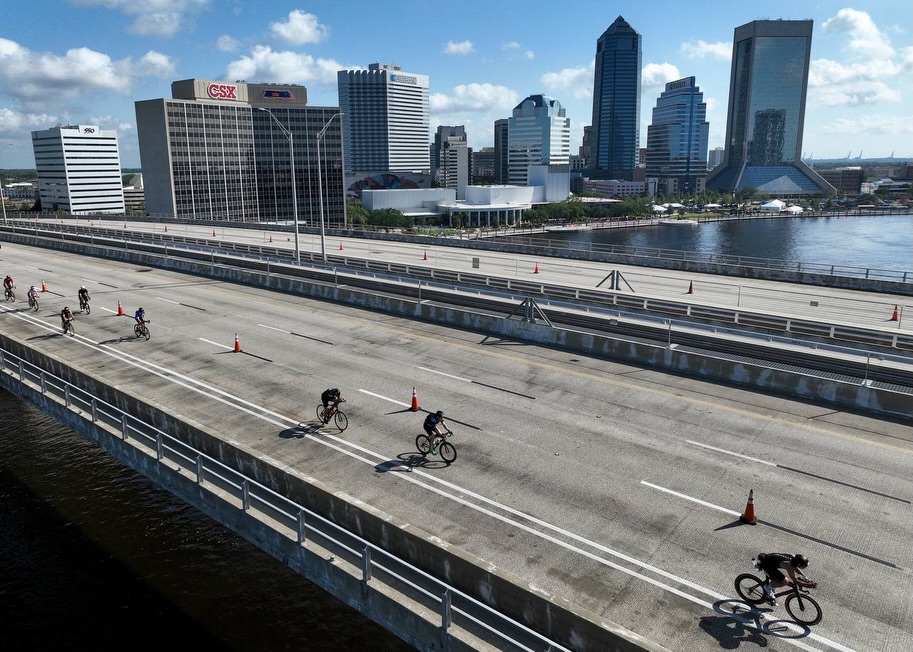
IRONMAN recently hosted a new full-distance race in the United States for the first time since the one-off IRONMAN Alaska in 2022. IRONMAN Jacksonville welcomed 1,900 entrants for its inaugural edition, with approximately 1,400 athletes crossing the finish line. For a new, early-season IRONMAN that had a relatively short runway (only being announced in early September of last year), it was a success from an athlete perspective.
It also, however, was a massive traffic disruptor in the area. Traffic was snarled for hours, as reported by local news. As one would probably expect for a full-distance race, the biggest issue was the bike course. Drivers were frequently stuck, or re-routed constantly as they attempted to find a way around the course. Some, unfortunately, took matters into their own hands, with two collisions with athletes; none were deemed serious. There was also a near-miss with a drunk driver who swerved through both the bike and run courses; he was arrested and charged with eight felonies and a dozen misdemeanors.
These types of issues are common and, in Jacksonville’s case, for two reasons. First, it’s the general type of teething problems that come from hosting an event in a city for the first time. You don’t ever really know how traffic will ebb and flow on race day until you’ve seen where the choke points actually are, and how drivers respond to it. The second, of course, is the population density of the area. There’s approximately 1.8 million residents in the Jacksonville metro area, and is the 38th most populous metro area in the country. It’s the third largest metro area to currently host an IRONMAN event, trailing The Woodlands and Sacramento.
In other words — it’s a lot of people. And, despite IRONMAN and the city of Jacksonville putting it just about everywhere that the race was coming and that there would be traffic impacts (heck, me here in Oregon saw it on every platform I can think of), that’s just too many people to really know that it’s happening. Even local government officials claimed, after the fact, that they did not know that the race was going to be impacting their community until either the day before the event, or while sitting in traffic.
As you would expect, the complaints were thick and fast from residents. The sheriff of St. John’s County, where a large part of the bike course took place, denounced the event and discouraged it from returning. For its part, Jacksonville released a statement, acknowledging that there had been pain points but that they were committed to following through on their three-year contract with IRONMAN.
“We are a world-class city, and IRONMAN chose us because of that. We benefit from the tremendous economic impact, the global exposure, the energy on our riverfront, and the pride on the faces of athletes crossing that finish line. We have a three-year commitment to this exciting event, and we intend to honor it by getting better every year IRONMAN Jacksonville comes to town. That means celebrating what worked and being honest about what could have been done better.
We are committed to a smoother experience for everyone next year, and are already in conversations with IRONMAN organizers, JSO, and city staff to conduct a full after-action review to make sure traffic and safety concerns are meaningfully addressed.“
Those conversations started the Monday following the event. All of this seems normal.
What is not normal, though, was the online discourse of some members of our broader multisport community, and the belittling of those who had taken issue with the IRONMAN event. Some of those comments, posted publicly on various social platforms, include the following:
- Directed at St. John’s County Sheriff Robert Hardwick: “Tough shit! Get with the program young fella!”
- Towards a couple whose wedding was disrupted by traffic: “I do feel bad for those that had wedding planned, but….they should have backup plans for sure and it’s not like brides aren’t checking everything prior to.”
- “I’m so sick of hearing all the complaints. It was one day. What’s the problem?”
- “Oh, but it blocked all those businesses that couldn’t get any business along the blocked roads! I loved that argument, one day of business as opposed to the week that people not normally in town were going to be there.”
- “The ignorant, impatient, entitled people in our society never ceased to amaze me. Oh lawd, it took me 10 extra minutes to get home today. The world is coming to an end!!”
- “Those people are just jealous they aren’t Ironmans!!”
And this, my fellow triathletes, is how we piss off the communities we are entirely dependent on in order to even have races in the first place.
Let’s rip off the band aid: we are neither as inspirational nor special as our sport (including us, here at Slowtwitch) tell ourselves. Triathlon, and especially full distance triathlon, is a logistical nightmare on its best days. What generally makes for a fantastic course for athletes (closed to traffic, scenic, single-loop) are hellacious for the communities hosting us. It’s how we wound up with the multi-loop courses at the former IRONMAN Arizona, and currently in The Woodlands for Texas; it helps to minimize the disruption because to have as safe of a course as possible, you must limit interactions with vehicles.
We, as athletes, are not entitled to have races on these roads. It’s why there’s a permitting process. It’s why there are so many stakeholders at play. And we ultimately need to be good partners. That partnership extends from just showing up and spending dollars in these communities, but by also understanding their concerns and needs while visiting their cities and towns. It means, for instance, spending money in some of the communities beyond those where swim or transition is located. Or it might mean ensuring that you know the traffic laws of that community while out on a ride.
But, what it is not part of that entitlement is simply sweeping complaints under the rug, and assuming that because you spend money in a community, that people should be thankful for your presence. There are significantly less challenging and expensive ways to draw tourism dollars to an area than hosting a full-distance triathlon. And we’ve seen time and time again that we wear the welcome mat thin in some of our host communities. We came close to losing IRONMAN Lake Placid. The aforementioned Alaska race was a one-and-done experience. St. George recently said enough was enough.
The line, to me, is clear: we, collectively, need to be better. And that starts by not throwing people who have concern about the impact of our races under the bus.
Tags:
IRONMANLifestyleOpinionRelated Articles:
Continue the discussion at forum.slowtwitch.com
94 more replies






I don’t disagree with your message at all. Just adding a comment that increasingly the difficulty is the nature of political discourse is about burning bridges and winning at all costs, even bizarrely redefining worse-off as winning.
The famous quote used to be that “all politics is local” with the news cycle, internet, meme-administration, further polarized parties, it seems like “national politics is the local way”.
Which goes to your point that even if we are better, and make things better, the spur of the moment anger and resentment wins the day. Kind of a bleak view, I know.
USA specific issue or do other countries also have issues with IM?
This is mostly a US issue. Hence the US stats.
Maybe stop trying to shoehorn races into metropolitan areas?
Subject of another article on the docket. The “problem,” per se, is that athletes want easy access from airports, which is typically defined as being less than an hour via car from airport to wherever the race will be. That also typically means enough hotel rooms, restaurants, etc. that you wind up not having the small town overwhelmed problem that you might see in, say, Kona or Lake Placid or Tremblant.
Flip side are logistics, volunteers, and the scenery of the courses themselves.
But more on that probably Friday…
The thing is a lot of these big cities send representatives to conventions for event organizers to city shop and offer events money to come there. I’m not sure if that’s how Jacksonville happened but it seems likely to me it’s how IM opens new races.
What should happen is Ironman needs to use their expertise and experience to guide irrationally exuberant cities from making mistakes that undermine their long term success in the city.
While taking the money and running, in a sense, might be profitable for Ironman it would be a disaster if the narrative got out that wherever Ironman goes, the voters punish the incumbent.
@rrheisler all good points in your article, but if triathletes say nothing other than “we thank you for hosting us”, will it change all the squeeky wheels complaining to their local town councils. I think the same people will complain and there will be enough anti bike town councillors who will do anything to appease motorists.
But point taken, we can all be better online. I was not in nor near Jacksonville so don’t know the issue at hand.
I know at Ironman Canada Ottawa even though 90% of the bike course is closed EVERY WEEKEND for citizen cycling, there were lots of whines by citizens about that final 10 percent of the roads. You just needed to know where to go when. It was all pretty easy with road closures here, but still plenty of complainers, but fortunately the mayor here has run the world marathon majors and gets the $8M-$10M economic impact to the community and largely all councillors and the Ottawa Board of Trade was hugely supportive.
I thought the online comments that you made the article about were totally not a thing, and then I read one comment on ST’s Facebook post with the article dude literally doesn’t realize the article is about people like him
Both Ironman Canada races in Whistler and Penticton wore out their welcome and folded. We had a long discussion about Triathlete behaviour in Penticton here on ST many years ago.
It would not surprise me to see Ironman Australia in Port Mac and Ironman Cairns drop the Ironman races and just run 70.3 events.
A very special (and amazing) example, is how European countries in many cases seems to “integrate” the races into the community, rather than just being an annoying “bolt-on” event.
In Denmark, you have the Royal Family, who all engages in Endurance sports. This past weekend, the Royal Run went down (as every year). The King (no not Elvis Presley) of Denmark, Frederik, ran 10K (sporting bib no. 1) and his whole family, wife and all their kids join him. Streets were closed, but trust me (with the love the danes have for their Royal family) nobdy in the public got too annoyed.
This build a whole different level of integrating a race into a community, I believe.
Where I live (in Spain) our Mayor shows up to races and either racing or spends hours on the finish line, greeting finishers.
Just a thought
They also want ‘fast’, i.e. easy (flat), bike course. Otherwise, I would think that ski resorts would make ideal locations for big triathlons: they’ve got the hospitality infrastructure, summer is their off-season, and their surroundings are usually more rural where road closures won’t impact as many residents as in urban areas.
Maybe Ironman could benefit from outside expertise in this area too. They should consider hiring the Walchshöfers as community relations consultants
if one is allowed to say that ,the issue in the usa is slightly bigger than a triathlon attitude problem…
I believe the the positive economic impact associated with hosting an IM often is overstated. Many/most events are held in locations that already see a significant amount of tourist revenue outside of triathlon; an event loss does not necessarily translate into lost revenue. Rather than looking at the economics of the IM event window, it might be better to contextualize it over the course of a full year of tourist activity.
Well, we are getting the UFC bouncy castle at the house for our birthday party.
Ironically the marines may have difficulty closing Camp Pendleton for a few mornings for 70.3 worlds, but looks like if you ask them to close Kharg Island or a stripe in Nuuk Greenlland, or somewhere in Caracas, suddenly the marines will be fully capable or they will just claim Canada as the 51st state and rename Ironman Canada to Ironman Stars and Stripes, and the problem will be solved.
OK OK, OK, its all pink font, back the whining about IM Jacksonville traffic.