


What Convinced IRONMAN and Challenge Roth to Move to a 20-Meter Pro Draft Zone
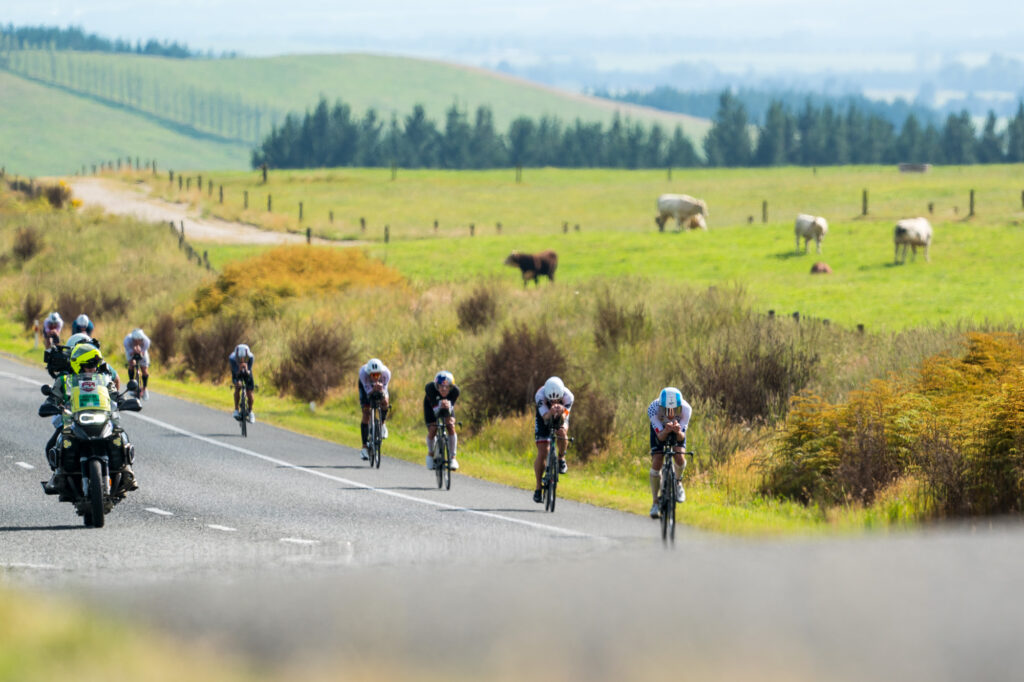
Earlier today we reported that IRONMAN announced it would be using a 20-meter draft zone for pros in 2026, and at about the same time Challenge Roth was also pushing out the news that it would also be moving to a 20-meter zone – albeit as a “controlled test to see if racing can be even fairer.”
So why did January 27, 2026 become the big “20-meter announcement” day? There was no-doubt some element of “we’re not going to be the second ones to announce this,” but, at the end of the day, IRONMAN made the call because of the data they saw in their last bout of testing. Challenge Roth, like Challenge Family and the Professional Triathletes Organisation before them, appear to be making the call based on the desires of pro athletes.
We chatted with IRONMAN’s head of officials, Jimmy Riccitello, on this issue in one of our podcasts – you can listen to that conversation through the link below.
During our conversation, Riccitello described the two different tests that IRONMAN did on the benefits of various draft-zone distances – specifically 12-, 16- and 20-meter zones. The testing was conducted by aerodynamic expert Marc Graveline. Our conversation with Riccitello came before there were any results from the most recent test that IRONMAN did in Tucson, Arizona, which included five pro men, including Lionel Sanders.
After that conversation, if you’d asked me what I thought would happen this year (as Eric Wynn did), I was confident that IRONMAN would do more testing, and also test the 20-meter draft zone at a few races before it made the call.
Why did I think IRONMAN wouldn’t pull the trigger right off the bat this season? I figured there were just too many complicating factors with their races. Having a 20-meter draft zone at a T100 race isn’t difficult – there are a maximum of 20 athletes in each race. Challenge Family events that offer a 20-meter draft zone (which is most of them), for the most part, don’t have the same numbers of athletes on the course that IRONMAN races do. While the pro fields are often large, spreading the entire field out isn’t as much of a … challenge (sorry, I just couldn’t resist), because there just aren’t as many people on the course.
The other complicating factor with the 20-meter draft zone is the interaction between pros and age group athletes, and also between slower pro men and faster pro women. In terms of age group athletes, they’ll still be working to a 12-meter draft zone and can “slingshot” through the draft zone. (They can ride up to the back of the bike ahead of them before they pass – pros have to pull out wide and then make the pass.) Pro men towards the back of the field who get caught by the pro women complicate things, too – if they get caught between a couple of pro women, suddenly the second pro woman is riding 24 meters behind the women ahead instead of 12 meters. Add a few more men to the mix and things get complicated.
Test Data
Why was I so wrong on my prediction? According to IRONMAN CEO Scott DeRue, it comes down to the data from the tests.
“There is a clear advantage at 12 (meters),” DeRue said. “That advantage gets greater as you go back in the train, so position two, three, four, and five … we thought that we would see lesser advantage at 16 versus 12, and we didn’t really. It was only until 20 where we started to see that advantage drop significantly, and that was really compelling in our findings.”
Based on those numbers, it was a no-brainer for DeRue – moving to a 20-meter draft zone “is in the best interests of the sport and our professional athletes.”
IRONMAN officials say that we’ll get to see the numbers that prove all those points. When remains unclear. There are a lot of variables at play with all this – size of athletes, speed, cross winds, etc. – so the powers that be no-doubt want the messaging to be as clear as possible. Especially since some age-group athletes are likely to want a 20-meter draft zone, too, which becomes a bit more complicated on a crowded IRONMAN course with, say, 2,000 to 3,600 athletes on it, as we saw at the IRONMAN 70.3 World Championship in Marbella last year.
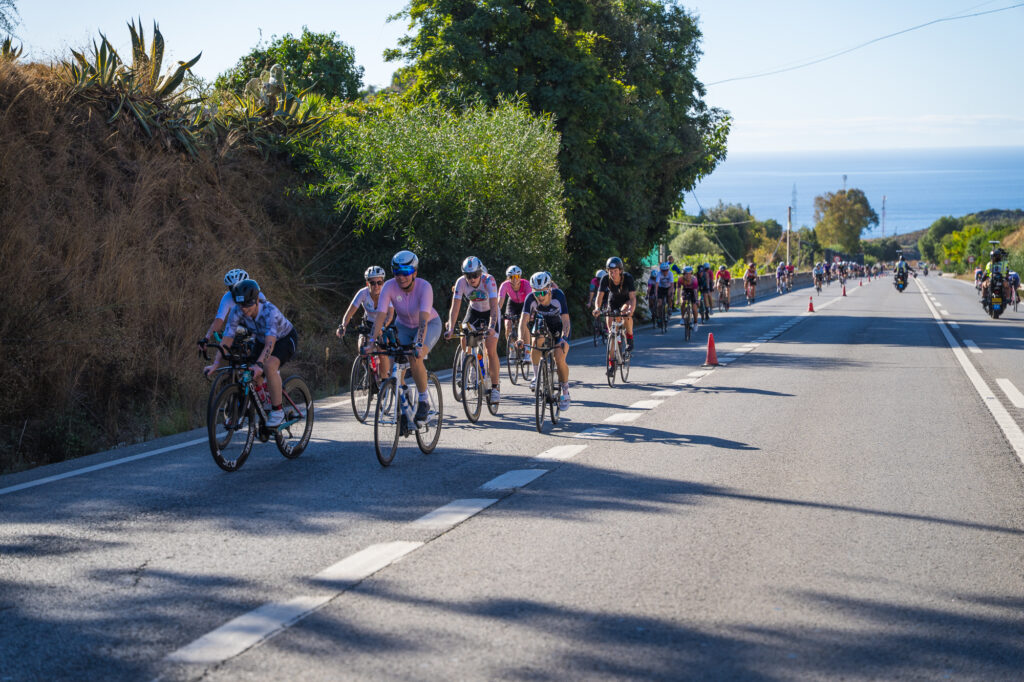
According to DeRue, the numbers also support keeping the age-group draft zone at 12 meters. The advantages seen at 12 and 16 meters are related to the speeds the pros are riding. Age group athletes, for the most part, aren’t riding at those speeds, so there’s no need to make the change.
IRONMAN’s release today also explains that we’ll likely see the “operational details related to the 20-meter draft zone” in the 2026 IRONMAN Competition Rules which are slated to come out next month and be put in to effect on March 1. That update will provide the details on how long an athlete will have to make the pass once they enter the draft zone (likely 45 seconds), and exactly how age-group athletes can interact with the pros. DeRue says they are aware of the issues that arise around that interaction, and will provide clarity within the rules to ensure the women’s races aren’t affected.
Pro Feedback
IRONMAN’s release, and their comments afterwards, make it clear that athlete feedback on this issue was an important factor, but ultimately the decision was data driven. IRONMAN’s testing seemingly backs up exactly what many pros keep telling us – there’s a real advantage to sitting in a group that’s riding 12-meters apart. During a podcast we recorded earlier today, we asked Austrian pro Lisa Perterer about that – she raced a number of T100 events last year, along with four full-distance IRONMAN races. She said you can feel a big difference between the 12- and 20-meter draft zones.
Challenge Roth’s announcement today celebrated the fact that the “test” being run this year is because they “listen to our athletes.” The announcement also addresses their reasoning for increasing the draft zone for pros, and not for age groupers.
The adjustment of the draft zone for 2026 is deliberately designed as a trial in the professional field. The aim is to understand, under real competition conditions, what effects a greater distance actually has on the fairness and dynamics of the race.
For the age group sector, the existing rule will remain unchanged for the time being.
We clearly see this adjustment as a test. In the professional field, we have very high, consistent speeds and a manageable starting field, which are ideal conditions for gaining insights.
With the age groupers, the average speeds are lower, the slipstream effects are smaller and the fields are much larger. Transferring the rule would require massive interventions in the race structure.
One of those “interventions” would be reducing the field size (roughly 3,400 individuals and 650 relay teams), which would mean “even fewer people would be able to experience the dream of Roth” and entry fees would have to be increased.
Despite all the issues with real estate on the course, the folks at Roth, like IRONMAN, made the call to move to a longer draft zone for pro racers today. IRONMAN has done the testing to back up its decision, and once the numbers came out, it made no sense to do further race-tests. Why mess around with the backlash of some races featuring a 20-meter draft zone and others with a 12-meter zone? And, if the folks at Roth got wind that something like this might be in the works, no-doubt they didn’t want to be the last to make the jump, either.
All of which means we’ll see a consistent, 20-meter draft zone at all the major pro events in 2026. That’s good news for the sport. Probably the best thing, though, is that IRONMAN’s announcement today made it clear that its decision derives from the numbers. Yes, there was pressure from pros, but in the end they made the call after doing some testing. While seeing that testing data doesn’t really make a lot of difference, IRONMAN will gain even more credibility by releasing as much data as they can to show exactly why today’s decision was a no-brainer.
Tags:
Challenge RothIRONMANRulesRelated Articles:
Continue the discussion at forum.slowtwitch.com
4 more replies



Excellent! No notes.
Regarding the age-groupers:
So you’re suggesting that half the WPros, on average, would be required to retire if they’re overtaken on the bike by an amateur starting 15 mins behind. Want to rethink that (notwithstanding your ‘fairness’ caveat).
While we at it, perhaps all MPros who get overtaken by the first WPro (even with a 5 minute ‘start’, let alone 2 minutes) would be deemed ‘lapped out’. Only fair. Charles-Barclay would be a killer.
I suggest the concern about amateur and WPro interactiins are being overblown.
Any amateur that catches a WPro on the bike is going straight past. The idea that they cause grief by “slotting in” at 20/12m is hypothetical and fails to reflect real life: if they’ve caught that much they’ll blow past. If a rule is needed, “the draft zone for all athletes, including amateurs, behind a Pro with Race Ranger is 20m” (and poor eyesight is not a defence).
touché - hadn’t considered the ladies.
Maybe outlaw cross-gender drafting completely? Nah - not enforceable.
It would not only have to be consistent, but it would have to be much larger. For example, if your rule had been in place at last year’s Ironman Hamburg, of the whole FPRO field only Laura Philipp, Kat Matthews, and Solveig Løvseth would have been allowed to finish the race. And that with Philipp and Matthews putting up the fastest and second fastest times ever for women in an Ironman race.
The difference between MPRO/FPRO versus FPRO/AG is that biology ensures that there will be a significant gap between the finishing times of the fastest MPROs and the fastest FPROs.
Any pro overtaken by first AG is out of the race. (Like when you’re lapped in an OD race). Harsh but efficient. AG start delay would have to be consistent across all races for that to be fair I guess.
…
Multi lap bike courses are going to be fun then.
Biathlon has a rule that if you’ve been lapped on a Pursuit, Mass start or Team Relay event you have to stop immediately. Normally it’s just back of the pack athletes getting lapped, or for relays countries without high level athletes. Low level countries will usually protect their teams a bit by putting their top skiers first to give them a better shot of staying in.
Though biathlon also has rule that every other year for mixed relays (2 men, 2 women) men and women take turns for which gender gets to go first. This year men go second and it’s absolute carnage on the 3rd leg where you have mid pack women being chased down by FOP men.
Though if you’re going to do that, you’d need to have a better way to enforce the pro vs AG distinction - on both sides. Pros who should be AG’s and vice versa.
Otherwise you have a guy like Dan Plews showing up and wrecking the women’s field
What’s interesting to me is that in the pro tri news poll something like 85% of the pro atheltes surveyed wanted to go to the 20 m. draft zone. Obviously it’s not in the best interest of 85% of athletes for that to happen. So you have a lot of them that wanted a rule change that will hurt them, which I think shows that people just view it as more fair racing in the sense that it’s supposed to be your own race. I think it’s worth experimenting with but I am curious to see if we will get more situations like what happened with Sam Long at St. George.
Im for the elimination idea… it would add excitement to the race now that the 20m distance will make it a bit boring
yes, there is far too much banter and utterly crazy ideas being thrown about for something that hardly ever happens. Thery can either make a simple rule for when this rarely thing happens to the back of the women’s pro field(who almost never are in the money), or just add 5 or so more minutes to the start gaps..Now lets move onto the next nothing burger, I heard electric cooling vests are about to show up to races…
There is really no such thing as a pro/amateur distinction. A lot of professional triathletes are professionals in name only. Their career as a triathlete isn’t what pays the bills. Which, if we’re brutally honest, means that it really isn’t a job to them, but just a very time-consuming and expensive hobby. Not that there is anything wrong with that, but neither is there anything wrong for triathletes in the same situation making a different choice and not bothering to get themselves a pro licence.
Does it really happen only rarely? To come back to the example of Ironman Hamburg once more, where Niklas Dellke started 10 minutes behind the pros and then passed every one of them except for those who would make up the Kona podium a few months later. He finished with a time of 8:08:30, which was faster than any woman had ever gone in an Ironman. The only reason he wasn’t the fastest athlete on that day is that Laura Philipp and Kat Matthews both broke the previous record by several minutes. But for our topic, what’s more important isn’t Dellke’s time compared the women pros’ times; it’s that this time didn’t put him leagues ahead of his competition. 4th-placed Anne Reischmann finished 24 minutes slower than Dellke, but while that was enough for 4th place among the women, it was already only the 13th best time overall if you include age groupers. Going down the list even further, 10th-placed pro Johanna Ahrens was already almost 50 minutes slower than Dellke and had almost 60 age groupers who were faster than her.
But it’s not only Ironman Hamburg. At Ironman Sweden, which also had only a female pro field, female pro winner Katrine Græsbøll Christensen had only the 4th fastest time of the day. At 8:27:49, she was 8 minutes slower than the fastest age grouper, Andreas Bonnichsen. The third woman on the podium, Chelsea Sodaro, already came in 26 minutes slower than Bonnichsen, with 13 male age groupers faster than her. For the 10th-fastest woman, Marie Ingerhed, the gap to Bonnichsen’s time was already over an hour, and there were more than 60 age groupers faster than her.
Yes, admitted those are just two examples, and the finishing times alone don’t tell us by how many of them the respective female pros were actually passed during the race, because we don’t know their respective start times. But with the pointy end of the age group field being as fast as the female pros nowadays and the FPROs only having a few minutes head start on the first age groupers, it sure will have been be a non-negligible number.
I haven’t done an in depth investigation, and from a first glance, the problem appears to be less acute in North American races, which seem to have either a deeper FPRO field or a less competitive age group field. But then, the results look even worse in some other European races, like Vitoria-Gasteiz (another FPRO-only race), where Julie Derron won the FPRO race with 8:21:48, which was still 15 minutes slower than the fastest age grouper and only the 5th fastest time of the day. And even if it is only an issue in some and not all races, it still needs to be addressed.
Like I said, very rare and almost never a hinderance of money places, or even when riding. When it does happen, it is usually the men ripping past the back women quickly. And it really is important to use swim/bike times, and not overall like you did. I don’t think anyone cares if male AG’ers pass women on the runs, which likely is a lot of what happened in the stats you posted as your proofs..
I think a lot of pros, both higher and lower level want what’s best for the sport and for “fair” competition (however you define it) even if it goes against their self-interests. For example, I’m a horrible swimmer relative to being a FOP bike/runner, but I don’t want more races with downriver, heavily current assisted swims because it waters down the competition and keeps the field closer together.
After you raised the extreme example of Hamburg, I had a quick look at this because, as @monty has pointed out, your analysis is weakened by your use of overall times whereas, and I’m sure you recognise this, the metric needed is the time to entering T2 (as @monty says ^^, plus knowledge of the gap between WPro mass start and the start of the first amateur wave). I used the PTO results and Coach Cox’s excellent (amazing) endurance resource plus my patchy (and unreliable) records of the gaps in some of the IM Pro Series races.
The ‘T2 time’ requires ‘effort’ - from you (an in depth investigation) - as otherwise the data used to illustrate your argument is an adornment.
But the reality remains.
If a male amateur is that good to catch 10 minutes on a WPro they’ll blow past.
Any problem on two lap bike courses with leading WPros and late wave amateurs mixing is minor and really no different to the current situation.
As I said on this thread (post #3) and replicated by @timbasile a few hours later on the other thread:
“The draft zone for all athletes, including amateurs, behind a Pro with Race Ranger is 20m.”
The number of (top amateur) athletes who will need to apply this - sitting in behind a Pro, capable of their speeds, yet unwilling to get on up the road - is minimal. And frequency of amateur/WPro interactions with riders of similar speeds is, in real life, minimal.
Which is why any suggestion of Chat as the venue for the 70.3 WC in 2027 is ghastly.
I think for the WCs in 2017 they had a section of the swim upriver against the current. Which depending on how strong the current is could really split the field in the pro race, and might not be doable for AGers. Wouldn’t be a bad choice with some upriver swim, the bike course going over lookout mountain + 20m draft zone (chatt is a draft fest in the pro and AG fields on the normal course), and a very difficult run course by 70.3 standards.