
Privacy Matters: TUEs Shouldn’t Be Public
We noticed in late March that Sam Laidlow launched a campaign on social media to make all therapeutic use exemptions (TUEs) public. His call for more transparency in anti-doping came in response to the International Testing Agency’s (ITA) releasing of their new interactive dashboard which publicizes TUE statistics from its partner federations, of which IRONMAN and World Triathlon are included. In the data, triathlon recorded 78 TUE applications submitted between 2019 and 2025 (16 for IRONMAN, 62 in World Triathlon) with 28 approved, leaving the rest withdrawn, deemed “not needed,” pending, or, in one case, denied. The list is public, but no athlete names are attached, leaving it somewhat anonymous.
Laidlow’s efforts have since gone quiet, but there were strong voices against him–and for good reason. Of course, we all want clean sport and anything that promotes anti-doping and increases transparency is, in principle, a good thing. But it’s not that simple.
TUE 101
A TUE allows an athlete to take a banned substance for legitimate medical reasons without violating anti-doping regulations. For example, common medications for ADHD and asthma often require a TUE. The process (which involves filling in forms and submitting comprehensive medical documents to a committee of physicians) exists so that athletes don’t have to choose between their health and their sport.
“Although only around 1–3% of athletes require a TUE, the system is often debated and sometimes misunderstood,” the ITA explains on its website. “TUEs are occasionally perceived as controversial, but in reality, they follow strict international rules and are carefully assessed by the ITA’s independent International TUE Committee (iTUEC). This body brings together highly qualified physicians from around the world, ensuring that all applications are evaluated according to consistent, expert and impartial standards. Importantly, no scientific evidence shows that a TUE provides an unfair performance advantage.”
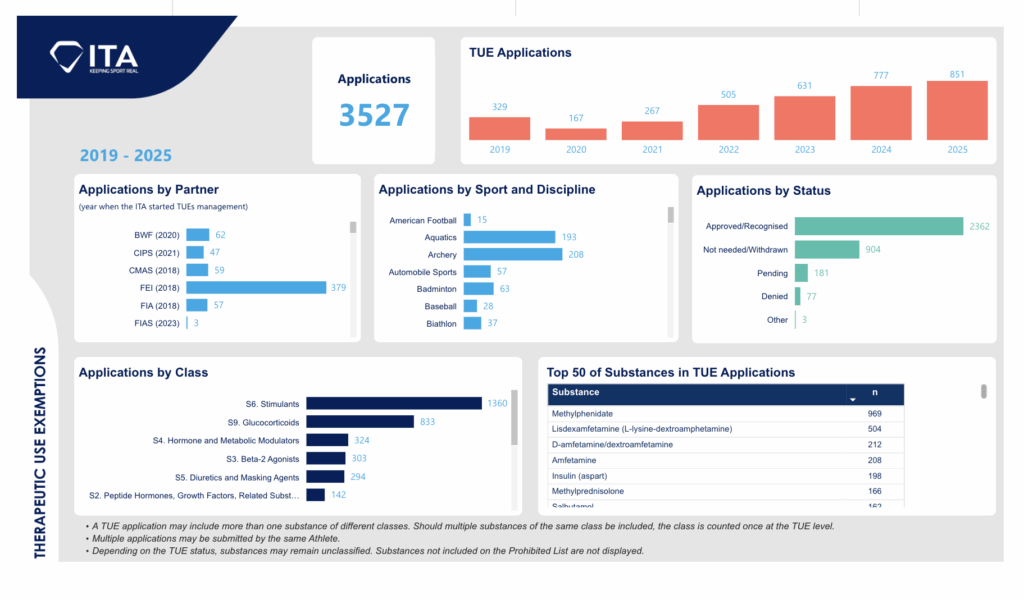
The Public List
The TUE process has been, is, and will continue to be abused because that is just the reality of sport. We’ve all been burned by busted athletes, so it’s no surprise that when the ITA released its database, the list of triathlon exemptions raised eyebrows and voices. As triathlon coach Paulo Sousa wrote on social: “Crazy to think an athlete can get a TUE for Testosterone. Also for Ritalin which is a powerful stimulant.” As non-experts, it can seem unfathomable for a professional athlete to be granted permission to use growth hormone (which, to my personal shock, was also on the granted list) and to see what feels like a lot of TUEs going out the door.
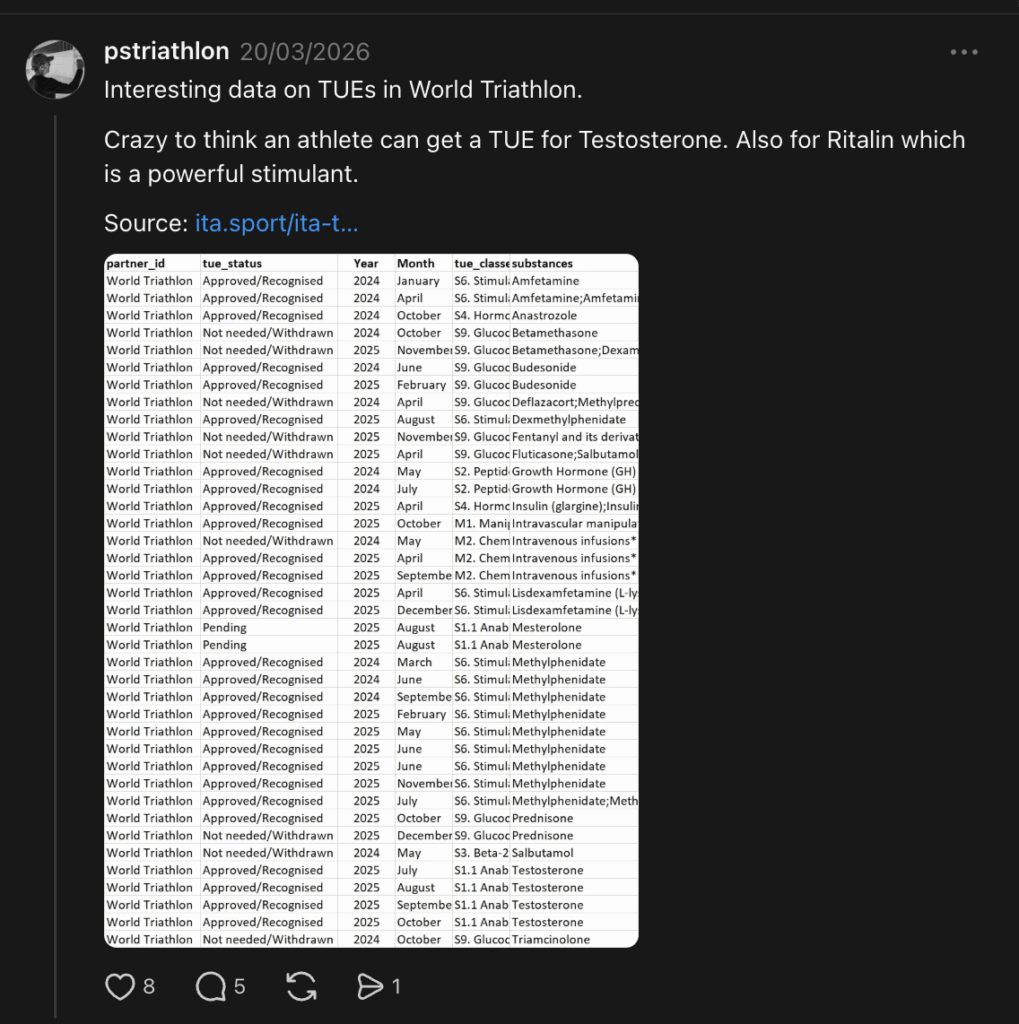
So, I took a closer look. Of the triathlon TUEs, 28 were approved. Within those there were eleven distinct drugs and, with a rudimentary internet search, they fell into a few categories. Four of those drugs were stimulant substances, often associated with ADHD treatment; two were commonly prescribed for respiratory treatment, possibly asthma or allergies; two were typical of diabetes treatment; and one was for fertility treatment. Of the outstanding three, one was for growth hormone, one testosterone, and the remaining for a hormone regulator.
Although we can only speculate what the substances treat and if they are being used legitimately, since most of us aren’t doctors and none of us have the specific case knowledge, speculating is all we can do.
Secrecy vs. Privacy
Which brings us back to Laidlow’s push for the pros to come forward and publicly share their TUEs. Instead of speculating, why not share a TUE if you have a legitimate reason–if you have nothing to hide? The problem is that asking athletes to publicize their TUEs is not about replacing secrecy with transparency. It’s about privacy, and that’s a very different thing.
Clean sport should be protected, promoted for, and remain the ultimate goal, but medical privacy is separate. The TUE process recognizes this. It’s designed to prevent abuse while also protecting the medical privacy of athletes–and before you think that individual medical privacy doesn’t matter as much as clean sport, consider the one TUE that was denied.
Of all the triathlon TUEs in recent years, only one application was denied. As the drama of the list unfolded on social media, American pro Jocelyn McCauley revelaed the denial was hers.
It was the first time McCauley, who finished seventh in Kona last year, had ever applied for a TUE. After a lengthy and expensive process to get all the medical requirements for the application, the substance was deemed “unnecessary” and with no further evidence she could present to convince the panel otherwise, her application was denied. But, she wasn’t surprised.
“When it was denied, I was like, well, I’m sure they deny so many TUEs, it’s not just me,” she says.
However, when the ITA published the list, she was stunned to discover she was the only denial on the list.
“When the ITA came out with all that fairly anonymized data, I was shocked to see that within the last four years, I was the only denial,” McCauley says. “You’re never really in the situation where you know what that one person is—it was me!”
A Public Appeal to Privacy
McCauley chose to go public and put up a video on social media, claiming the denial as hers and explaining why she applied for TUE in the first place. McCauley had suffered four miscarriages over a two year period and sought TUE for fertility treatment. After the denial, she pursued more natural fertility options and, at the time of her video, was several months into a healthy pregnancy.
Although she didn’t need a TUE, she remains adamant that the process must stay private and shared her harrowing experience of multiple miscarriages.
“The fourth miscarriage was in July 2025. I was ten weeks along when I miscarried and it was actually ten weeks before Kona,” she shares, adding that she had planned to skip the race when she was pregnant.
“One of the hardest things I have ever had to do in my life was sitting in the ER, and we had to have our other two children with us at the time, and process losing a child that we had been hoping for for a very long time. I didn’t want to do Kona because it meant that I could and that I didn’t have a baby,” she says, emotion still heavy in her voice. “Obviously, things changed and turned around and I did the world championship. But I wouldn’t have been seventh in the world last year, I wouldn’t have put myself in that situation to be able to accomplish that, if that TUE would have been public. If I had to go through all of that– physically, mentally, and emotionally– publicly, I don’t think I would have had the support I needed to be able to do what I have done in the last year.”
”For so many reasons, TUEs shouldn’t be public,” she says simply. “But I didn’t realize that there could be reasons they shouldn’t be public until I was put in a situation where I felt like they shouldn’t be public.
Medical Privacy is For Every Athlete
McCauley isn’t the only woman to come forward and claim one of the anonymous TUEs. Swiss cross-triathlete Aneta Grabmüller Soldati also required a TUE for fertility treatment. Hers was granted. As Grabmüller wrote on social media:
“Because of a TUE, I have a daughter. The medication I used, Letrozole [sic], is on the prohibited list. Yes, it can be misused to mask doping. But it’s also a common part of fertility treatment. Now imagine this was public. My federation, sponsors, everyone would know I’m trying to get pregnant while the treatment might not even work. As if pregnancy in elite sport wasn’t already complicated enough. And this is just one example! There are reasons behind TUEs that are medical, personal and should remain deeply private.”
Both women speak to a broader issue. The fact is, there are many medical situations that require TUEs and, whatever they may be, both woman advocate they are of a “deeply personal” and private nature–and they are right. Publicly exposing medical conditions is a backward approach to clean sport and could even deter athletes from seeking necessary treatment
“I am sure there are some that exploit TUEs, but we should be questioning the system that allows that,” Grabmüller continues. “Making them public doesn’t fix the system. It just makes the most vulnerable athletes even more vulnerable.”
Consider how you would feel if you had to release your medical information in order to compete in sport. And, before you say professional athletes are different and should just accept that their medical records should be public for the sake of clean sport–that’s exactly what the TUE system already addresses, but in an as-fair-as currently-possible and private way.
Demanding athletes to reveal their medical information constitutes a breach of privacy. Instead, building trust and stronger checks within the anti-doping process–such as the ITA’s new public database–offers a more just and effective path forward. It’s not the perfect solution we all crave, nor is there ever going to be one, but there will always be athletes who break the rules–let’s protect and support the vast majority of clean, honest athletes instead.
Tags:
Anti-DopingRelated Articles:
Continue the discussion at forum.slowtwitch.com
25 more replies






Thabnk you for the artricle which had exposure 30 days ago and chat in various threads on here. No apology for pasting in some extracts.
Here’s the current International Standard for Therapeutic Use Exemptions (ISTUE)(2023):
https://www.wada-ama.org/sites/default/files/2022-09/international_standard_for_therapeutic_use_exemptions_istue_2023.pdf
4.2 [Edited, p11 of 23 in the ISTUE linked above]
An Athlete may be granted a TUE if (and only if) they can show that [all] of the following conditions are met:
We can see from this why a TUE for drugs for fertility may be denied: there are permitted alternatives (though I think McCauley’s failed on all three counts - I am of course delighted she’s now ‘in the club’ and wish her all the best).
On Testosterone and hCG:
I doubt the panel who decide whether to approve T or HGH do so without very great care and consideration.
Here are the Therapeutic Use Exemption (TUE) Physician Guidelines - on Male Hypogonadism.
Prohibited Substances: Testosterone and hCG ]
Your article makes it seem like all those TUE’s were for pros, is that right? Because I thought it was triathlon in general, including age groupers. Could you clairfy
The ITA TUE Dashboard says: “The dashboard presents aggregated data on TUE applications managed by the ITA for athletes defined as “international-level” by their respective International Federation.”
Every Federation defines “international-level” differently. For Ironman, for example, this site says “international level” athletes are those in Ironman’s Registered Testing Pool. Anti-Doping | IRONMAN
This site allows you to click through to see each sport’s “international level” definition. TUE Assistant - International Testing Agency. World Triathlon’s is: “International-Level Athletes are all Athletes that compete in Events that are included in the World Triathlon calendar in the Elite, Junior, U23, Para Triathlon, and Mixed Relay programs.”
So, the ITA database would be primarily pros, at least w/r/t triathlon. Everyone else would go through their National Anti-Doping Organization (USADA, etc)
But that all kind of sounds like athletes in the “AG” pool might just be included too, no? I don’t know what the current system is, but didn’t they used to put you in the pool once you qualified for Kona??
And if it just the pros from Ironman, where do they keep the records and numbers of AG’ers that apply and/or get TUE’s??
Ironman’s actual Registered Testing Pool (those that need to register whereabouts, etc.) is pretty small – a specific list of some pros. Anti-Doping Testing | IRONMAN
They’ve delegated responsibility for handling TUEs for that limited group of the highest level athletes to ITA.
The rest of the athletes subject to Ironman’s Anti-Doping Rules (AGers, lower level pros, etc.) would go through USADA or their national ADO to apply for a TUE. I’m sure USADA, Sport Integrity Canada, etc have all those numbers but aren’t publishing them anywhere that I know of.
It would be great to be able to downvote topics.
Privacy matters? No. This is sport. Want privacy? Work a 9 to 5.
Privacy is a complicated topic for sure. A nurse practitioner in our office who I work with closely if off work for 6 months, “to focus on her health” according to human resources. Predictably this spawned all sorts of speculation/gossip about if she had a serious health problem. I spoke to my nurse and she told me that she was trimming the hedge in her backyard and one handed the hedge trimmer and lacerated the flexor tendon in her left hand. A significant issue but if that was shared by HR all the gossip would have not occurred. Not only that she is somebody we really like in the office so we are/worried about her. Maybe HR could have asked her if she was comfortable with letting everybody know why she was going off. I get it HR is bound by protocols but it seems like privacy can be as destructive as transparency.
I think in many cases you have to chose. It is pretty well impossible to have transparency while maintaining strict privacy.
If your health records are maintained in electronic medical record I’d say there is a pretty good chance they are not private. In our town a hospital that serves 100,000 people had their entire records system hacked and held for ransom. I am sure the hackers have a copy of all that stuff somewhere.
Yes. Just give all athletes a location tracker and webcams everywhere they go and make them publicly accessible. Forget going to the bathroom without everyone knowing. They need to be accountable for where they are and what they do 24/7.
I have nerver had a podium age group athelte testest at world tri or european age group champs. in total about 15 en. SO I would say it’s very unlikely that they are included. and the definition is clear
elite u23 juniors para and relay. thats not age group.
At the same time many feds do test at national champs ( the overall podium ) and there could be age groupers that then might have to apply for a tue, iam not aware of an athelte ever post applying for a tue in 20 years and I have worked with about 30 different podium winners in four different countries at nat champs. While nat champs do give world ranking points they are not on the world tri calendar. SO again they do not meet the definition.
So I would say adnama is most likely correct with that post above.
Ion Tiriac is a former Romanian tennis player who became an agent and tournament owner. He is very much a tennis insider and a billionaire from tennis. Tennis has served him well. Last year he gave an interview to L’Equipe ( « Trop c'est trop » : révolté par l'affaire Sinner, Ion Tiriac réclame plus de transparence ). In the interview he said that the top two hundred pro tennis players generally have TUE’s for 14 or 15 drugs, and he called for more transparency. He believes that the situation is similar across all sports. It surprised me how little coverage this got in the media.
I don’t know the answer, but keeping all this completely secret seems to working against fairness in sport.
If we’re talking about pros, part of me feels like we’re fighting yesterday’s battles. The age of using a questionable TUE to gain an advantage in a completion was over a decade ago when Sky did it. The frontier of doping has moved on.
If we’re worried about people doing it in small scale today, the solution isn’t to reveal things publically, the solution is to impose a time out period for any drugs which confer a performance enhancement for non-chronic problems. E.g. If you legit need testosterone for something then you need to sit out a certain number of days from the last dosage.
After that, it’s a out WADA policy on how and when things get approved
When it comes to actual drug testing, that’s the whole point of ADAMS, to know where a person is at all times. And yet people get suspended for Whereabouts Violations all the time.
Whereabouts are not about your location at all times. It is about a 1h slot each day.
Thats right - if they miss 3 drug tests during that 1 hr window where they are supposed to be in a certain location, they can be suspended. Also they fill in Overnight accommodation (where they sleep, Regular daily activities, including: Training location, Work or school; Other predictable commitments and Competition schedules. The athlete can be tested randomly during these times I believe.