


If I Get Lost, Hurt or Die, It’s My Own Damn Fault — Tales From the Arizona Monster 300
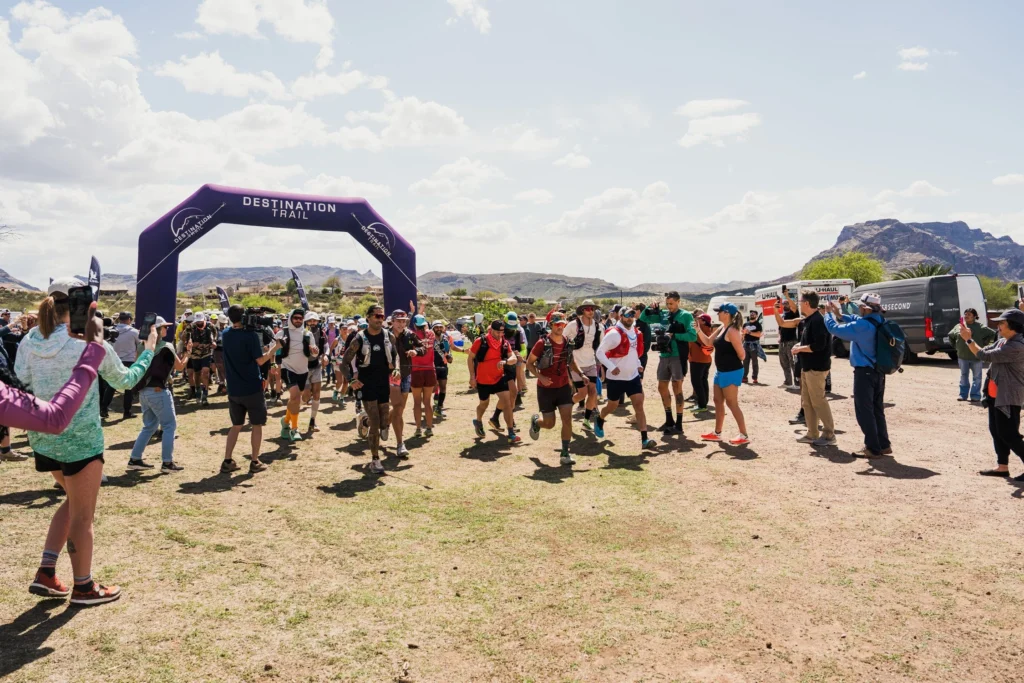
Candice Burt and her team from Destination Trail were at it again for the second annual Arizona Monster 300. The 304 miles of singletrack is an obstacle course of saguaro cacti, mountain passes, and relentless sun stretching from Superior to Patagonia, Arizona. It is currently the longest point-to-point foot race in North America.
The inaugural edition of the Arizona Monster went off on April 4, 2025. Two hundred eighty-four runners started in staggered waves. Before athletes heard the starting gun, they all took an oath at the start line that has become part of the race’s identity: “If I get lost, hurt or die, it’s my own damn fault.”
Above is the destination trail oath
Like all new adventures, the inaugural year had growing pains. Multiple race reports acknowledged logistical challenges. The livestream fell apart due to a public dispute between Burt and a contracted videographer who withdrew a week before the race. The drama played out on social media and generated commentary in the ultrarunning podcast world. But the runners ran, the aid stations were staffed, and 208 people finished something that had never been done before.
This year brought harsher conditions on course and fewer runners taking part in the day. According to the athlete tracker, only 122 runners started. A total of 72 of them finished, with 50 DNFs.
Though there were fewer athletes on course this year, some of the biggest run-fluencers were out and about. Through them and their accounts, such as David Jin Young Park, Catra Corbett (Dirt Diva) and Andrew Glaze, we got to see some of the conditions athletes faced down this year. Even Cameron Hanes chimed in to cheer on these athletes.
The Course and Athlete Guidelines
The Arizona Monster 300 runs from Superior, AZ to Patagonia, AZ — roughly north to south, almost to the Mexican border. It loosely follows the Arizona Trail and takes place entirely on National Forest lands and is a Western States 100 qualifier. It even goes up into Summer Haven Resort which is one of the Triathlon staples of Mt Lemmon in Tuscon, AZ
That said, Destination Trail classifies the Arizona Monster 300 as an “endurance run, not a race.” It is officially framed as a life accomplishment rather than a competition. Finish times are recorded and top finishers are awarded, but the stated spirit of the event is the journey itself. Which makes sense considering if you do achieve a finish line I would say that is one hell of an accomplishment. With a $2,000 Dollar entry fee. This is what you are also signing up for.
| Distance | 304 miles, point to point |
| Elevation Gain | 41,162 ft |
| Elevation Loss | 42,463 ft |
| Terrain | 84% singletrack (259 mi) • 10% bike path (34 mi) • 3% paved (9.5 mi) • 2% dirt road (6 mi) |
| Aid Stations | 19 |
| Cutoff | 170 hours (7 days, 2 hours) |
With this much of a commitment comes the need for some major guidelines and rules. Going over them, I was reminded of Ultraman and Race Across America rule books.
Here are some highlight of the whole manual
Mandatory Gear: To Be Carried at All Times
Clothing
- Waterproof jacket with hood
- Gloves
- Hat or buff
- Pants or tights (must cover entire legs)
- Long sleeve insulating layer
Equipment
- SPOT satellite tracker (provided by Destination Trail)
- Emergency bivy (provided by Destination Trail)
- Device with GPX course track loaded
- Cell phone
- Headlamp or waist light
- Extra batteries
- Whistle
Nutrition
- 500 extra calories for emergency use only
Enforcement: Random gear checks are conducted on course. Runners missing mandatory gear face disqualification or a time penalty. Pacers are required to carry the same mandatory gear as runners.
Safety Protocols
Tracking & Communications
- All runners carry a SPOT satellite tracker, provided by Destination Trail and monitored 24 hours a day by race HQ alongside HAM radio operators stationed at all 19 aid stations.
- Only authorized aid station personnel may reset or replace a tracker. No personal tracking devices are permitted for live tracking purposes.
- Runners are required to have the course GPX loaded on a navigation device, verified at check-in. If trail markings are disturbed by weather or wildlife, runners are expected to self-navigate.
Medical Authority
- Medical staff and aid station captains can pull any runner at any time if they deem it unsafe to continue — whether the issue is physical or mental.
- Any runner requiring an IV during the event is automatically disqualified. IVs are not permitted under any circumstances.
- Any runner requiring emergency medical services (EMS) or search and rescue (SAR) is automatically disqualified.
- A runner who is medically pulled may not volunteer, pace, crew, or otherwise participate in any aspect of the event without explicit approval from the Medical Director.
- Any runner withdrawn for medical reasons must obtain clearance from the Destination Trail Medical Director before entering any future Destination Trail event.
Course & Environmental Hazards
- Temperatures on course have ranged from 7°F in the mountains at night to over 100°F in the desert during the day. Runners must carry warm layers at all times.
- Course hazards include dangerous cliffs, potential rockfall, rattlesnakes, scorpions, spiders, and long exposed sections with no shade or shelter.
- Water caches found at bear boxes and trailheads belong to thru-hikers — runners may not use them. Only official aid station water or filtered natural sources are permitted.
- Leave No Trace is enforced with zero tolerance. Any waste, toilet paper, or wipes left on the trail results in disqualification. Runners are responsible for their crew and pacer’s compliance.
Key Rules
Pacing & Crew
- The first 105 miles are solo. Pacing begins at the Tiger Mine aid station (mile 105.3).
- Only 8 of the 19 aid stations allow crew access. Crew contact with a runner outside of designated crew-access stations results in disqualification.
- One crew vehicle per runner, maximum 20 feet long and 8.5 feet wide. A crew parking pass must be displayed at all times. No RVs or trailers.
- No muling — pacers may not carry a runner’s gear, food, or water. If a pacer shares food or water in an emergency, the runner is disqualified.
- Crew is not required. Many runners, including international participants, complete the event without crew or pacers. Aid stations are designed to support solo runners.
- Runners are 100% responsible for the conduct of their crew and pacers. Most DQ issues in the event stem from crew rule violations.
On Course
- The entire course must be completed on foot. No bikes, motors, or mechanized assistance of any kind. Runners may sleep in crew vehicles at aid stations but may not be transported.
- If a runner leaves the marked course, they must return on foot to the point where they departed and continue from there.
- Rillito aid station exception (mile 173, Tucson): Runners may leave with crew or take an Uber/taxi to a hotel, Airbnb, or restaurant. They must check their SPOT tracker in with the aid station captain, and must return and check out before the station cutoff or they are pulled from the race.
- On the Tucson bike path section, runners may use water fountains, restrooms, and purchase food at convenience stores, but must re-enter the course at the same point they left. No crew contact is permitted on the bike path.
Disqualification Triggers
- Course cutting or skipping any section
- Taking outside aid between aid stations
- Crew contact after an aid station’s cutoff time
- Refusing direction from medical staff or race officials
- Breaking any law
- Endangering other runners, volunteers, or trail users
- Littering or leaving waste on the trail
- Having crew leave supplies anywhere along the course
The Whole Manual can be found here
The Top Finishers From the 2026 Race
MEN
| 1 | Michael McKnight Smithfield, UT • Age 36 | 82:49:45 |
| 2 | Ryan Snickles Chandler, AZ • Age 42 | 90:48:45 |
| 3 | Sam Carroll Yuma, AZ • Age 41 | 94:52:20 |
McKnight’s 82:49:45 is the permanent course record — the course moves for 2027.
WOMEN
| 1 | Selene Mallone King City, ON, Canada • Age 31 | 99:55:02 |
| 2 | Anne Tisdell Mount Lookout, WV • Age 37 | 106:11:32 |
| 3 | Michelle Lomeli San Jose, CA • Age 45 | 120:04:05 |
Mallone finished 4th overall, ahead of 50 men. First woman under 100 hours on this course.
RECAPPING THE TOTAL FINISHER’S FIELD
| Total finishers | 72 (54 men, 18 women) |
| Countries | 7 (USA, Canada, Australia, Japan, Finland, UK, Mexico) |
| Cutoff | 170 hours (7 days, 2 hours) |
Overall Time Stats
| Fastest finisher | Michael McKnight — 3d 10:49:45 |
| Last finisher | Scott Imlay — 6d 23:59:26 |
| Average finish | 5 days, 18 hours, 45 minutes |
| Median finish | 5 days, 22 hours, 24 minutes |
Men
| Fastest | Michael McKnight (Smithfield, UT) — 3d 10:49:45 |
| Average | 5 days, 15 hours, 44 minutes |
| Last finisher | Scott Imlay (Snohomish, WA) — 6d 23:59:26 |
Women
| Fastest | Selene Mallone (King City, ON) — 4d 03:55:02 |
| Average | 6 days, 3 hours, 11 minutes |
| Last finisher | Cassady Birdsong (Oak Creek, CO) — 6d 23:59:24 |
Notable names in the field
Michael McKnight (1st, 82:49:45) — Two-time Bigfoot 200 winner, 2023 Cocodona 250 champion. Set a permanent course record on a route that moves for 2027.
Selene Mallone (4th overall, 1st woman, 99:55:02) — From King City, Ontario, Canada. First woman under 100 hours.
Andrew Glaze (28th, 132:31:42) — Firefighter, ultrarunning content creator, documented the race extensively on social media.
Carter Williams (35th, 142:13:31) — 65 years old, from Salt Lake City. Oldest male finisher in the top half.
Julie Brock (18th overall, 4th woman, 124:12:10) — 59 years old, from Terrigal, Australia.
Scott Imlay (72nd, 167:59:26) — 67 years old, from Snohomish, WA. Oldest finisher and the last person across the line, with 34 seconds on the clock.
Why 300 Miles?
Candice Burt might have invented the modern point to point 200-mile race. In 2014, she directed the first Tahoe 200 — the first non-repetitive, non-looped 200-mile trail race in the United States. I remember her talking about it on social media back in the day. With ninety-five runners starting, sixty finished. Before that, races beyond 100 miles existed, but they were almost exclusively timed events on looped courses. Burt brought point-to-point adventure racing to the 200-mile distance and made something that turned in mainstream.
She later followed Tahoe with the Bigfoot 200 in 2015, then the Moab 240 in Utah in 2017. Together these became to “Triple Crown of 200s” — all three now have lotteries to get in. The success of Burt’s series catalyzed an entire wave of 200-plus-mile events, including the Cocodona 250 and others that have popped up in the decade since.
It’s crazy how something so small is really so big. While the fields are limited in size the hype and buzz is very real. We have bigger names talking about these than some of the bigger IRONMAN events. What’s next for the series? Next year it looks like the Monster will have a new course, which might bring back more runners. Until then, the 2026 series has five more races left: the Tahoe 200 (June 12–16, Stateline, NV) and Bigfoot 200 (August 14–18, Mt. St. Helens, WA) are both already sold out with waitlists open. The Moab 240 (October 9–14, Moab, UT) went through its lottery in January. For those looking at shorter entries into the Destination Trail ecosystem, the Tahoe 100K (June 14–15) and Bigfoot 20M (August 14) both have registration open.
For those of you crazy enough to do these things.. BRAVO and stay safe out there!



Start the discussion at forum.slowtwitch.com