
Speedland RX:SKY. If A Gravel Bike Was A Shoe.
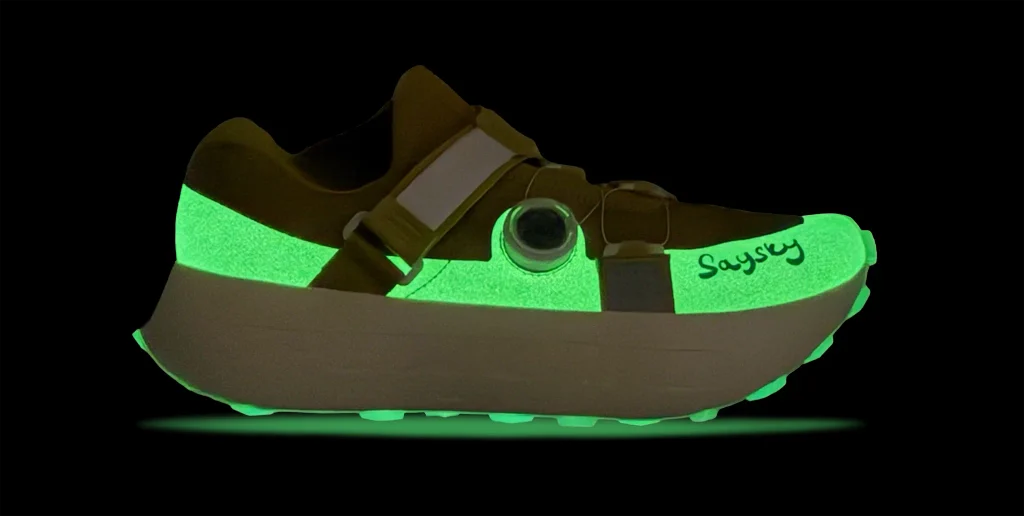
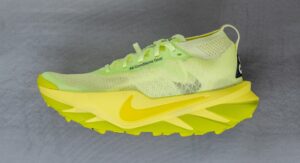
If a gravel bike was a shoe, it would be the RX:SKY. It’s meant for running far. Really far. It’s meant for trails, but reasonably well maintained ones. And it trades some stability and control for straightline speed.
Just as gravel bikes are, pretty much, road bikes (drop bars) with fatter tires, the RX:SKY is mostly Speedland’s RX road-shoe platform with a treaded – rather than smooth – outsole. There are some important differences, but I think the analogy holds.
Speedland’s naming convention is that the model name is the initial two letter prefix with the “thematic” style being the following three-plus letter suffix. The SKY marks the collaboration with Danish running apparel company Saysky, founded in 2013 by Danish windsurfer Lars Pedersen, who wanted to bring the vibes and style of surf sports to running, where he found the apparel, “very generic, technical and fast-looking.” Unsurprisingly, Saysky first took off among triathletes. While they no longer make tri-specific apparel, the brand’s roots in triathlon run deep. And like Speedland, it’s a brand founded in a desire to do things differently.
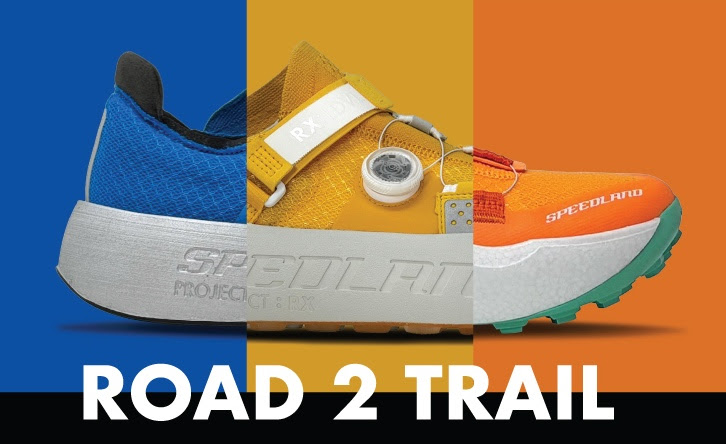
While this is an RX model shoe, it’s really the RXT. The two-letter prefix breaks down a bit here, since the RX prefix first applied to the RX:FPY, which was a road shoe. The RX:SKY is the first off-road variant of the RX, and Speedland did change the trail models with the upcoming RTX:PHX to use the three-letter RXT prefix in the future to make it easier to tell from the name whether it’s a road shoe – like the RX:BLK or RX:PNW – or a trail shoes – like the RX:SKY or RX:LDVL.
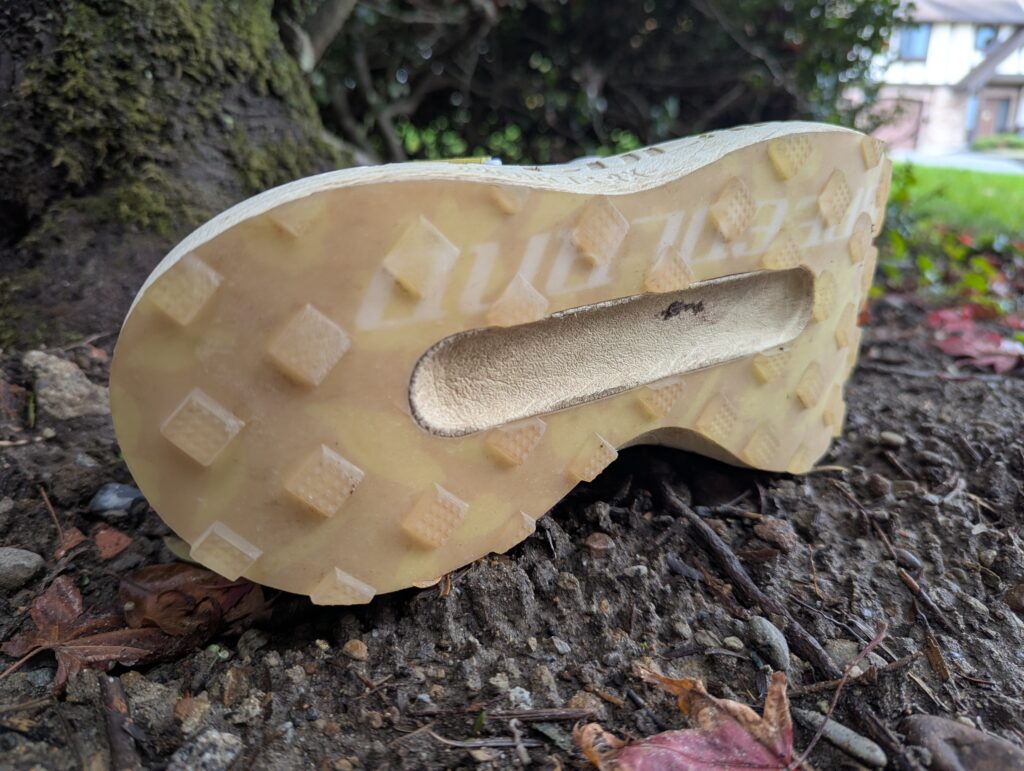
But the RX(T) versions differ from the RX versions based on more than just the outsole. Both shoes feature Speedland-proprietary outsoles – a departure from the Michelin-sourced Fiberlite outsoles on the GS and SL models. The smooth rubber on the road versions does not yet have a tradename, but the lugged outsoles on the trail versions is made of a new Speedland-trademarked rubber, branded as “Feathercast.”
These 3.5mm lugs are meaningfully less beefy than the 5.5mm lugs on the GS or the 7mm lugs on the SL platforms. But the biggest difference is in the midsole. And the midsole is the main reason that these shoes share the RX model name. The RX trail versions started out as prototypes with the same uncompressed SCF (Super-Critical Foam) of the road version. The foam is notably lighter than the beaded ATPU foam in the GS models and at least as bouncy – more in my experience – at the cost of durability and some stability. I put almost 800 miles on my GS:TAMs, and even after all of that, the soles showed literally no sign of creasing. While the bounce definitely died down, the shoes remained incredibly stable and supportive mile after mile. I still use them as wear-around shoes because of the support they offer, even though the soles are pretty well cooked at this point.
The trail versions of the RX were also initially spec’ed with the same single-BOA upper as the road versions. So the initial concept was simply to replace the smooth outsole with a lugged one. And so the idea of just calling it an RX shoe made sense.
But feedback from testers made the shoe meaningfully different enough that it could easily carry an entirely different model name. The uncompressed SCF got swapped for an ATPU (non-beaded) one. And the single-boa upper inherited the velcro-strap-plus-BOA upper of the SL. Both of these contribute to a shoe that’s meaningfully lighter at 9.0oz (US9) than a GS – 10.3oz – and only very slightly heavier than the road-variant RX – 8.3oz.
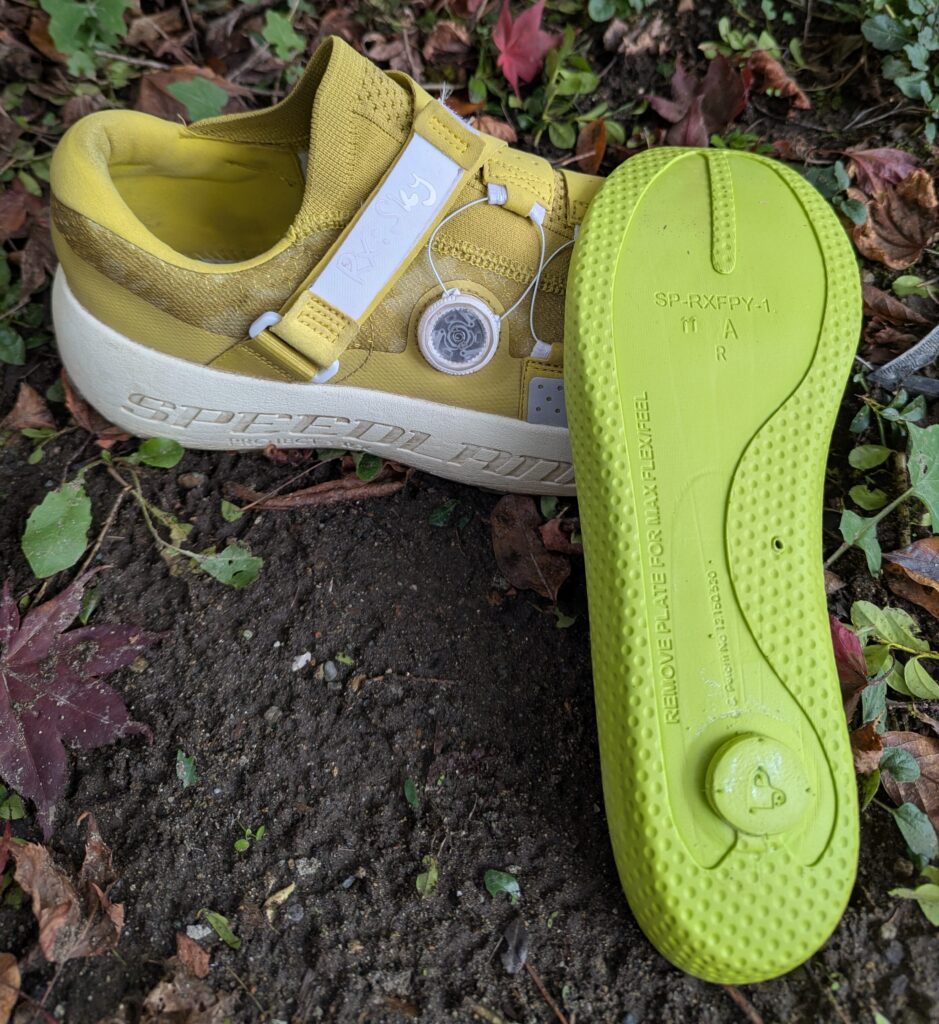
But weight has never – to me – been a critical factor with Speedland’s shoes. They’ve always been “light enough,” and – most importantly – the shoes feel lighter than the stated weight, I believe because of the substantial energy return offered by their midsoles and ultra-thick insoles, which also serve double duty by allowing you to remove (or insert) their proprietary swappable carbon plates.
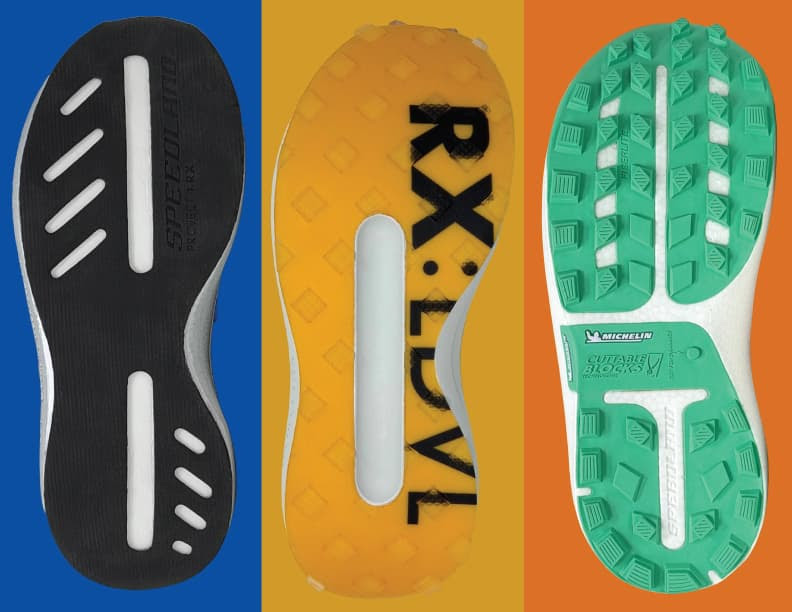
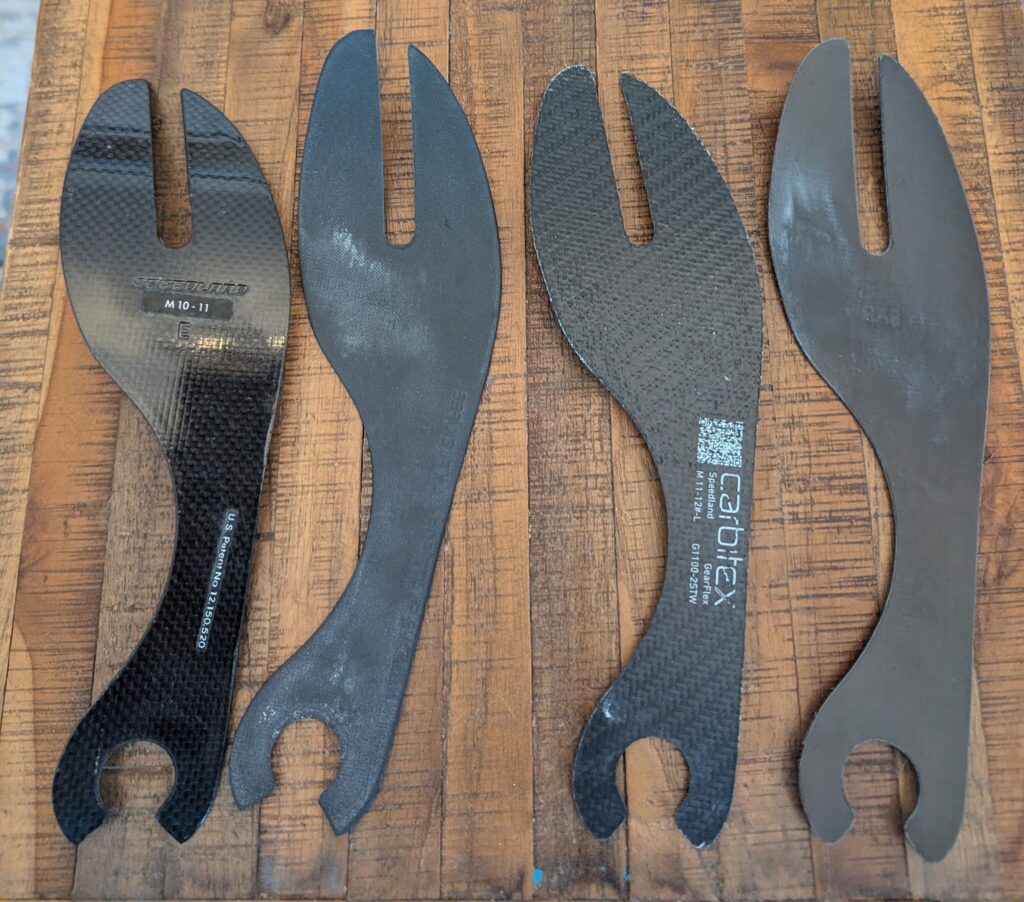
The trail versions come with the same fully-rigid carbon plate of the road variant, rather than the Carbitex plate which is rigid only along its front-to-back axis and which is extremely flexible laterally. Even on the road when testing the original RX, I preferred the lateral flex of the Carbitex plate for anything other than pure speed sessions. The fully rigid plate is unquestionably faster. And also unquestionably harder on your ankles. The ability to remove the plate – or to swap it – is one of the things that I love best about Speedland’s shoes, since I enjoy having the boost of the plate when I want to run fast but I also find the shoes are much more forgiving and amenable to going for easy runs without it. Likewise, the difference between the fully-rigid plate and the more flexible one gives you some room to experiment when doing tempo work where speed matters but where it is not the sole focus.
But as with most good shoes, the RX:SKY is more than just a sum of its parts. The shoe offers the same ultra-distance oriented stability of all Speedland models – these are shoes that are meant for long – really long – distances. But I appreciated that the shoe allowed for more pronation – which makes it easier for me to run fast – than the GS does. The GS is a fantastic shoe. I feel incredibly sure-footed when I’m wearing it. But I also find that on non-technical trails – well-maintained gravel/dirt trails and bike paths – that the shoe offers more stability than I need or want. I don’t mind the extra stability, but I do find it restricts my ability to run fast. Slower than about 4:15/km, I don’t really notice it. Faster than about 3:45/km, I definitely notice it. And in that middle range, which is Z2/Z3 for me, it really depends on the terrain. I find the speed comes easier when I can pronate more, and so I will more often reach for road shoes – rather than trail shoes – on such terrain. But I like the grip of proper lugged outsoles. And this is where I found the RX:SKY to really shine.
The lugs are small enough that it isn’t a nuisance to run on the road sections connecting trails. And likewise I didn’t feel like I was “clomping” along on packed dirt or gravel. But it was really the forgiveness of the midsole and the degree to which it allowed me to pronate – that I enjoyed the most. The RX:FPY was, for me, too supportive a shoe for my relatively short typical runs (10mi). But that amount of support (or just a tad more) turns out to be just right when running off-road-but-on-smooth-trail. This is a great shoe for running fast offroad.
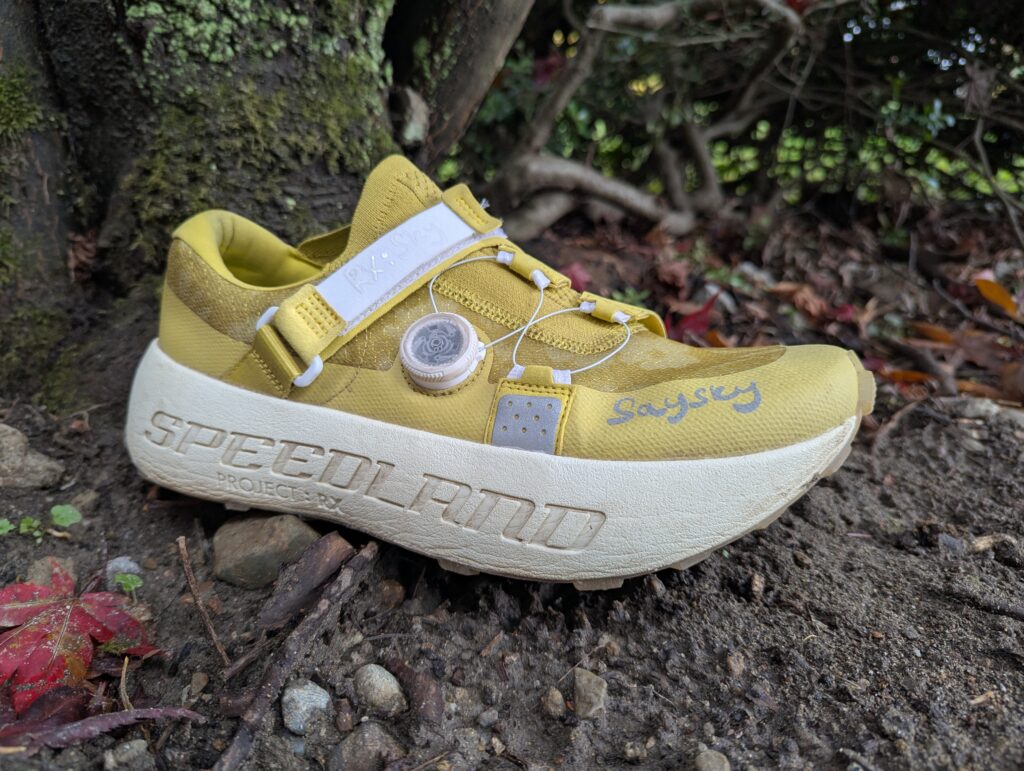
Speedland’s uppers all come with a generous toebox. It isn’t quite as maximalist as its midsoles – a la Altra – but it’s still plenty roomy and gives you plenty of room to splay your toes, especially if – as I do – you like to run in toe socks such as those from Injinji. The strap-plus-BOA design is unquestionably better than the single-BOA design of the road-focused RX:FPY, and I think it’s good enough that it really ought to be the standard even for the road shoe. Especially for triathletes. It’s light enough and simple enough that I see the merit over dual BOAs for shoes where you may not want to totally lock your foot down, but two-zones of control is just better in my opinion. The speed of a single BOA necessarily comes with the tradeoff that the lack of friction in the system means that the tension is evenly dispersed, unlike with traditional laces. I have never really understood why road runners would not want the same degree of control over how their shoes fit as trail runners. The single BOA on the RX:FPY felt like a miss, and the velcro strap of the RX(T) models seems like the perfect approach to keeping weight down while preserving precise control over fit. The 3.5mm lugs worked well, although I never pushed them on the trails I ran on in the way that I pushed my GS on more technical trails. Likewise, I haven’t yet put on enough miles on them except to say that at over 100 miles of mostly trail but some road the lugs seem to be wearing extremely well. Speedland has said that you can expect less life, of course, if you run a lot on the road. The shoe is meant primarily as a trail shoe that works well enough on the road, rather than as a shoe that is equally at home in either place. But regardless, you should expect the lugs to last – and grip well – for hundreds of miles.
There is a growing class of shoes that seems to be struggling to find a name. Hybrid, Road-To-Trail, and Gravel all seem viable. The idea of these shoes is that, as with a gravel bike, the shoes are meant to excel across a wider variety of terrain. While the RX:SKY definitely plants itself in the gravel – rather than road-to-trail category, I think the line there is admittedly very blurry. I would not choose to race a pure road race in these shoes. But for everything outside of racing, I think that they will excel across a wide range of terrain, especially if that breadth is encountered during a single run, as I am lucky to have on one of my regular routes that’s about 40% paved path and 60% dirt and gravel trail along a river. The generously thick and bouncy midsole matters much more than anything else, in much the same way that tires tend to dominate everything else about how a gravel bike feels.
The definition of a gravel bike is rather fluid, but I would say that the two non-negotiables are drop-bars and relatively large – 40mm+ – tires. You can change a lot of things and still call a bike a gravel bike as long as it has those two things. Critically, gravel bikes wager that you are willing to trade some amount of control as compared with a mountain bike for faster straight line speed, which is generally a very good trade given the primacy of aerodynamic drag. Analogizing to shoes, the same tradeoff applies – that as compared with a mountain-bike-esque trail shoe – where grip and stability are of primary importance, a gravel-esque trail shoe would sacrifice some amount of both for faster straight-line speed. If cross-country spikes are the cyclocross bikes of the shoe world, then a “gravel” shoe should offer more cushioning, comfort and stability, but should still care enough running fast to let your gait stay largely unchanged from the road. And, more than that, the feel of running on the road should be mostly similar to the feel of running off-road. In particular, these shoes must not exhibit the wobbliness – and slowness and overall clunkiness – of running in heavily lugged shoes, clomping along on the pavement, feeling like you are more likely to twist your ankle running on the road rather than off it.
But while it might be tempting to analogize shoes solely to tires, the geometry and structure of shoes is much closer to the idea of a bike frame. The parallels between outsole lugs and tread patterns is obvious – and there is a reason that many shoe companies turn to tire manufacturers for their rubber. While Vibram remains the king to many, Adidas has found great success using rubber from fellow German company Continental, and Speedland’s Michelin-provided Fiberlite outsole on their GS line. As with tires, lugs are part of the story, but not the whole story. The analog of lower tire pressure affording greater comfort through the suspension it provides also applies in the case of thick, supercritical foam. More foam – especially when that foam comes with a minimal weight penalty and where it actively returns a great deal of the energy imparted to it (and even more energy when paired with a carbon plate) – is the analog of wide, supple-casing tires. This is especially true for shoes that put the runner down “in” the shoe, as the original Hokas did and which all Speedland models do. This is the trick to not just preserving – but actually gaining – stability as you increase stack height. More foam underfoot also allows trail shoes to forgo a rockplate and to increase the overall flexibility to give better underfoot feel. The trick with gravel bikes was the discovery that tire width could make up for a lot of what had previously come from lug depth. Gravel bikes are remarkably capable offroad – even on rather technical terrain – because wide tires offer a lot of grip. Lugs do make a difference, but lugs often make much less of a difference than it might appear. And wide tires – it turns out – pay very little penalty on the road. The same is true for shoe midsoles.
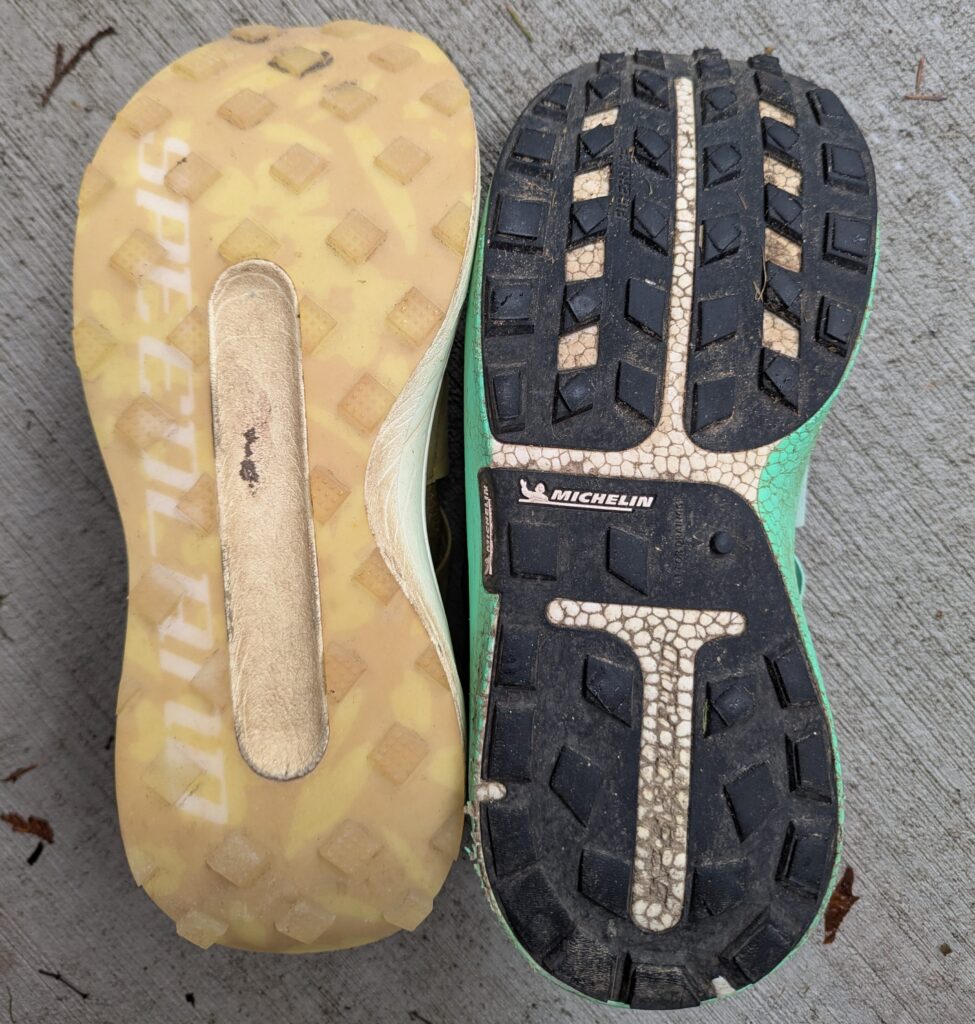
As with bike tires, outside of muddy conditions, lugs are rarely as necessary as people imagine. Lightly treaded outsoles work just fine on a lot of trail conditions. And, of course, it’s a quite a bit easier to choose where you plant your foot than it is to decide precisely where your tires will roll. In the end, you can solve most of the challenges of offroad running – as the original Hoka Bondi and Mafate demonstrated – simply by adding more foam and cradling the foot properly. If you do this, you often need less aggressive lugs. Or, at least, you can slim down lugs that never really needed to be that big anyway, but which existed at least partly to signal that this particular shoe was a trail shoe which was a very different thing than a road shoe. Perhaps, in this way, a gravel bike ought to be best described simply as a bike – the universal idea of a bike – and then other types of bikes need to specify their particular niche. A gravel bike is just a bike. It can be ridden anywhere. But a road bike – or a mountain bike – is then specialized, with tradeoffs that may or may not be worthwhile to a particular rider. Such a universal device – whether a bike or a shoe – needs especially to be good everywhere, even if that means it is specifically – and acceptably – great nowhere. Being bad at any one discipline is unacceptable. For shoes, that means they need to be not unpleasant to use on the road.
In comparison with the shoe that seems to me to be closest competitor to the RX(T) – Mount-To-Coast’s H1, with the “H” standing for “Hybrid” and which they describe as both a Road-To-Trail and Gravel shoe, the RX:SKY’s lugs are slightly more prominent – at 3.5mm vs 2mm for the H1. It’s a bit heavier – 9oz vs 8.5 – but also a bit thicker – 34/41mm vs 29/35mm. I have not run in the H1, but its results in the most brutal of races speaks for itself, as is the case with Speedland. Again, as with bikes, there is plenty of room for fatter-tired-road-bikes and drop-barred-mountain-bikes and everything in between. Mostly I think this class of shoes is great because, like with gravel bikes, it expands the possibilities that are open to you. Running should be fun. And the ability to smoothly and confidently mix road and trail together – if you are lucky enough to have access to such terrain – is a joy. It’s much nicer to run the roads to a local trailhead and run home than it is to drive. And it’s nice to feel like you are wearing the right shoes the entire time.
As someone who was an avowed minimalist for most of my career, the obviousness of the maximalist trend is still a treat. Nike’s bouncy LunaRacers were the first shoes I truly loved – and what I wore to my first Ironman win. And I had wonderful runs in the very first Hokas. But for reasons I still don’t fully understand other than to say I made a lot of bad decisions in my professional career to go along with what were, I hope, I always asserted that my love of the LunaRacers was primarily due to their weight rather than their bounce. And that Hokas were fine to train in, but too heavy to actually race in. Of the many decisions I wish I could revisit, I think this ranks at the top of the list. I am, however, thankful that bouncy shoes have allowed me to continue to run happily for all of the years since I have retired and to run faster than I probably deserve to. Super shoes have had a remarkable impact in running. But the impact on ultra-distance triathlon – where leg pain is a meaningful limiter to running speed – is that much more remarkable. There are many reasons for the massive drop in Ironman finish times – aerodynamics has meant that bike times are faster at the same (or less) wattage, which means less calories expended. Likewise, the ability to fuel with even larger quantities of carbohydrates has meant athletes start the marathon with more reserves, both because they’ve been on the bike for less time and because they have gotten more calories in while doing so. But the biggest relative drop in time seems to be in the marathon, and I believe it is because super shoes do double duty for Ironman runners. The energy return of the supercritical foams and carbon plates provides the same benefit it does to pure runners. But the suspension provided by that ultrabouncy foam also means a lot less shock – and pain – in legs that have just pedaled 112miles. That same benefit applies to training on tired legs as well.
Norway’s Jakob Ingebritsen said as much in a recent interview, where he said modern shoes allow him to run both faster and easier. The same lesson comfort applies on the bike – wider tires and lower pressures along with more comfortable (and aerodynamic) full-arm cradles, where less fatigue and pain means it’s easier to ride faster. All of which comes back to shoes like the RX:SKY that are designed to help ultra-racers get the absolute most out of their body, but which also work equally well for helping you get the most fun out of your running. I have never needed the cushioning or bounce of these shoes. But I consider the joy they bring me to be a more than good enough reason to keep running in them.
If Speedland’s original GS:TAM planted me firmly in the maximalist camp, it also made me pay more attention to overall shoe geometry. I love maximalism, but I don’t want to give up the freedom of movement that kept me running in minimalist shoes for long. The RX:SKY feels like a better balance on most of the trails that I run, which are decidedly non-technical and oriented more towards dog walkers than hard-core ultra runners. On these trails – and on the roads to get there – the RX:SKY shines most brightly. Especially given that they glow in the dark…
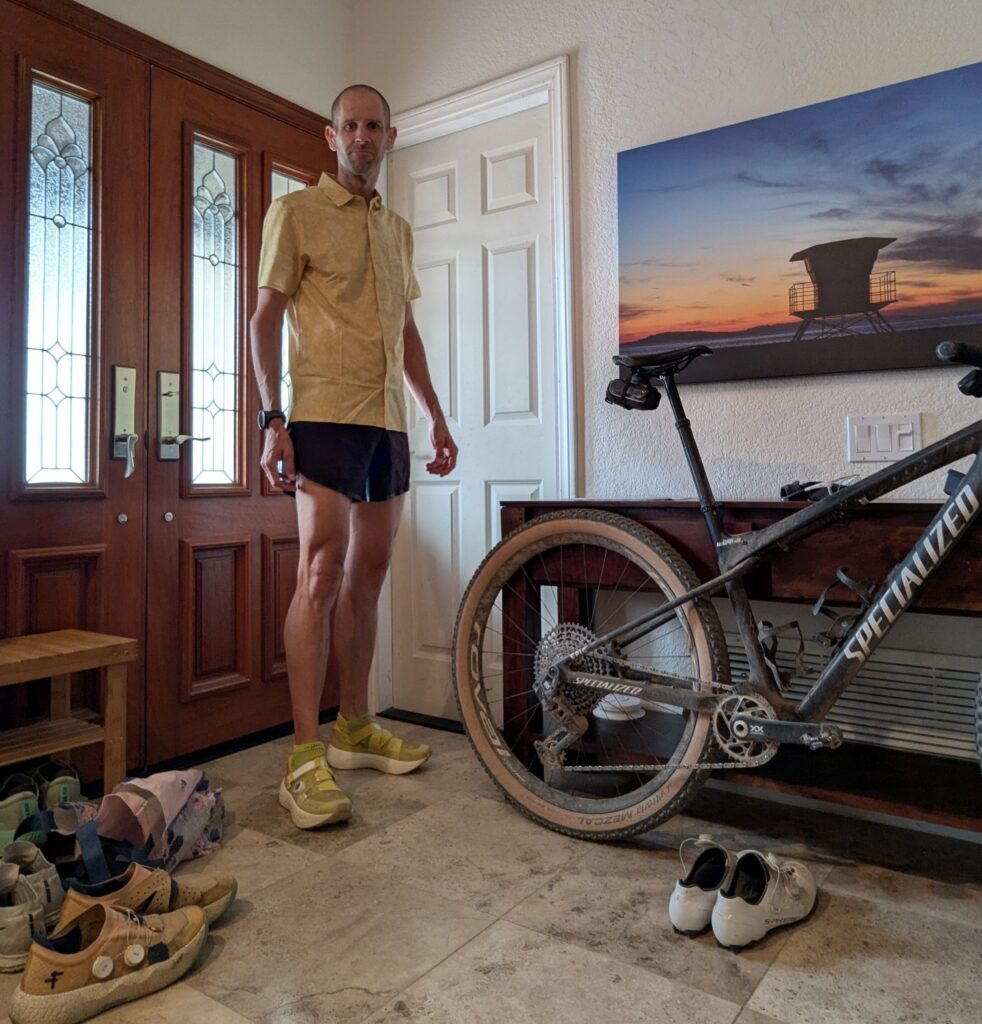
In addition to the shoe collab, Saysky and Speedland also partnered on a unique button-up, collared tech shirt. A button-up shirt is a creative solution to some common problems with running tops – especially for long distance running – that I had not considered. The structured collar helps keep hydration pack straps off of your neck. And the ability to button (or unbutton) the shirt gives you a nice option for temperature control on days where the weather is variable that a classic t-shirt lacks. Most importantly, though, they look good. The idea for the shirt came from entirely Saysky, and Speedland embraced it as being a typically over-the-top and unique idea for, “how do you make the most technical gear possible for people who want to run very, very far?” Bonus points if it does things a little bit funky in the process.
This is not the first such top – both Roark and Rabbit make running-specific collared button-up shirts. But it is delivered with signature Saysky – and Speedland – style. Like the glow-in-the-dark trim on the RX:SKYs, the Speedland X Saysky tech shirt features glow-in-the-dark buttons and logo. And while I don’t expect them to replace the tech tee anytime soon, I did enjoy running in it. Especially when it was hot. The collar stayed out of the way and wasn’t noticeable even when running without a hydration pack. It’s a good shirt that has a bit of extra fun and flair. At $93, it is not cheap. But it’s also not meaningfully outside the range of typical high-end tech tops from Rabbit, Tracksmith, or Saysky itself.
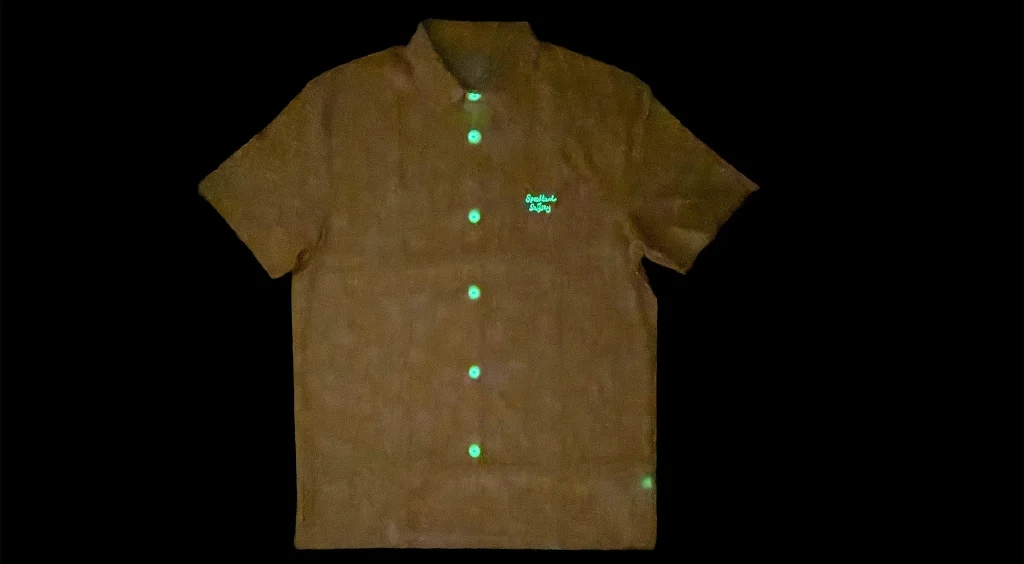
The shirt has the usual features that you’d expect from a high-end tech shirt – bonded seams and a nice grid-perforated fabric that breathes well. It’s a remarkably comfortable shirt that looks as good as it performs. I wore it as often as a wear-around shirt as I did running, especially during the summer. The idea for the shirt came from Saysky, and Speedland unsurprisingly embraced it. Speedland keeps the focus on their shoes – in addition to this one shirt, they offer two different hats; that’s it for apparel.
While you certainly need a good detergent to wear the shirt as both training and casual apparel, I think the shirt does both better than any other shirt I own.
The Speedland RX:SKY is available in limited sizes on runspeedland.com for $299 which includes the rigid carbon plate (removable). It has been succeeded by the RX:LDVL, available in most sizes for the same price, also including the rigid carbon plate. The RXT:PHX – the first model to “officially” carry the “T” designation – is available for pre-order, shipping in mid-December, for $279 without the plate included, allowing you to purchase either (or both) plates separately a la carte.
The Speedland X Saysky tech shirt is available in all sizes for $93.
Speedland provided the pair of shoes and shirt reviewed here free of charge. No other consideration was provided relating to the publishing of this article.
Glow in the dark photos and Speedland collage photos credit runspeedland.com.

Start the discussion at forum.slowtwitch.com