
Indoor vs Outdoor Bike Training: The Real Question You Need to Be Asking
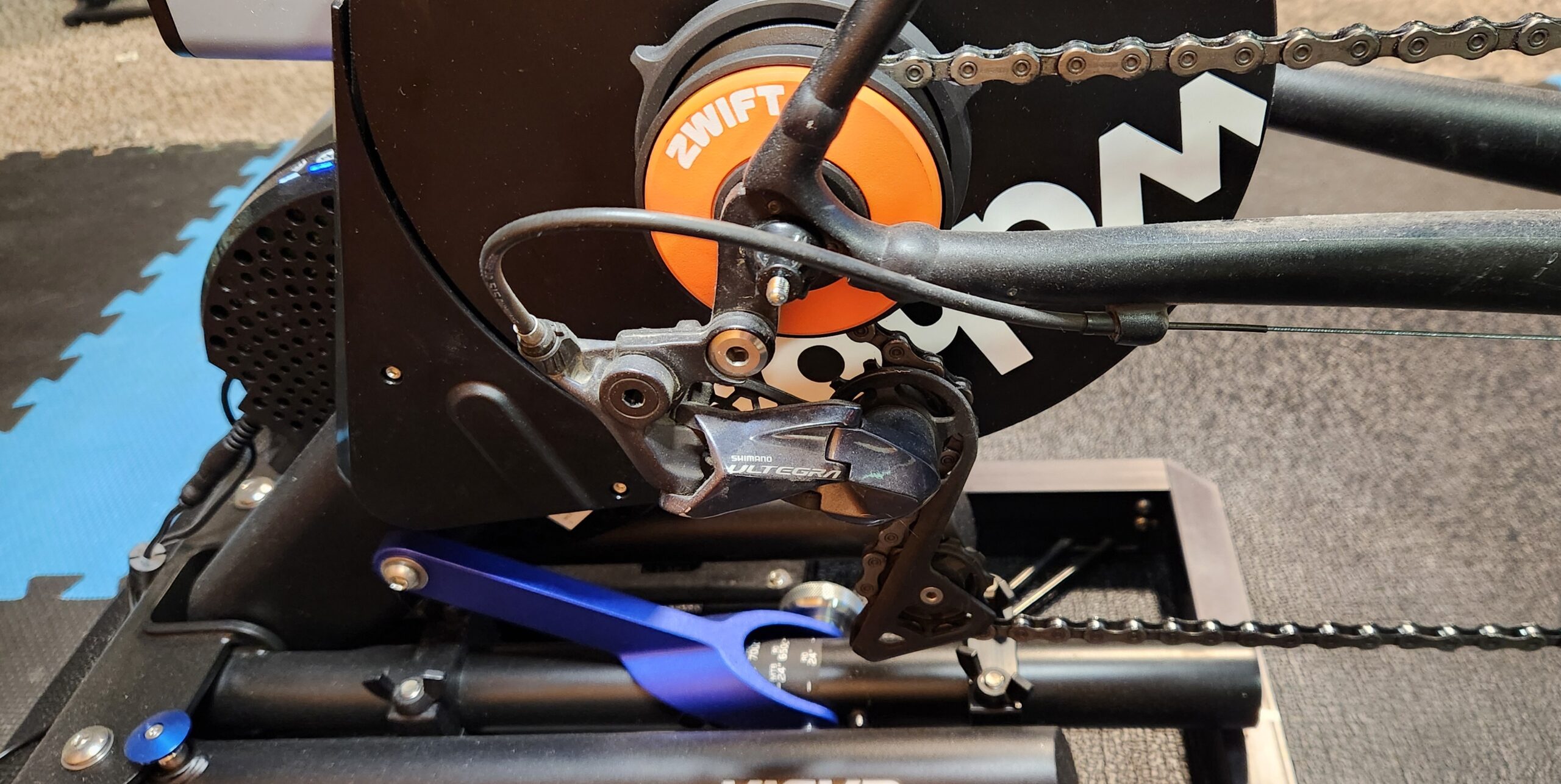
The indoor versus outdoor debate is no longer seasonal. With increasingly better platforms, better smart trainers, and more data-driven training, indoor training has become a year-round tool. So, the question is no longer which is better but what adaptation are you seeking?
Foul weather or other basic matters that make inside training an obvious compromise don’t necessitate more discussion. And, for numerous reasons–from bike handling and pacing skills to just plain joy–there is no debate that outside riding can ever be replaced. So, assuming that you are training with a purpose and following a structured training program: When should you choose outside over in? How do you convert an outdoor session to an indoor one? And why should you always be considering which is best for every session?
Why should you always consider riding inside?
Riding inside offers one massive advantage: control. There is no weather, traffic, or imperfect terrain to interfere with your prescribed session. You can control, or at least influence, every variable from cadence to temperature. You can set a smart trainer at a certain power output, you can stay in the aero position for as long as you like, and execute a structured session to perfection.
Of course, all of the good things about indoor training come at a cost. Thermal control might pose a problem, as well as cardiac drift, since it’s near impossible to get the same cooling effects as outside in a home set up; there is no skill development or bike handling challenge, and, as much as virtual platforms and music can make it fun, there is no denying it can be tedious.
Nevertheless, there is a reason why many pros even opt for an inside session in the middle of summer. The control–and challenge that control brings–is simply unmatched since there is nowhere to hide. There are no hairpin corners or descents or even slight terrain changes to offer microseconds of respite, you simply have no choice but to pedal constantly. While that makes indoor training incredibly efficient, it makes it equally difficult–which can seem like a negative but, as endurance athletes who love to suffer, we all know that’s actually a positive.
When should you choose inside over outside?
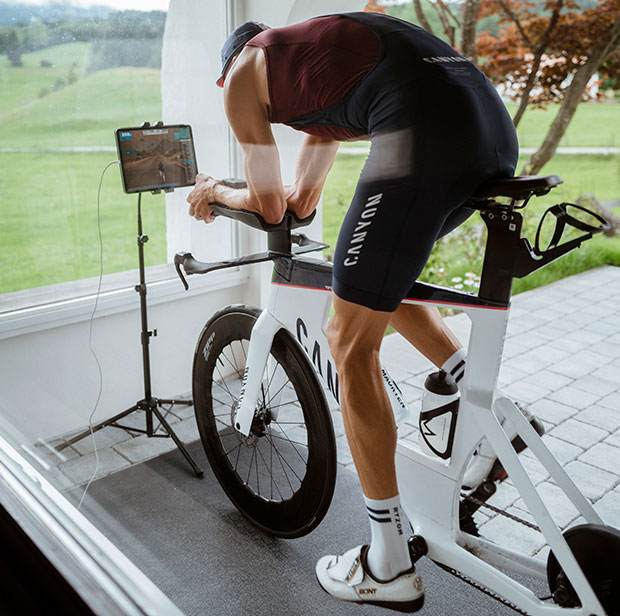
Putting aside that every workout can be executed outside, some sessions can offer more inside. For triathletes especially, those sessions include race pace and threshold work where you want to stay in aero. Over/unders, where you’re holding a high aerobic power and bumping up into threshold only to come back to high aerobic power, is a good example of a great inside session since it negates any micro rests between changes and forces the precise power. Longer sessions in the aero bars can’t be matched outside, especially since you can do them safely and even with a mirror to really work on your position and position durability.
Skill development might be best done outside, but that doesn’t mean the indoor trainer has nothing to offer in that department. High and low cadence efforts can work well inside, as does one leg pedaling. Without the worry of bike handling, you can truly relax in the effort to engage your core and train your pelvic stability without gripping the bars or worrying about external factors.
How do you convert an outdoor session to an indoor one?
In the past, time and distance were always the metrics used for conversion, but that’s a bit of a misnomer. The gold standard is to match intended stimulus. Matching the intended TSS (training stress score) or IF (intensity factor) is more accurate. Time should still be considered since inside offers continuous load, but the reduction in time should aim to yield the same TSS or IF. Alternatively, as German pro Dr. Merle Brunnee prefers, you can also you energy expenditure as measure, using by kilojoules as your metric. For example, a 3-hour aerobic ride can be reduced to a 2.5-hour ride, both aiming for an IF of 0.70, or a TSS of 130, or 1,200 kilojoules.
Intervals can be matched exactly, but power can be difficult to reproduce. Some athletes can match their indoor and outdoor power numbers, while others need to reduce their indoor targets slightly. Using the whole range of your power zone with heart rate data and RPE (rate of perceived exertion) will give you guidance for if, and how, you need to adjust. For example, if your threshold zone is 250 to 270 watts, outside you might be closer to 270 watts, whereas inside 250 watts might feel the same and be enough to yield the same desired result. It’s important not to let your ego get in the way here–listen to your body feedback and objectively adjust.
What should you watch out for training inside?
Temperature control, as mentioned above, can be difficult. Without the cooling effects of the air outside, it is essential to have a fan and adjust your fluid and electrolyte intake. Heat stress can significantly impact performance, so stay cool and hydrated.
ERG mode can be your best friend or your worst enemy. ERG mode is a fantastic tool to ensure you’re staying on the prescribed watts, but if your cadence drops and the trainer adjusts making it feel too heavy to turn the pedals, choose another mode of resistance.
Don’t forget to ride outside. Training inside is great for physical stimulus and even mental toughness, but it will do nothing about teaching you how to descend a mountain pass, ride in a peloton, pace your efforts yourself, or give you the same amount of joy as summiting a mountain or winning the group ride town sign sprint. Even pedaling outside is different and, since most of us are aiming to race and perform outside, use indoor training when necessary or more effective, not as a complete replacement.
Tags:
Indoor TrainingWahoo FitnessRelated Articles:

Continue the discussion at forum.slowtwitch.com
125 more replies



I’ve done the vast majority of my training this year indoors. I’ve always incorporated indoor bike workouts into my training but primarily during the week when work prevented me from getting outside. This year, however, I’ve really bought into training inside and I’ve done a steady diet of 3 and 4 hour rides. I’m going to continue to do long indoor sessions as we move into the spring. For me, training indoors is more convenient and safer. I live in a neighborhood that has a basically unbroken 5 mile loop around a large lake. When I ride outside, I do my rides on that loop. I’ve done 60 milers before. I feel pretty safe riding outside on that loop but not out on the open road. I’ll do it but I’m nervous. So those are my primary considerations.
I have been pleasantly surprised at how easy it’s been to adapt to long indoor rides. I’ve even embraced the treadmill quite a bit.
Indoor training trains parts of the physiological aspects - cardiovascular endurance and muscular endurance for the prime movers - quite well. It completely fails to train other parts of cycling performance like cornering, riding downhill, breaking, race dynamics, effort distribution with the wind and with topography, the small muscles necessary to balance …
It is fantastic for riders that already ride well, it is terrible for new riders. Take two new riders, one trained on alpine road, the other on zwift and put them on the Nice racecourse. Quite easy to see, who will be faster.
If you measure the efficiency in a lab (on an indoor trainer) I am sure, indoor training does well. But I see a lot of bad riding, early braking and bad effort distribution in the real world.
I ride outside, when the weather allows it. I much rather ride on a gravel bike outside, even for VO2 intervals, than on a trainer. But I use the trainer a lot in winter when it is not possible to train outside safely. And when I switch to outside riding again, I always experience neck discomfort, small muscles being sore and worse descending. Takes me from March to April, to get back into fast riding on the triathlon bike again.
Last aspect is enjoyment, I work indoors behind a screen. Guess what I don’t want to do, in my free time!
I’m currently coming back from a pretty serious injury, and have been exclusively on the trainer since mid January. I’ve done more indoor sessions this year than I did for the entire 2025!
It looks like I will be on it for a few more months, so I am hoping I can see some decent ‘re-gains’. The one thing that I will struggle with is endurance; I find it really hard to do some of the sorts of sessions some of my colleagues do. I am yet to crack two hours; some of my buddies do 4hrs plus. I don’t know how they do it.
Riding indoors also totally neglects all the stabilising muscles you use holding aero outdoors, especially in gusty conditions. Many a athlete spends half the race sitting up on the base bars for this very reason
Nah, not at all. Most athletes spend have the race sitting up because they don’t train in the aero position enough, or at all, indoors. Seems like most people I know (and seems like most pros, judging from interviews, which I’ve been amazed at) ride upright and not in the aero position indoors almost entirely. Almost every pro athlete interviewed that I’ve heard on the Triathlon Hour podcast, doesn’t train in indoors aero, which was amazing to me (!!).
But yeah, you do have to practice enough outdoors that you can roll with reasonable wind gusts and not be too scared out of the aerobars, especially with 88-range wheels. But I seriously doubt that instability on these mostly straight and mostly non-crazy wind triathlon courses is the reason that people are sitting up - it’s the back discomfort from not being acclimated to it for long UNBROKEN periods.
In your opinion… In my opinion I can sit aero indoors reading a book, hell having a asleep with no engagement in any of my upper body, shoulders, traps, back etc. Try doing that outside..
Yes, but the reality is that the new rider who trains on zwift all winter will crush the other new rider who as a new rider, typically doesn’t train much at all of winter due to cold, ice, and darkness. It’ll even a big (but lesser) advantage in the spring/summer where the convenience of being able to train indoors even at weird hours and if it’s raining/etc outside lets the indoor rider be super consistent vs the typical new outdoor rider that only rides when it is nice out.
If you’re riding outdoors in heavy rain, darkness, or ice patches on the road, you aren’t a new rider by that point. That’s for experienced folks who know what they are doing.
For summer though, I do think for new riders, they gotta be outdoors as much as possible, to train the bike handling, and to get their equipment/nutrition dialed in. Winter and early spring though, trainer focus for high consistency is the way to go. Even in sunny Norcal where I can ride outdoors ALL winter, we get intermittent heavy rainstorms, we get some frost in the hills, and early darkness is still a limiter, so I focus on indoors mostly. (Still LOVE outdoors though - if it’s nice, I’m typically out there.)
Most people are the opposite, I’m pretty sure, including me. If I can hold aero for 1.5hrs indoors, I am good to go for 3-4 hours outdoors in aerobars. Absolutely not the reverse. But a lot of this has to do with trainer static position, which is tough to hold, even if you’re not in the aerobars.
Outdoors, I and most other regular cyclists ride 7+ centuries with no/minimal back problems - and I ride in the drops most of the time on a road bike if it’s not a mountain climb. That same me indoors, is struggling with back fatigue (and butt fatigue) at the 3hr mark indoors. I do ride on a static bike, no rockers, so maybe rockers would make it easier indoors.
Same for many of us, I always find it harder to stay in aero indoors, if I can do about 4 hours indoor mostly in aero I know I can ride outside in aero “forever”. My totally random uneducated made up theory is that wind outside supports your body position when you are in aero whereas you don’t have that support when riding indoors.
Another N of 1 datapoint… I ride mostly indoors or outside on a road bike. I will probably only ride my tri bike 4-5 times outside ahead of a race. I am mixed aero position on the trainer - constantly in and out and usually do not hold for more than 5 minutes. But I rode my tri bike 3 hours outside yesterday, the first time in like 7 months, and locked into aero for long stretches with no issues in control or comfort. (I only came out of aero for intersections, narrow sections, or other traffic.)
I have a Tacx Neo with the motion plates, and it is way more comfortable than a static trainer. I highly recommend. I don’t think I could go back to a locked-in static trainer, and it is one of the main reasons the trainer bikes do not appeal to me.
Lots of indoor riding article these weeks lol I love a good indoor riding sessions but every time I go outside I know that only nature is free.
On a separate note, I’ve been thinking for a while now and I think I might finally get a Zwift Ride in the coming months. So far I have always used my Tri bike but the bike kinda gets weird issues but moreover it pains me how I have this great fancy bike and never get to really ride it in aero position outside of races. I feel like it would be so much better if I at least used it for the flat rides and use my normal road bike only for group rides or really long rides. Kinda pains me that I have two bikes and feel like I don’t clock enough time on them despite outdoor/indoor well over 10k km each year. Need to more riding.
Why don’t you use your TT bike as often as possible, def on all flat outdoors rides and long triathlon-type weekend rides? That’s the whole point of having them. If it’s too uncomfortable in aero, think about making the position less aggressive - you’ll still be way faster than no aerobars and enjoy it a lot more.
I never understood why people who have both TT and road bikes keep riding their road bikes. Ok, I sort of understand, in the vast majority of cases its because they don’t like the comfort of the aero position, but in that case they should fix it as per above. You don’t have to look like a UCI TT Pro to get the majority of the aerobar speed benefit. I started triathlon with a fairly nonagressive position and never had problems even in my first few months of riding, with holding it for hours. (Now it’s pretty aggressive, and my trainer bike setup is actually TOO aggressive, I have to add a big towel to get more stack height.)
Atm it’s mostly because my tri bike is on the trainer and is easier adjustable (saddle height) than my road bike so my wife can occassionally use it too. I have no issues riding aero for long stretches of time, it’s just something that I have been too lazy to switch around.
Ok then, with two riders, you absolutely should get the Zwift bike. I dunno about you, but my on-trainer bikes get absolutely wrecked by all the sweat that eventually seeps into all the metal joints and connectors - the headset is pretty much guaranteed to be dead after a season even if I use a cover and towels. I’ve even tried saran wrapping bits like the front brakes, and that doesn’t even help them from seizing. Unless I remove the bike and ride it outside every weekish, it’s going to get fused/ruined. So I have my old near-dead entry level bike on my trainer now, but I’d get a Zwift bike if another family member wanted to also ride.
Get that TT bike outdoors and ride it more, though - that’s the whole point of having a TT bike!
One of the stimuli that’s missed is with indoor training is the stabilization muscles - both for steering/staying upright as well as for the rumble of the pavement underneath you.
Especially if the course you’re going to be racing on has poor pavement, one thing that indoor training misses is the constant rumble of imperfect pavement, as well as the cathunk-cathunk frost contraction/expansion patterns we tend to get where its cold for part of the year.