
Barrelman: Inspired by Roth and a Rare North American Independent Half-Distance Race
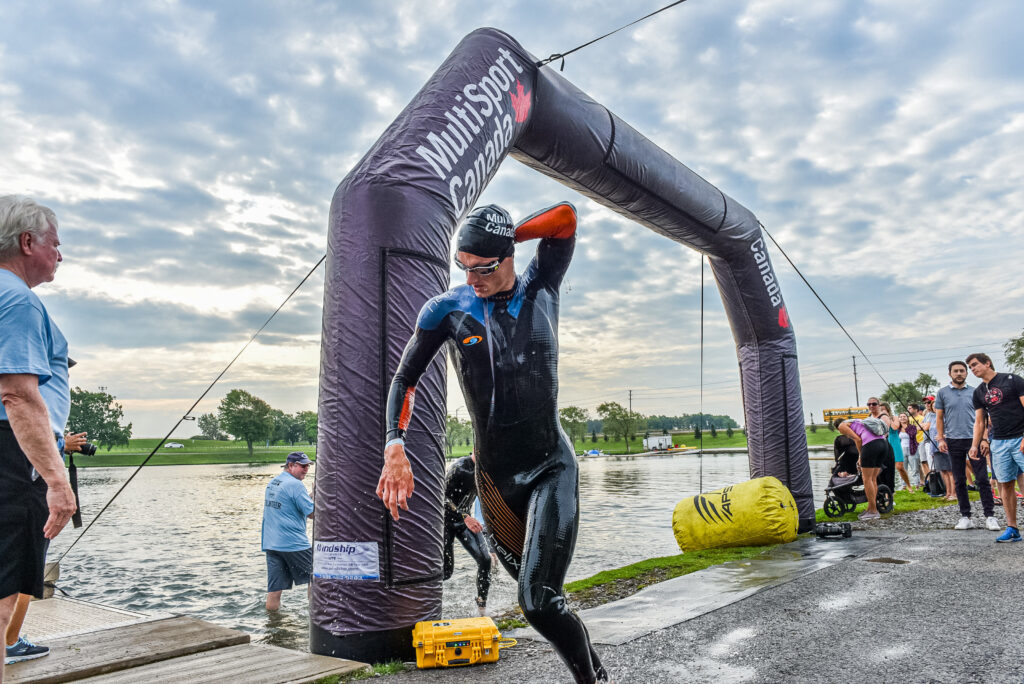
Twenty-five years ago, a recently retired retail banker had a stubborn idea – he decided that the Canadian province of Ontario required a triathlon series with more heart. John Salt had spent two decades in retail banking, obsessing over customer experience, when a corporate shakeup pushed him out the door with a settlement and a lot of time to think. He was racing himself back then, reasonably competitive, hooked on the camaraderie that draws so many people into this sport in the first place. Standing at the Collingwood Half one weekend, watching his wife Ann compete, he found himself telling anyone who’d listen that Ontario needed a series built around fun and family, not just finish times. He got in his car, called his friend and pro triathlete Mike Buck before he’d even made it home, and announced they were starting a triathlon series. Buck’s response was blunt: “No, we’re not, John. What are you, crazy?”
They were, a little. And it worked anyway.
That phone call became MultiSport Canada, launched in the summer of 2001 with roughly half a dozen races and a business plan built on instinct more than data. Salt had the vision and the corporate discipline; what he needed was someone with a feel for the logistics, the permits, the equipment, the sheer machinery required to get hundreds of athletes through a swim, bike and run without anyone getting lost or hurt. That’s where Jason Vurma came in. A University of Western Ontario student Salt knew from his own time on campus, Vurma was recruited to help set up races in the earliest days and never really left. Salt doesn’t hesitate to say it: without Vurma, there is no MultiSport Canada as it exists today. He describes him as a logistical savant, someone who can look at a bare race venue and see the whole event unfold in three dimensions before a single cone goes down.
Together they built something that grew from six races to more than ten, from a few hundred athletes to a series that, in its peak years, drew over 10,000 competitors across a season. They did it while the established players in Ontario triathlon were consolidating around the IRONMAN brand, which meant Salt and Vurma had to win people over on something other than name recognition. Their answer was deceptively simple: put real, caring people in front of the operation, not to be the center of attention, but to make sure every athlete felt looked after. Salt used to stand at the finish line himself, shaking hands, because that’s how you find out if someone actually had a good day. The response he heard again and again was some version of “you changed my life” — to which his answer was always the same. They didn’t change anyone’s life. They just built the venue and the atmosphere that made it possible for people to do that themselves.
That philosophy, tested and refined across two decades and dozens of race weekends from Lakeside to Wasaga Beach, is the foundation everything else sits on. And it’s the foundation beneath the race MultiSport Canada considers its signature achievement: the Barrelman Triathlon, a half-distance event staged in one of the most recognizable destinations on the planet, Niagara Falls.
A Vision Born at a Training Camp
The idea for Barrelman didn’t start in Ontario. It started around 2009 or 2010, during a training camp, where Salt was talking with friends about wanting to build something in Canada that would stand apart — a longer-distance race, something with real scale. Someone mentioned a race he’d never heard of: Challenge Roth.
That single tip sent Salt down a path that would define the next chapter of his career. Challenge Roth, he learned, had grown out of what used to be IRONMAN Germany and IRONMAN Europe, and under race director Felix Walchshöfer, it had become something extraordinary — Challenge Roth, the largest full-distance event in the world, a race built by Walchshöfer’s father and expanded into a phenomenon. Salt picked up the phone and called Felix directly. He explained who he was, what he and Vurma had built in Ontario, and asked whether Challenge had any interest in expanding into North America. Felix’s answer was an invitation: come race Roth yourself, and then we’ll talk.
Salt did exactly that. He flew to Germany, competed in what he still calls, without hesitation, the best race in the world, and then sat down with Felix for hours afterward. That conversation planted the seed for what would eventually become Barrelman — carrying forward the same philosophy of big-event spectacle wrapped in genuine community warmth that makes Roth legendary among triathletes worldwide. Around the same time, Salt and Vurma had already started eyeing Niagara Falls as a potential venue, floating the idea with the mayor of nearby Welland during an off-season planning conversation. The mayor’s response reframed the whole project: the swim might be tricky right at the Falls themselves, but Welland was only twenty-some kilometers away, and there was plenty of room to build something remarkable.
By then Salt and Vurma had already spent nearly a decade proving their model could scale. For a stretch, the series even ran kids’ triathlons alongside the adult races, until the sheer scale of some weekends — different distances, different transitions, thousands of athletes moving through a single venue — pushed Salt and Vurma to hand that torch to a dedicated kids’-tri organization and keep their own focus on safety and the adult experience. It’s the same instinct that shaped Barrelman from day one: grow deliberately, keep the community relationships strong, and never let ambition outrun the ability to look after every athlete on course.
In 2011, Felix Walchshöfer flew to Ontario and spent several days touring the region with Salt and Vurma, mapping out roughly ninety percent of what would become the original Barrelman course. But vision is one thing and approvals are another. It took three more years of meetings with community stakeholders, the Niagara Parks Commission, and local municipalities before the race could actually happen. Barrelman finally launched in 2014 — a distinctly half-distance event by design, since getting a full 180 kilometers of biking into the region would have meant crossing four or five active railway lines, an unacceptable risk when a freight train can hold up a field of two hundred athletes for fifteen minutes at a time. Half-distance wasn’t a compromise. It was the only version of the race that made sense given the geography, and it let organizers concentrate on building something exceptional within those bounds.
None of it came easily. Unlike most municipalities, which rarely handle events at this scale, the Niagara Parks Commission was used to large productions and became a genuine partner rather than an obstacle. Even so, the early years brought a running list of race-day dramas: bike courses rerouted with a week’s notice because of frost heave or late-season construction, a run course in the first two seasons that funneled athletes through a five-road intersection in the heart of the city, and September heat that reliably pushed into the low thirties regardless of the calendar, turning aid-station ice and water into a constant logistical scramble. Vurma has described the whole enterprise as a kind of joint logistics exercise between organizers and athletes alike — competitors driving to Welland to rack their bikes the day before, then busing to Niagara Falls the next morning while their gear is quietly relayed ahead of them and staged under their bikes before they’ve even finished the swim. It’s an unusual amount of choreography for participants to buy into, but it’s also part of what makes the event feel like a genuine adventure rather than a standard-issue race morning, and post-race surveys consistently rank it among the best-organized experiences athletes have had anywhere.
The Destination Is the Draw
Ask Salt what separates Barrelman from the dozens of half-distance races that have quietly disappeared across North America in recent years — and there have been many, as USA Triathlon’s own data shows non-Ironman-branded half-distance events all but vanishing — and his answer comes down to two things. The first is everything MultiSport Canada has always done well: logistics, atmosphere, a race-day experience where the people running the show are visibly invested in every athlete’s day. The second is location, and Salt doesn’t hedge on how much that matters.
He’s blunt about the data: races in towns nobody’s heard of, without name recognition or a reason to stick around, see their numbers erode over time no matter how well they’re organized — even under the IRONMAN banner. Races in genuine destinations hold. Niagara Falls needs no introduction to anyone, anywhere. Salt tells people in Europe he lives an hour north of the Falls and watches recognition click into place instantly, faster than if he’d said Toronto. That’s the whole pitch for Barrelman in a sentence: come race a legitimate half-distance event, then stay for two, three, four days with your family at one of the most famous natural wonders on Earth. There are gorges to walk, boat tours, wineries, casinos, and enough to fill a long weekend for anyone who came along just to cheer. Athletes aren’t choosing between a race and a vacation. Barrelman is built so they don’t have to.
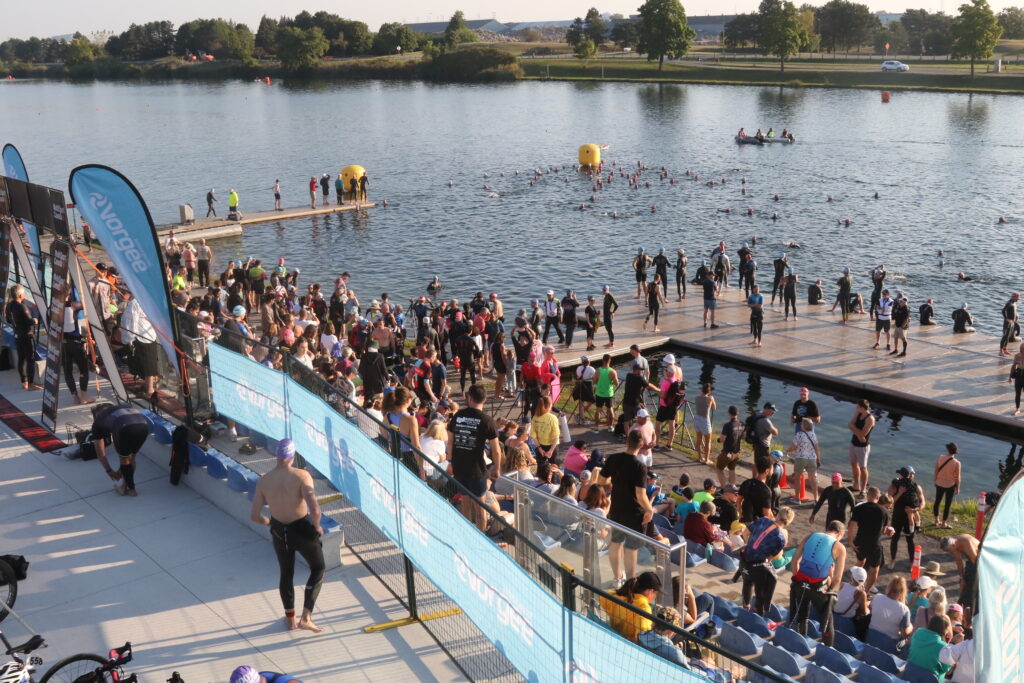
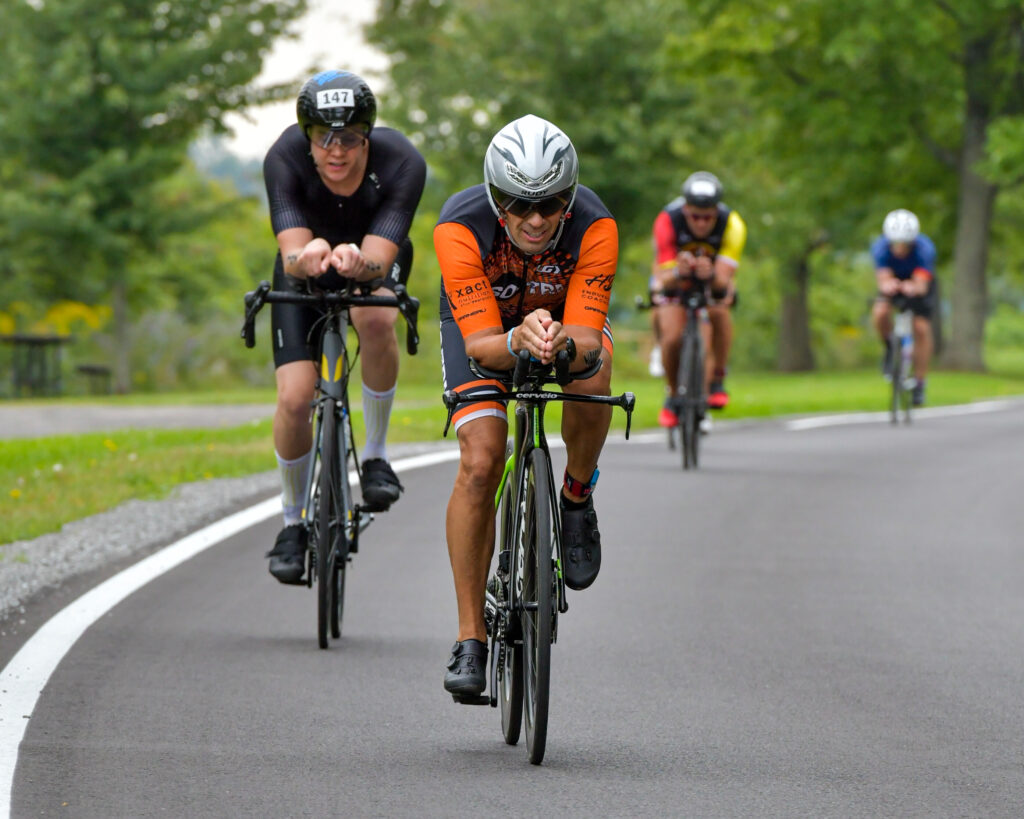
The current course reflects years of hard-won refinement. Athletes drop their bikes in Welland on Saturday. On Sunday morning they get to swim in a rowing basin that offers, in essence, a giant, current-free pool in the Welland Canal. From there they set out on freshly repaved roads toward Niagara Falls itself. A couple of years ago, working closely with the Niagara Parks Commission, the bike was changed to a closed, looped course along the Niagara Parkway near the Falls — pristine, traffic-free pavement with no vehicle interference, run as roughly two and a half loops. The change also opened the door to add an Olympic-distance event on the same infrastructure, since Olympic athletes can ride straight through to Niagara Falls without ever crossing paths with the half-distance field on its loop. That first year of the Olympic race was, by all accounts, an immediate success, and it’s added another layer to the festival atmosphere Barrelman has always chased — alongside aquabike options and relay teams that are pulling in local running and cycling clubs who’d never previously considered triathlon.
After American participation declined thanks to the COVID pandemic, the numbers of athletes from south of the border are approaching the 25% of the field once again. Salt has a straightforward pitch for anyone south of the border still weighing whether to make the trip: with the current exchange rate, both the entry fee and the accommodations — whether that’s a campground or a luxury hotel overlooking the Falls — run about thirty percent cheaper once converted. Add a course that’s now flatter, faster and fully closed to traffic, a swim in placid canal water, and a finish line in one of the most photographed places on the continent, and the value case makes itself.
Twenty-five years after a phone call from a car leaving Collingwood, and more than a decade after a training-camp conversation turned into a partnership with the team behind Challenge Roth, Barrelman has become the clearest expression of what Salt and Vurma set out to build: a race where the logistics disappear into the background, the community shows up to help rather than merely tolerate, and the venue does half the selling before an athlete ever laces up. Roth taught them what a truly great race feels like. Niagara Falls gave them somewhere worthy of that standard. Every September, Barrelman puts both of those lessons on full display.
What to know more? Listen to the lastest podcast.
The Triathlon Series That Changed the Game: A Look at Multisport Canada and the Barrelman Race
Kevin Mackinnon sits down with John Salt and Jason Verma of MultiSport Canada to explore the origins, challenges, and successes of organizing one of Canada’s premier triathlon series — including the iconic Barrelman event in Niagara Falls.



Looks fantastic. Oh and apparently they charge CA$ 417, or US$ 300, or EUR 260 for the half. Can be done!
I did this race c.2016 when it was still new. Very well run event and would recommend. I haven’t done Roth, but the vibe I got was “Like IM in terms of scale and production but without the crass commercialism.”
I’ve done this race twice: the very first year it ran and then again in 2022.
Both times it was incredibly well-run. As an athlete you’re so inside your own head on the day before the race / race day that when everything goes smoothly you might not even notice. Check in, race day, support on course, etc. was all fantastic. The race organizers (Gord and Jason) were out there checking in with athletes; both are fantastic.
I was disappointed in 2022 that we don’t run right past the falls anymore but it was very busy by the casinos so I get it. It’s still a fantastic course, and a ton of fun. Highly recommend it, fwiw.
Excellent article! It’s important to promote those races, and John was a slowtwitcher for a good while, as well.
More of those articles please!
they should really quote you in their website, seriously
There’s also a friendlier touch - I don’t know if John still does this, but when I raced he personally shook everyone’s hand at the finish line.
Yes, Tim, I am still there at the Finish line and try to greet everyone as they finish. Getting longer in the tooth so I am occasionally spelled off by either Jason or our business partner, Joseph Park (our version of Mr. Enthusiasm!) Hope to see you there this year!
Durhamskier…..I couldn’t resist…JOHN and Jason… Of course I realize you knew that.
With the 30% exchange rate our U.S. based friends get that same benefit on accommodations, food and attractions for the family!
I’m so sorry! I was trading email with Gord earlier in the day. Any relation? Ha ha.
No apology necessary!!! It happens up here where we live near Collingwood. For years I’ve been asked all the time if I am any relation to Gord. Perhaps I’ll meet him one day
Great article and read. Others have come and gone, but Multisport Canada has remained as, in my view, the BEST Triathlon Race/Event Organizer in Ontario and perhaps all of Canada! The WHY of this perhaps remains hidden and a bit of a secret - Multisport Canada also supplies behind the scenes Operational and Logistics support for a RANGE of other races/events across Southern Ontario - from the legendary, Paris to Ancaster Bike Race, to last weekend’s SuperTri Toronto event. That’s how good they are! They get it and other races/events actually HIRE them!
If you are considering doing a Half Iron Distance Race this year - I hope you will enter the Barrelman. To our friends across the Border in the U.S. - Barrelman remains an outrageous deal - your US$ goes 30% further in Canada!! See you in September!
It’s still something that is done at not just the Barrelman, but EVERY one of the Multisport Canada Triathlon Series Races/Events.
Working a range of Endurance Sports Races/Events with my Announcing across Canada and the U.S. - this level of Customer Service and interaction is RARE!
Who’s “Gord”?
The Team behind Barrelman are John Salt - the Race/Event Founder and Jason Vurma - Co-Founder of Multisport Canada!