


Miguel Hidalgo: The Path of Obsession
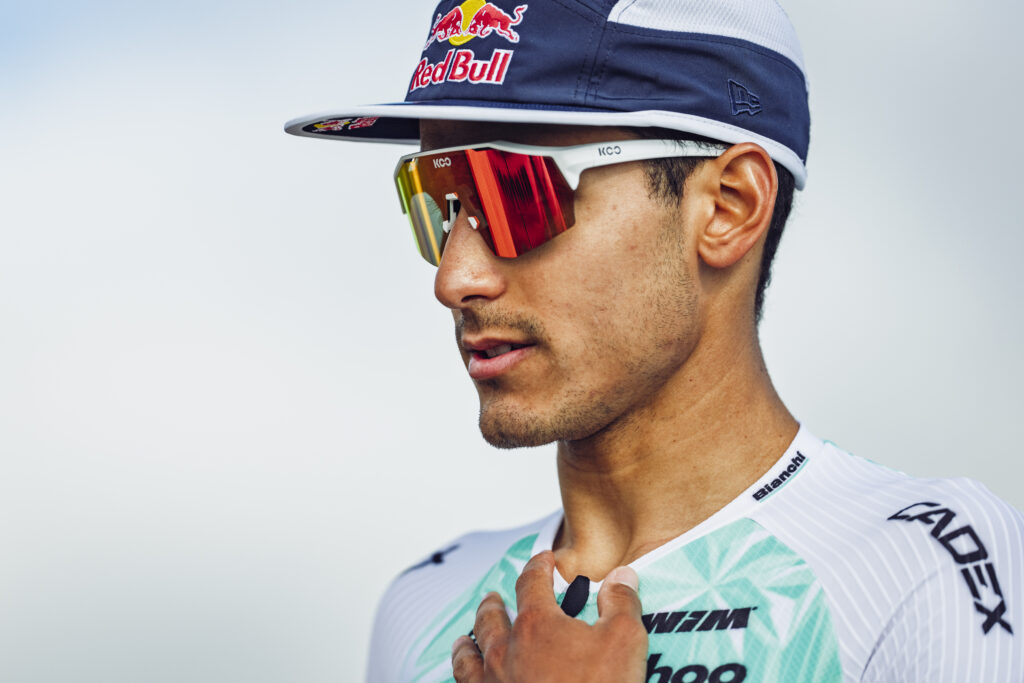
I’ve crossed paths with short course superstar Miguel Hidalgo a few times, sharing the same training location. Today, we are both in Lanzarote and he just finished a track session. He tells me about the quality of the rubber and that, close to racing, he likes to do 12 x 1 km at 2:42 pace to know he is fit. When I’ve run into the Brazilian before, he is always quiet, focused, perhaps even a bit shy.
“Not in Portuguese,” he tells me with a smile as we begin the interview.
The 25 year-old trilingual Olympian finished the World Triathlon Championship Series (WTCS) season ranked in second, just behind Australia’s Matt Hauser, taking his–and Brazil’s– first-ever WTCS win at Alghero back in May. On paper, you can trace his win back to a breakthrough performance in 2022 at WTCS Leeds. Hidalgo finished sixth, his best WTCS result at the time. But that high came with an immediate low and a lot of pressure and, as he explains how he handled that time in his life, I mentally correct my initial impressions. He isn’t quiet, he’s calm. And he isn’t focused–he’s obsessed.
The Decision
As a front pack swimmer, it’s not a surprise Hidalgo’s first sport was swimming, competing in that sport from the age of six until changing to triathlon at 15.
“My times, when I was 15 years old, are pretty similar to my times today,” he laughs. (He likes to average 1:02-1:06 for his 100 meter repeats, in case you were wondering).
As a teenager, he committed to triathlon and rose to the top in South America, becoming junior national champion at 18. But, in a nation consumed by football, triathlon is niche and Hidalgo’s success did not translate overseas in bigger competitions.
“I was dominating races in South America, but when I came to the World Junior Championships, I was being smashed and finishing a lap behind,” he says. “It was like three or four years (of) always being so disappointed at the junior world champs. I was improving every year, but it was always a reality check.”
And the reality was: Hidalgo had a lot of work to do in order to meet his own expectations to compete on the world stage.
”It was just learning from my mistakes and being very obsessed,” he says. “In my mind, I had no option other than to succeed in this sport. I was going to find a way. When I put my mind to doing something, I always find a way.”
Hidalgo’s way was to move from his smaller home town, Salto, to the Olympic training center in São Paulo, forgoing his tertiary education to fully commit to his sport. Over the next five years, he navigated his way from 60th to 30th to eighth in the junior and U23 championships.
”It got to a point where I was always developing myself as an athlete, getting more experienced, and now, I think, we got there,” Hidalgo says. “But in a different way.”
Building A Different Way
“ When you come from a country with no background in endurance sports in general, or no tradition in triathlon, from one perspective, it’s a little bit harder to get to the point I am at the moment, but also you learn a lot more than someone that already has a path to follow,” Hidalgo says. “If you have to create your own path, I think you’ll end up learning a lot more.”
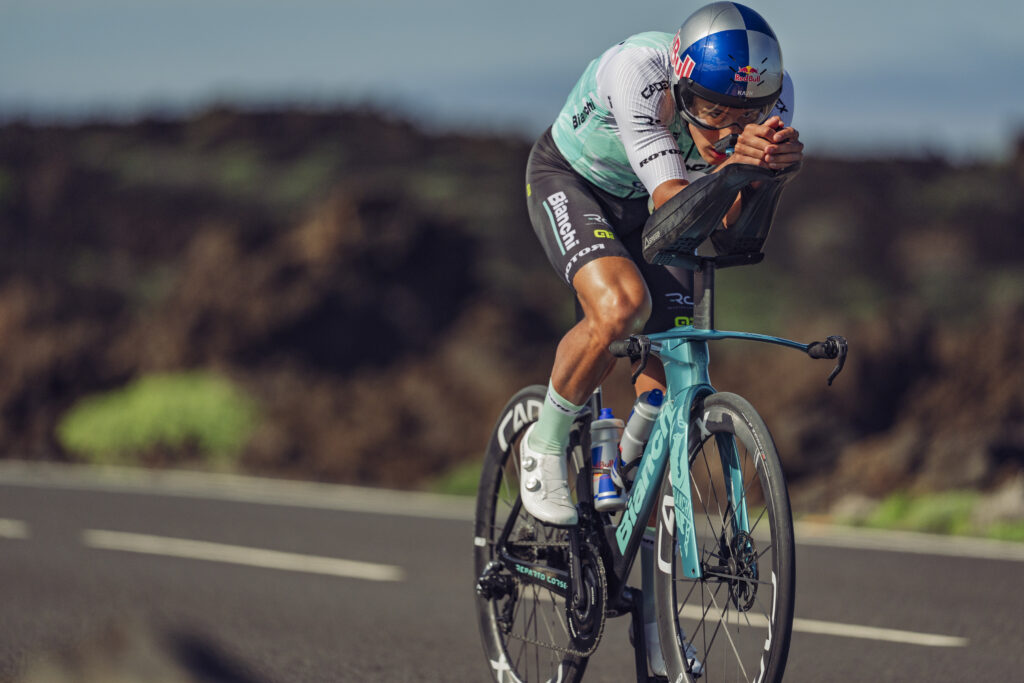
Making his own path meant making more mistakes and finding solutions the hard way. He talks about how triathlon nations have a pathway for athletes to follow, and how there are role model athletes to learn from first hand. In contrast, he talks about his struggles as a junior again, and how his breakthrough in Leeds was immediately followed by a stress fracture from “just pushing too hard.” Being unable to race, Hidalgo slid down the world rankings and his national federation support was in jeopardy.
“ I was still recovering my running level, but I really needed a good result at WTCS Hamburg to keep myself in the Olympic qualification,” he recalls. “I had a lot of pressure on my shoulders to perform. I finished seventh–and after that I was basically top 10 in every WTCS I started until I finally got on the podium 15 months later.”
Hidalgo kept his funding, and went on to qualify for the Paris Olympics where he finished 10th in the men’s individual race, and eighth in the mixed team relay. Now, Hidalgo is a one of the best contenders in the field, a regular on the podium and became the first Brazilian to win a WTCS race. Figuring it out one step at a time, Hidalgo created his success.
“It’s a long process,” he says. “You have to keep insisting and being obsessed, really obsessed, because it’s not from one day to another that you get good, it’s just little by little.”
The Path of Obsession
The “little by little” is not something Hidalgo takes lightly. When he talks about his obsession with his sport, with improving, it’s not in a crazed, controlling or macho way. It’s a detailed-oriented, creative and constantly calculating way. It’s a mindset shaped from having to figure out how to train, choose the best equipment and even maintain sponsorship relationships–whatever yields the best improvement–primarily by himself.
Many athletes spend time away from home at training camp; Hidalgo spends almost all of his time away at training camp. Most athletes dream of a shoe sponsorship; Hidalgo told Mizuno back in 2022 he wouldn’t sign if they didn’t have a carbon shoe. And, most short course athletes wouldn’t join a long course team, but he did in 2025.
“ I like to focus on one thing and do the best I can to be the best I can,” he says. “I’m making some sacrifices also, which is part of the obsession, like living in a training camp lifestyle. It’s pretty hard sometimes, but it’s what it takes, for me at least. I feel like I improve a lot more by being at training camp instead of being at home, comfortable.”
Comfortable doesn’t seem to be a word that he associates with. In 2022, when Mizuno offered him a sponsorship, he had the confidence to negotiate with the big brand.
“When I signed with them, they didn’t have a carbon shoe yet so I told them, look, I cannot sign if I feel like I’m having a disadvantage compared to the other athletes,” he says. “I want to have the best equipment possible, I’m not going to sign only for money. They found that really interesting, so they gave me a prototype that was going to launch two years later.”
Although the shoe was unavailable to the public, it was already approved by World Athletics, so Hidalgo gave it a try and has been racing and helping to refine prototype Mizuno shoes since. He can’t help but talk about the weight of his preferred racer, the Hyperwarp Elite, down to the gram, how he influenced the midsole, and how responsive and stable it is. No detail goes unnoticed, or unconsidered, and, while that might not be for every brand, it has paid off in long term relationships for Hidalgo.
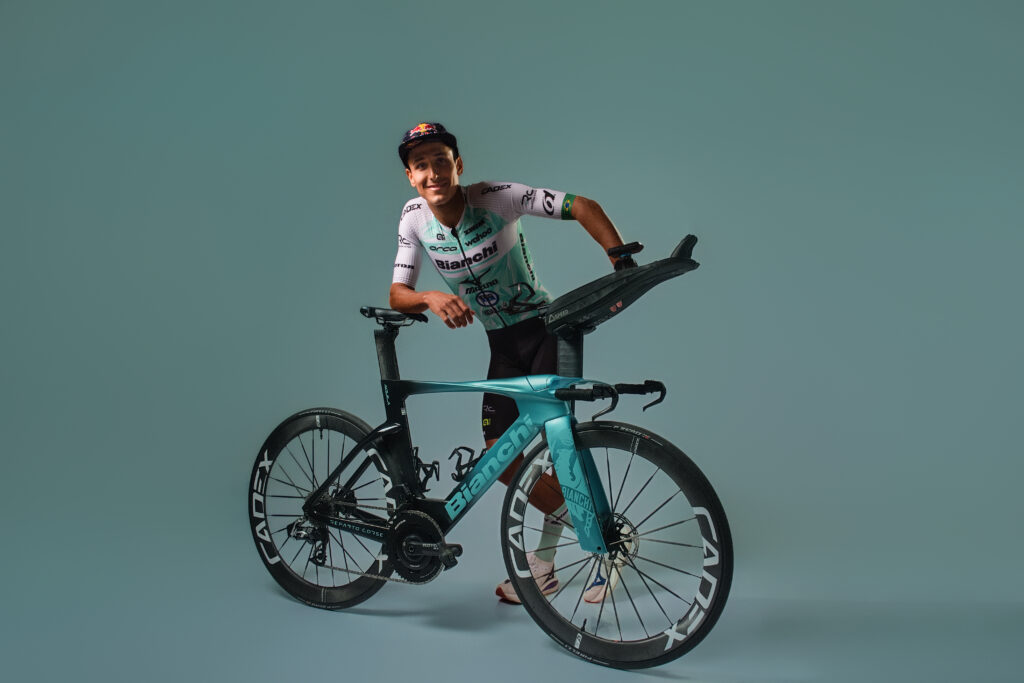
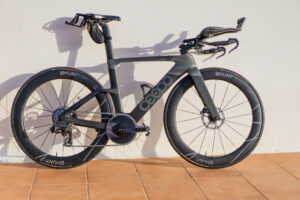
So, when he signed with Team Bianchi (formerly Team BMC) in 2025, it was a curious move. Aside from the team being focused solely on long course racing and Kona, being part of the team meant committing to a specific bike, kit, tires, nutrition, etc. The two parties came to an agreement to let Hidalgo focus on short course racing while adding a few 70.3s to the calendar but, for an athlete so obsessed, handing over some control seems incongruent.
Hidalgo has a different take – and not just because he plans to eventually move into long course.
He first explains there are good relationships with the team brands. Bianchi even sent the triathlon bike designer to the team camp where the athletes could give first-hand feedback, while Alé is using their experience to improve the weight and breathability of the trisuit. But then he truly clarifies his decision to sign with the team:
“It’s been a very nice experience because you can see things from other perspectives,” he says. “I feel like long course athletes are like more entrepreneurs.”
In his obsession with improving, it makes complete sense Hidalgo took the opportunity to explore, learn and extend his path forward, even while he is still on the WTCS circuit. Sure, Hidalgo might appear to be no different than the myriad of short course athletes planning to race longer in the future, but as someone who has always forged their own path, here he is doing that in a unique way.
The Number One
Long course ambitions are still very much on the distant horizon because, for the 2026 season, for the world ranked #2, there is clearly only one target.
“The goal is definitely improving the position from last year,” he says with a sense of calm. “We just keep training a little bit more year by year so, if we keep improving this year, it might be possible. But, it is something that does not depend only on me, because I can be better than last year and still not win.”
“If I’m getting better every year, that’s the important part,” he emphasizes.”It’s just a matter of time until I win. If it’s this year, or next year, or in two or three years, I don’t know. But the goal is to get better than last year for sure.”
His perspective is a far cry from the desperate junior who was disappointed year after year, and that’s not just from experience. Hidalgo chose to work with a psychologist and that investment has made him into what can only be described as “zen-like.”
“I worked with a mental coach for four or five years,” he says. “This helped me a lot because it was something I wasn’t good at early in my career. But now I feel like I’m one of the best in my mental game compared to the other athletes. I feel like I can control myself in the race much better than most athletes.”
His obsession to improve is a trait many of the world’s best share, but it is less common to see it coupled with such a deep sense of calm. It’s not just the “control the controllables” line he has learned to repeat, there’s a depth of peace that can only come from someone who has, by failure and flourish, created his own path step by step.
“It doesn’t matter where you come from, or what your background is, if you don’t have a path to follow, if you are obsessive enough to create your own, you can achieve everything,” he concludes.



Very good interview with a great talent of our sport. Well done and thank you!
Good article. I remember Hidalgo expressing his disappointment after his second ever WTCS podium in Yokohama last season. The problem was of course that he had been wanting to climb onto the top step of that podium. Lo and behold…
Well… There’s no denying that there’s not been a constant stream of top brazilian athletes through the years, but Hidalgo could have paid tribute to a guy like Leandro Macedo, who surely paved the way a bit for future brazilian athletes. I guess we could add a Fernanda Keller or a Reinaldo Colucci too. It’s not a shame to not know your history, but he should refrain from definitive statements like that.
Good read though.
Why not go all the way back, Djan Madruga was the guy that got the ball rolling for Brazilian traithletes.