
What Tools To Pack For A Race
It’s race season and that means one of the worst evils is upon us: travelling with a bike. The schlepping, airplane fees, car Tetris, and constant packing and repacking is enough to make you want to stay home all together. But, that’s not happening, so let’s talk about the tools you need to make sure you can ride your bike (and fix the basics) once you arrive.
What you pack your bike in–a box, soft bag, hard case–is a discussion for another article. But, no matter how you pack your bike, the basic tools you need to travel with are the same. Since the tools are heavy, they are best packed in another suitcase. If that’s not an option, make sure they are in a well-sealed, padded bag and secured tightly inside your bike bag so they don’t move around and damage your bike during transit.
The Non-Negotiables
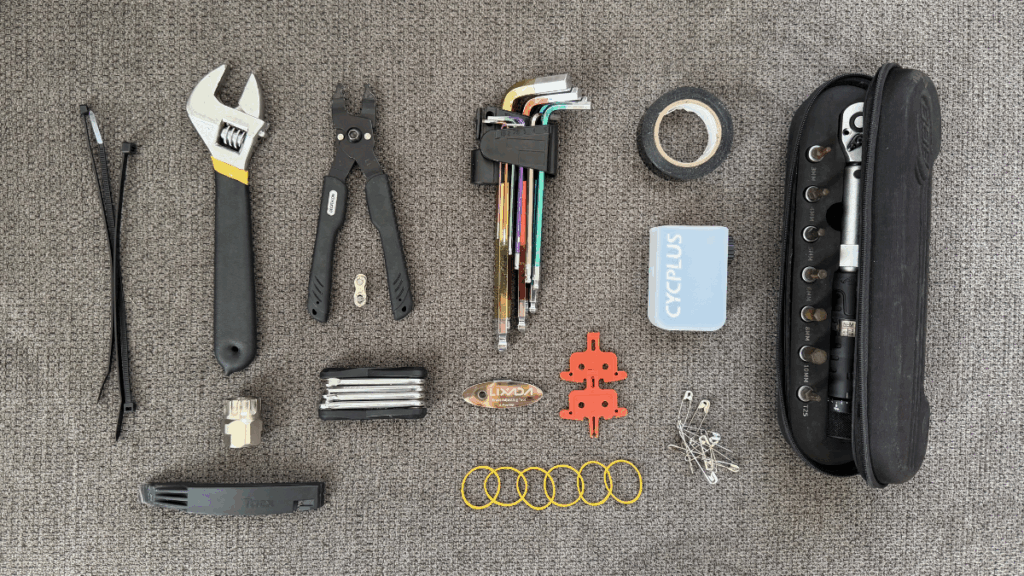
Never travel without a torque wrench. It is the centrepiece of your tool kit and will do most of the work. A basic torque wrench set comes with a range of Allen key and Torx extensions for around $60-$70. While you can get away with plain-old Allen keys, having a torque wrench will save you from making very costly mistakes that come with under and over-tightening bolts. (Race day Hercules arms are real–just ask the famous announcer Paul Kaye who found my bike on the ground in T1 and my saddle swinging from the rack after an overtightened seat post bolt gave way.) Plus, nowadays they are pretty light and there are even travel versions.
But, it’s still good to also travel with a full set of Allen keys or, at the very least, the packable set that you normally ride with. If your bike has a special bolt, make sure your set has that particular attachment.
Speaking of what you normally ride with, you should pack your “lucky packet” (your saddle bag or pocket bag of spares) as well. Along with the aforementioned packable Allen key set, that should include at least whatever you need to fix a flat–tire levers, a tube (preferably two–and make sure the valves are the right length), and a pump (see below). If you usually use a CO2 cartridge, remember you can’t fly with them, so you’ll just be taking the adapter and you’ll need to buy one upon arrival.
Whether you go floor/track pump or an electronic one, take more than a hand pump so you can properly inflate your tires. Electronic pumps are more affordable these days and, with their precision settings and small, lightweight size, it makes everything a lot easier. If you have a small electronic one, it can double as your pocket pump for training so win-win.
Disc Brake Stuff
Once you remove your wheels for travel, you will need to insert plastic spacers into the brakes. They are dirt cheap so just buy them–and buy a multi pack because they are easily lost.
Traveling with your disc brakes on is a no-no. The rotors are easily bent and bumps along the way can disrupt your brake pads and even lock the pistons shut. Taking off and remounting a disc brake rotor is incredibly easy so you should do it every time you travel. Depending on how your lockring is, you will need a centerlock tool and a wrench (for inside notches) or bottom bracket tool (for external notches). It’s easy to change the lockrings so they are all one style, meaning you only have to travel with one set of necessary tools.
Even if you remove your rotors and use brake spacers, you still might need to adjust your brakes when you arrive; therefore, you should also travel with a brake alignment tool. The small steel “clamshell” like tool is affordable, easy to use, and light to pack.
Rim Brake Stuff
If you’re still rocking rim brakes, it never hurts to travel with an extra pair of brake pads. If you’re changing from aluminum to carbon wheels for a race, don’t forget to take the appropriate sets and make sure your Allen key set has the small key you need.
Preferred Essentials
There are few simple extras that should pad out your travel tool kit. Yes, you can buy most of these things upon arrival but they are on the lighter side and will make your life easier once you arrive.
Quick Link and Tool: If you don’t have a quick link in your lucky packet, take one in your tool kit. Snapping your chain is always a surprise but an easy, fast fix with a quick link. Personally, I always remove my chain for travel (since it’s fresh out of wax anyways), which saves any potential damage to the frame during transit but also means I take a quick link chain tool along with spare quick links.
Valve Adapter for Disc Wheel: If you’re running a disc, don’t forget the all important valve adapter so you can inflate your tyre.
Chain lube: If you’re not waxing your chain, a travel size chain lube is a must as well. A race day lube saves watts.
Electrical tape: It can be a quick fix for so many things. Broken computer mount? Electrical tape your head unit on to your bars. No where to put your spares when you race? Electrical tape them under your saddle. Broken bento box? Electrical tape it back on. I’ve done all three and been happy every time I packed my electrical tape.
Cable ties: I once saw a fellow pro blow a spoke, cable tie it to another one and go on to salvage a top 10 finish. I’ve seen hydration systems brake in transit and function well enough with cable ties for a race. And once when it rained overnight, I came back to transition in the morning to find my brakes had ceased shut. Neither the mechanic nor I could fix it so–and this is ill-advised and not recommended–he cable-tied my front brake open and said “don’t touch it.” Luckily, it was a flat course and I had the second fastest bike split.
While you might not feel the need to slip one in your bento box, having them in your travel tool kit will be useful at some point.
Baby wipes: Possibly the most used thing in my tool box. Washing your bike before you travel and then simply baby wiping your bike before your race or throughout your holiday can do the trick. They are also great for cleaning your hands after any maintenance and doing a quick bike clean when you’re tired after a race but your frame is covered in juice and sweat.
Elastics and Safety Pins: For flying mounts, bib numbers, tying nutrition together in T2 (#protip), and all sorts.


Start the discussion at forum.slowtwitch.com