
I wrote on this subject seven years ago, revised it five years ago, and revise it again today. I think it stands up fairly well, because cars still have four wheels, bikes two wheels, roads operate the same way and car doors still swing out when drivers enter and exit them.
While you're out on your training rides your fellow countrymen are driving directly at you, cell phone in one hand, cheeseburger in the other, steering with their knees. Accordingly, I and my fellow veterans of the road agree that it's defensive riding that has stood us in good stead. One develops instincts that come from this truism: You can drive a truck between what motorists ought to do — what they're legally obliged to do — versus what they actually do. Just because I have the right of way does not mean I can proceed apace in the comfort that my rights, and my life and limb, will not be violated.
When I hear that another of our sport's compadres is hit by a car, whether in training or in a race, two things come to mind: Yet another oblivious or impatient driver has taken out one of our own; and I wonder whether the cyclist took into consideration the space between what drivers ought to do and what they often do.
Below is a list of "Danger, Will Robinson!" moments that should provoke heightened awareness while cycling (and if you're old enough to understand the Will Robinson reference above, and have been riding your bike most of your life, you already know all this stuff.)
Below is a list of habits I'd you might consider adopting while riding in urban areas. Later I'll write about behaviors that attend rural riding (riding in the countryside might be safer, but you just trade urban perils for rural ones.)

CARS TURNING RIGHT
I can't begin to guess how many times a motorist has passed me only to turn right at an intersection, cutting me off. But I don't tend to smack into those cars anymore, like I did when I was in my 20s (I smartened up the time I got into my 30s). I assume he's going to make a right-hand turn in front of me, whether or not his right turn directional is blinking.
You'd be amazed how much you can divine of a motorist's intent through a micro-second glance at him through his car's window. Did he see me? Is he looking in his rear view mirror, or side mirror? Is he slowing down, in anticipation of executing a turn? Is he looking left at the oncoming traffic (certainly a signal of an intent to turn right) without looking back toward me?
I'll be honest. When I was a young hothead (I'm an old hothead now), I'd almost dare drivers to do that to me. I would get mad in advance of the act that would trigger getting me mad, because I knew it was going to happen. I was yet again going to be cut off(!) in contravention of my rights as a cyclist. I had not yet learned that my own high standards do not apply to everyone. Even if my standards of behavior were righteous or reasonable, they were not universal. All my railing and hand-wringing would not make it so. No, those drivers should not be turning in front of me. They should also be able to name capitals of all 50 states, by God. But, I live, work, and ride my bike in a world where people either choose ignorance or have it thrust upon them. Selah.
CARS TURNING LEFT
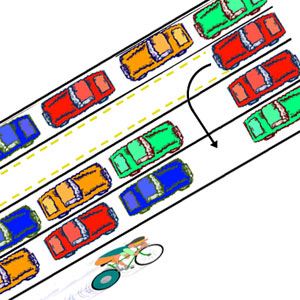
Let me tell you the story of one of my vintage crashes. I'm riding on Highway 50, in South Lake Tahoe, during a circumnavigation of that lake with a group of friends. We're one mile away from finishing our 72-mile journey.
It was a typical Summer day, with cars bumper-to-bumper on both sides of the road. We're riding on the right-hand shoulder at 20mph or better. All of a sudden, a Volvo appears out of nowhere, and we all plow into him, the whole paceline of four or five guys. We all go down. What happened? A motorist traveling in the other direction desired to make a left-hand turn across traffic. Obliging motorists traveling in our direction made a space for him. He didn't see us. We didn't see him.
Who was at fault? Technically, the driver of the Volvo turned into oncoming traffic. But a case could just as easily be made that we were guilty of "unsafe passing on the right." If a policeman is predisposed against cyclists, he's likely to see it that way.
If you have to ride in traffic like that, look for an opening in the traffic in front of you. The likeliest reason for this space is that kind motorists chose to allow a vehicle to cross the road, right in front of them and, unwittingly, you.

CAR DOORS
The scenario above is the sort of thing that might happen to cyclists who live in beach communities. An overwhelming number of triathletes and cyclists live and ride along the Pacific Coast Highway corridor in Southern California. I used to be one of them in my younger years, and most of my youthful crashing took place on that stretch of road.
Laguna Beach was my particular bad luck city. I crashed into cars, or they into me, in North Laguna and South Laguna. In retrospect it was due to three causes: PCH was thoroughly busy and subject to cars exiting and entering that road; this stretch of PCH was hilly, so I had less opportunity to avoid a collision when I was descending at high speed; and I was inattentive to the bad habits of motorists.
Certain cities like Laguna Beach, Huntington Beach, the South Bay area of Manhattan and Hermosa Beach, feature parallel parking on Pacific Coast Highway, which grants you precious little space between cars on the number-2 lane on the left, and parked cars on the right. Again, you'd be amazed at what you can see with a quick glance: people seated in those parked cars; people's faces in their side mirrors; and of course back-up lights. When you see those back-up lights, that means the car has just backed into its parallel parking space. When the lights go out, the driver has just turned his car off. What's next? He's got to exit his car. Will he see you before he opens his door? Will he even look? Probably not.
INTERSECTIONS
Look, I don't care how much time I lose in a race. I'm just not going to assume an intersection — even one that is controlled, even one that is barricaded — is safe for my passage. Remember, people are ignorant. They are just barely smart enough to pass a driving test. Or not. (You don't think that a simple lack of a valid license is going to stop someone from driving, do you?)
Besides, what do you think people at 7am are doing on the road on a Sunday morning? They're probably engaged in one of two activities: They're on their way to church, for which they will be late because of the intersection at which they're now unexpectedly sitting; or they're on their way home from whatever it was they were doing Saturday night. The truest thing you can say about these people is that they are not thinking of the consequences of your bike hitting their passenger-side door.
Here are a few things we know. Police do not show up at the intersections they're supposed to control. When they do show up, they have no training in, and so no idea about, how fast oncoming triathletes ride their bikes. They'll wave through motorists when they should not. Even those who do understand the speed at which you ride your bike have no control over how fast a motorist will step on the gas pedal and get his vehicle through the intersection.
This is the case when in fact the police are taking care of traffic control. It's just as likely that your life and spinal cord are in the hands of 85-year-old police volunteers or 15-year-old quasi-junior police volunteers. Or by no one.
And barricades? They've never stopped a motivated driver.
Look, here's the sad truth: There is no such thing as a controlled intersection. I don't care of there's a $100,000 prize for first in my age group, and I'm in the lead. Some things are just not worth it. Some races I just don't do, because there are so many intersections with cross traffic. When I do find myself in this position, I sit up, get out of the aero bars, with my hands on the pursuits. Of course I do so in a fashion not to cause the person behind me to slam on his brakes, but my main concern is not meeting the driver face to face as I fly through his side window.
ATTENTIVE POSTURE
Those of us who've ridden for decades all know fellow athletes who tend to crash more often than others. At first, you assume it's motorist error. When it happens over and over again, or when they ride their bikes into the backs of parked cars, it's a little harder to blame the other guy. Typically, these are the inattentive riders. This might be excused but for the consequences. At some point inattentiveness, and the disinclination to practice defensive riding, shifts the onus onto the cyclist. When you decide to engage in the sport of cycling, you're the one who'll pay the steepest price in an accident, regardless who is at fault.
The list of problems and dangers a cyclist might face on the road are legion. They each require a tactical response, and I've listed some of them above. But, I've barely nicked the surface. The message here is strategic: What is your current posture when contemplating a road shared with motorized vehicles? The safest posture is to assume the worst from those on the other side. Then, you'll be pleasantly surprised when these drivers do the right thing and, more to the point, you're more likely to arrive home safe and sound and able to ride another day.